A Teenager Nobody Wanted, and Then Everyone Did
On June 5, 1962, a comic book called Amazing Fantasy #15 changed the world. Written by Stan Lee with art by Steve Ditko, it told the story of a kid named Peter Parker, his encounter with a radioactive spider, and the death of his uncle.
Marvel’s publisher didn’t want it. Stan Lee was looking for a new superhero idea and the teenage demand for comic books and a character with whom they could identify led to the creation of Spider-Man. When he pitched it, the response was essentially: teenagers can’t be the lead, spiders are repellent, and nobody wants to read about a kid with personal problems. Lee put the character in a comic that was already being cancelled — which was the only reason he got permission to try at all.
Young readers responded powerfully to Peter Parker, prompting an ongoing title and ultimately a media empire spanning video games, animated series, live-action films, and a Broadway musical.
Six decades later, Spider-Man is arguably the most recognised superhero in the world. He’s appeared in more films than any other Marvel character, his face is on more merchandise than almost anything in popular culture, and the question of which Spider-Man is the “real” one has become a genuinely interesting argument now that Miles Morales, Spider-Gwen, Spider-Man 2099, and a dozen others have all built their own devoted followings.
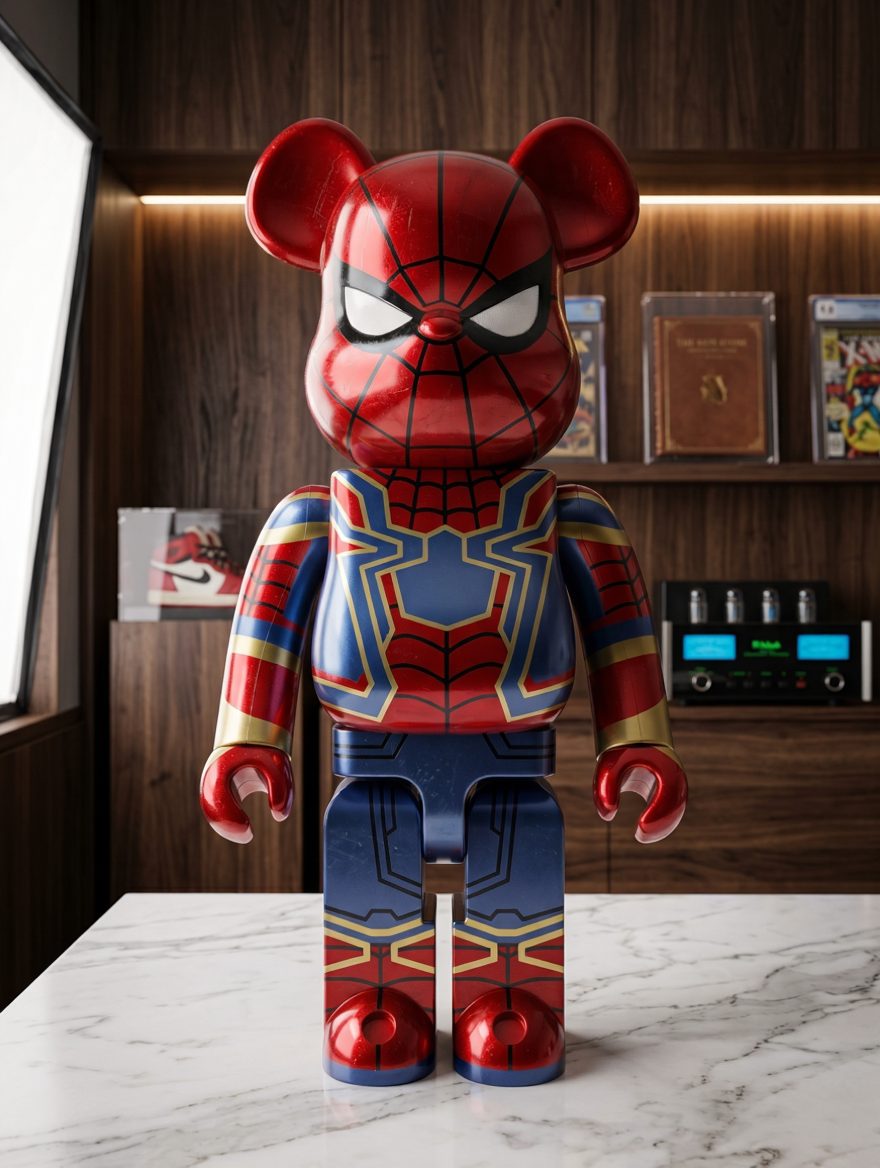
When Medicom Toy began producing Spider-Man Bearbricks, they stepped into all of that. The web pattern on a 70-centimetre vinyl figure isn’t neutral. It carries sixty years of comics history, five film franchises, and the specific emotional memory of whoever is looking at it and remembering which Spider-Man was theirs.
Why Spider-Man Works on a Bearbrick
Not every character translates cleanly to the Bearbrick format. The rounded head, the rounded body, the simplified geometry — some characters lose their identity when filtered through it. Spider-Man doesn’t.
The web pattern is the key. Ditko’s original costume design — red and blue with black webbing, white lenses set into the mask — works precisely because the pattern is the costume, not a decoration on top of it. The web lines define the surface. Put that same logic onto a Bearbrick and the webbing follows the bear’s curves without losing coherence. The white eye lenses translate naturally to the Bearbrick’s minimal face. The red and blue colourway is vivid enough at any scale.
Then there’s the silhouette. Spider-Man doesn’t have a cape, a utility belt, or specific accessories that the figure needs to include to read as itself. The costume is the character, and the costume is printable. A Spider-Man Bearbrick in a sealed foil bag communicates what it is before you open it, which is more than most character figures can claim.
The fact that Spider-Man has multiple distinct visual identities — Peter Parker’s classic suit, Miles Morales’s black and red, Gwen Stacy’s white and pink, the 2099 blue on black — gives Medicom Toy a range of design options that other Marvel characters don’t. Each film, each character, each iteration produces a new visual language that can be mapped onto the Bearbrick format with genuine distinctiveness. You can tell a Miles Morales Bearbrick from a Peter Parker Bearbrick immediately. That’s not always possible with superhero figures that rely on subtle differences.
The Releases: Every Major Spider-Man Bearbrick
Medicom Toy’s Spider-Man collaboration with Marvel has produced figures tied to specific film releases, comic book storylines, and ongoing Marvel character expansions. Here’s what the catalogue actually contains.
The Amazing Spider-Man — 2012
The Amazing Spider-Man 1000% Bearbrick was released in November 2012 at a price of 29,400 yen (approximately $370 USD). This was a film tie-in, corresponding to the Marc Webb–directed Amazing Spider-Man reboot with Andrew Garfield in the lead role. The figure carried the classic red and blue web pattern at 70 centimetres — the first major Spider-Man Bearbrick at the 1000% scale.
The timing matters. 2012 was an interesting moment for Spider-Man in popular culture — Garfield’s version was attempting to reset expectations after the Sam Raimi trilogy had ended, and the character was being reimagined for a new generation. The Bearbrick landed in that context, which gives it a specific cultural timestamp for collectors who remember that moment.
Smaller versions from the same era appeared through the Happy Kuji lottery system — the Japanese prize redemption format where you pull a card at a convenience store or toy shop and win one of a tiered set of figures. Happy Kuji Spider-Man figures covered a wide range of characters from the Marvel universe: Scarlet Spider, Venom, Carnage, Mysterio, Doctor Octopus, and classic Spider-Man all appeared as 100% figures through the Happy Kuji lottery releases.
The Happy Kuji system is significant for European collectors because it represents a distribution channel with essentially no official Western outlet. These figures were available in Japanese convenience stores and specific lottery venues — not in comic shops, not through standard toy retailers. The European secondary market for early Happy Kuji Spider-Man Bearbricks reflects that geographic restriction.
No Way Home — The Three Peters
The Bearbrick x Marvel Spider-Man No Way Home Upgraded Suit 100% and 400% set was released on December 1, 2021 and retailed for $155.
No Way Home was a different kind of Spider-Man moment. The film brought together three live-action versions of Peter Parker — Tobey Maguire, Andrew Garfield, and Tom Holland — in a multiverse storyline that functioned simultaneously as nostalgia, franchise continuation, and a genuine argument about what the character means across different generations of viewers. It was the first film in years where the emotional stakes felt genuinely earned by decades of accumulated audience investment.
Medicom Toy’s response was to produce multiple figures tied to different versions of the character appearing in the film. The Friendly Neighborhood Spider-Man 1000% from the No Way Home lineup currently has a lowest ask of $801 on StockX, with a last sale of $575. The gap between retail and secondary market reflects the film’s cultural weight — No Way Home broke box office records in December 2021 and generated a level of collector interest that most Marvel films don’t approach.
Multiple No Way Home variants exist in the Bearbrick catalogue: the Upgraded Suit, the Friendly Neighborhood version, and various 100% and 400% set configurations. Collectors building a complete No Way Home Bearbrick set are pursuing a focused sub-collection that documents a specific film moment in the format.
Into the Spider-Verse — Miles Morales
This is where the Spider-Man Bearbrick catalogue gets most interesting for collectors who care about the character’s evolution beyond Peter Parker.
The Bearbrick x Marvel Spider-Man Into the Spider-Verse Miles Morales 100% and 400% set was released on September 1, 2022 and retailed for $120. The set featured one 2.75-inch figure and one 11-inch figure, both in Miles’s black and red suit from the 2018 film. The thing that made this version special was that it showed how much Spider-Man has evolved over the years.
Into the Spider-Verse won the Academy Award for Best Animated Feature in 2019. That’s not a minor detail — it’s the only Marvel film to win an Academy Award in a non-technical category, and it won because it was genuinely artistically significant. The animation style was unlike anything that had been done before in mainstream animation: panels from a comic book rendered in motion, different characters drawn in different visual styles, the whole film operating as a love letter to comics as an art form while also telling a genuinely moving story.
Miles Morales as a character had been around since 2011 in the comics — created by writer Brian Michael Bendis and artist Sara Pichelli — but the film made him a mainstream cultural figure on the level of Peter Parker. His suit design is deliberately different from the classic: black ground with red and blue rather than red and blue with black webbing. The contrast between the two suits is immediately readable. When the Miles Morales Bearbrick sits next to a classic Spider-Man Bearbrick on a shelf, the visual argument about legacy and succession is right there in the colours.
The Into the Spider-Verse Miles Morales 100% and 400% set currently has a lowest ask of $376 on StockX, with a last sale of $318. That’s a meaningful secondary market premium on a figure that retailed at $120, reflecting sustained collector demand from audiences who love the film.
Spider-Gwen — Ghost-Spider
The Bearbrick x Marvel Spider-Man Into the Spider-Verse Spider-Gwen 100% and 400% set currently has a lowest ask of $190 on StockX with a last sale of $172.
Spider-Gwen — Gwen Stacy in the dimension where she was bitten by the radioactive spider rather than Peter Parker — has her own specific design language. The white suit with pink and black accents, the hood pulled back to reveal her identity in certain panels, the ballet slipper-style feet in the original comic design. When Medicom renders that on a Bearbrick, the figure is immediately distinct from the Miles Morales and Peter Parker versions. The three figures together represent three different Spider-People from three different dimensions — which is both the plot of Into the Spider-Verse and a compelling display logic for collectors.
Across the Spider-Verse — The 2025 Sets
The BE@RBRICK x Spider-Man: Across the Spider-Verse collaboration was released on April 30, 2025, featuring four figures in two sets. The Spider-Man Miles Morales and Spider-Gwen 2pcs set, and the Spider-Man 2099 and Spider-Woman 2pcs set, each at approximately $25.
Spider-Man 2099 — Miguel O’Hara — has a specific design that reads completely differently from any other version of the character. Dark blue suit with a red spider symbol, white eyes without webbing, a harder silhouette. The character’s visual language is more science fiction than superhero, which reflects his origin as a Spider-Man story set in a dystopian future.
The Spider-Man 2099 and Spider-Woman 2pcs set is a 100% scale figure, posable at the shoulders and hips, compact enough for display almost anywhere. At the $25 price point, these are the most accessible Spider-Man Bearbricks Medicom has produced — entry-level figures for new collectors, or additions to an existing Spider-Verse display.
Scarlet Spider and Comic Variants
The Bearbrick x Marvel Spider-Man Scarlet Spider 100% and 400% set currently has a lowest ask of $129 on StockX.
The Scarlet Spider — Ben Reilly, Peter Parker’s clone — has a costume so specifically of its era that it functions almost as a historical document. The blue hoodie with a red spider symbol across the chest, the torn sleeves, the webbing on the hands — this is a 1990s comics aesthetic rendered faithfully, and the collector market for it is primarily people who read those comics as children. It’s nostalgia as design brief, and it works precisely because the Bearbrick format preserves the visual details that make it recognisable.
The Happy Kuji Extended Universe
The Happy Kuji lottery releases deserve more attention than they typically get in Western discussions of Spider-Man Bearbricks. Venom, Carnage, Mysterio, and Doctor Octopus have all appeared as 100% Bearbrick figures through the Happy Kuji Marvel lottery system.
These figures are important for a few reasons. First, they represent characters who won’t receive standalone 1000% releases anytime soon — the lottery format allows Medicom and Marvel to test demand for secondary characters without committing to a major production run. Second, the lottery distribution means they’re genuinely hard to find outside Japan. A Carnage 100% from a Happy Kuji Marvel lottery is not the same as a standard retail Bearbrick — it went through a specific Japanese distribution system with no Western equivalent, which creates secondary market scarcity that has nothing to do with production numbers.
For collectors building a comprehensive Spider-Man Bearbrick collection, the Happy Kuji figures are the hardest to source and the most representative of how deep Marvel’s character roster goes when Medicom Toy has the right licensing relationship.
The Price Landscape: What Spider-Man Bearbricks Actually Cost
The Spider-Man Bearbrick market is more accessible than the art collaboration end of the Medicom catalogue, but it’s not cheap, and specific figures command genuine secondary market premiums.
At the entry level: the 2025 Across the Spider-Verse pairs at around $25 retail make the format accessible to anyone. The Into the Spider-Verse 100% and 400% sets at $120 retail are recent enough to still appear at reasonable secondary market prices — the Miles Morales set around $318–$376 on StockX.
In the middle tier: the No Way Home Upgraded Suit 100% and 400% set at $155 retail, the Spider-Gwen set at $172–$190 secondary market. These figures represent film collaborations with active collector bases on both the Bearbrick and Marvel sides.
At the upper end: the No Way Home Friendly Neighborhood Spider-Man 1000% with a last sale of $575 and current lowest ask of $801. The 2012 Amazing Spider-Man 1000% in clean condition with original packaging — a figure nearly fifteen years old at this point — commands prices that reflect both age and scarcity. Medicom Toy has created many Spider-Man Bearbrick products, including those inspired by the original Spider-Man as well as those tied to No Way Home. The earlier releases, produced in smaller initial quantities when the global Bearbrick market was less developed, are the harder ones to find now.
Happy Kuji lottery figures sit in their own category. Venom and Carnage 100% figures in sealed original packaging with lottery cards trade at premiums that reflect their specific distribution history. A Carnage 100% from the right Happy Kuji set is not available from any Western retailer. You are always buying from someone who either pulled it themselves or sourced it from Japan.
Spider-Man 2099 and the Multiverse Expansion
The introduction of Spider-Man 2099 as a Bearbrick character in the Across the Spider-Verse collection represents something interesting about where the Spider-Man franchise is heading. The multiverse concept — which the comics have used since the 1960s but which became a mainstream film concept with Into the Spider-Verse and then the MCU’s Phase 4 — means the character’s visual history is now officially multiple simultaneous things.
Miguel O’Hara’s 2099 design was created in 1992 by Peter David and Rick Leonardi for a comic set a hundred years in the future. It was a specific, deliberate departure from everything that defined the Peter Parker aesthetic. The suit is darker, harder-edged, without the web pattern that’s been part of Spider-Man since 1962. The white eyes are larger. The figure reads as science fiction first and superhero second.
On a Bearbrick, these differences are visible. The 2099 figure in the Across the Spider-Verse set doesn’t look like the Miles Morales figure or the Spider-Gwen figure — they share a format but not a visual language. This is exactly what collectors building a multiverse display are looking for: multiple figures with a shared identity but visually distinct enough that the differences tell a story.
Collecting Spider-Man Bearbricks: A Practical Guide
The Spider-Man Bearbrick catalogue is large enough that having a focus makes collecting significantly more satisfying.
The most natural approach is film-based: a No Way Home collection, an Into the Spider-Verse collection, an Across the Spider-Verse collection. Each film has its own set of characters, its own visual language, and its own cultural moment. A complete No Way Home Bearbrick display — multiple suit variants, multiple characters from the film — tells a specific story about 2021 and what that film meant.
The character-based approach is different: all Miles Morales Bearbricks across different releases, or all Gwen Stacy figures, or every classic Peter Parker variant from 2012 to the present. This approach treats the character as the constant and the different releases as documentation of how that character has been depicted across time.
The comprehensive approach — everything, all characters, all sizes, all releases — is a serious project that requires patience and budget. The Happy Kuji lottery figures alone are a years-long secondary market hunt. The 2012 Amazing Spider-Man 1000% in original packaging is not easy to find. Early series 100% figures where Spider-Man appeared in the Hero category are scattered across collector markets with varying authentication.
Authentication matters throughout. The Spider-Man licence is broad enough that the market has counterfeit products at multiple price points. For the larger figures — 400% and 1000% scale — check the Medicom Toy foot stamp and the Marvel licensing credits on the packaging. For the Happy Kuji lottery figures, the original lottery card and sealed packaging are the primary authentication markers. Figures offered significantly below known secondary market prices deserve careful scrutiny.
Condition affects value non-linearly at the upper end. A No Way Home 1000% in pristine condition with original box is a different proposition from the same figure with paint wear and no box. The difference in price can be several hundred dollars. At the 100% and 400% scale, condition is less critical — these figures are smaller, more robust, and the secondary market is more liquid.
The Villains: Venom, Carnage, and the Spider-Man Universe
Any serious discussion of Spider-Man Bearbricks has to include the villains, because they’re part of the same collector story.
Venom is one of Marvel’s most recognisable character designs — black symbiote suit, white spider symbol, wide white eyes, the exaggerated teeth. As a Bearbrick, the contrast between the white eye shape and the solid black body is visually striking, and the Happy Kuji lottery distribution means it’s consistently one of the most discussed figures in secondary market communities.
Carnage — the red and black symbiote bonded to serial killer Cletus Kasady — has an even more distinctive visual: chaotic red tendrils against black, no clear edges, the design deliberately unstable-looking. The Bearbrick format creates interesting constraints for this design because the format is inherently ordered and rounded, while Carnage as a character is defined by formlessness and violence. The tension between format and subject is genuinely interesting on the figure.
Mysterio — the illusionist villain with a fishbowl helmet and green cape — appeared in Happy Kuji releases tied to Spider-Man: Far From Home. The fishbowl dome translates directly onto the Bearbrick’s rounded head in a way that works immediately. Doctor Octopus, the Shocker, the Scarlet Spider’s villains — the Marvel universe is deep enough that Medicom and Marvel have a nearly inexhaustible source of characters for future releases.
Why the Spider-Man Bearbrick Is Different From Other Marvel Figures
Marvel has licensed its characters to Medicom Toy across a wide range — Iron Man, Thor, Captain America, Deadpool, the X-Men. Spider-Man occupies a different position in that catalogue, and it’s worth understanding why.
Spider-Man is the only Marvel character who has appeared across every major Medicom format and at every scale, consistently, across more than a decade of production. The character’s visual range — multiple costumes, multiple characters wearing the mantle, multiple film franchises with distinct design languages — gives Medicom more design options than any other Marvel licence. And the character’s cultural reach is genuinely global in a way that some other Marvel heroes aren’t: Spider-Man is as recognisable in Tokyo as he is in New York, which matters when you’re a Japanese toy company making objects for a global collector market.
The Into the Spider-Verse and Across the Spider-Verse films specifically accelerated this global recognition by making the multiversal concept explicit and by introducing characters — Miles Morales, Gwen Stacy, Spider-Man India — who resonate with audiences who didn’t always see themselves in the Peter Parker version. A Miles Morales Bearbrick collector is often a different person from a classic Spider-Man Bearbrick collector. The Marvel licence now covers both of them simultaneously.
Frequently Asked Questions
When was the first Spider-Man Bearbrick released?
The Amazing Spider-Man 1000% Bearbrick was released in November 2012, tied to the Marc Webb–directed Amazing Spider-Man film with Andrew Garfield. Earlier 100% figures appeared through the Happy Kuji lottery system before this.
Which Spider-Man Bearbrick is the most valuable?
Currently, the No Way Home Friendly Neighborhood Spider-Man 1000% commands the highest secondary market price — with a lowest ask of $801 and a last sale of $575 on StockX. Rare Happy Kuji lottery figures in sealed condition can also command significant premiums.
Is there a Miles Morales Bearbrick?
Yes. The Miles Morales Spider-Man Into the Spider-Verse 100% and 400% set was released in September 2022 at $120 retail, featuring Miles’s black and red suit from the film. He also appears in the 2025 Across the Spider-Verse set.
Is there a Spider-Gwen Bearbrick?
Yes. The Spider-Gwen Into the Spider-Verse 100% and 400% set is available on the secondary market with a last sale around $172. She also appears in the 2025 Across the Spider-Verse paired set with Miles Morales.
Where can I find the Happy Kuji Spider-Man figures?
The Happy Kuji lottery figures — Venom, Carnage, Mysterio, Scarlet Spider, and others — were distributed through Japanese lottery retailers with no Western equivalent. The only legitimate source for European collectors is the secondary market: documented collector sales, reputable dealers with Japan sourcing, and platforms with authentication guarantees.
What sizes do Spider-Man Bearbricks come in?
Spider-Man Bearbricks have been produced in 100%, 400%, and 1000% sizes across various releases. The 2025 Across the Spider-Verse figures are 100% scale. Most major film tie-ins produce 100% and 400% paired sets plus a standalone 1000%.