Worldwide Shipping & Free EU Shipping

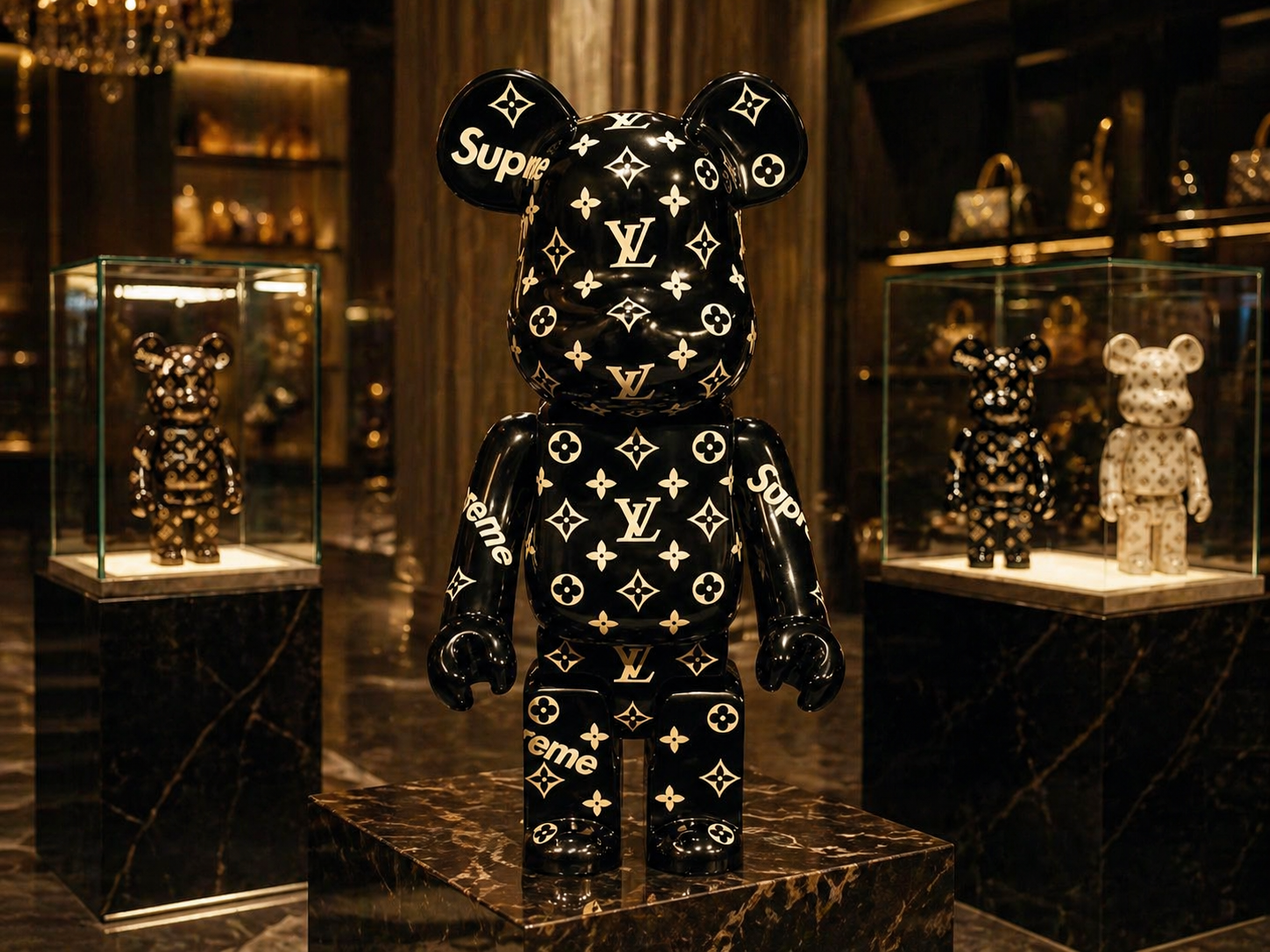
  • Supreme Bearbrick: The Red Box Logo Bear That Streetwear Collectors Can’t Ignore

    A Store That Started With Skaters and Brown Paper on the Windows

    Peter Bici skated all the way from Queens to downtown Manhattan in 1994 looking for the new Supreme store. He kept going the wrong direction on Lafayette Street, which at the time was mostly empty antique shops, until finally he spotted a sign and walked in. “This is a state-of-the-art, modern skateboard shop,” he said. “This is sick.”

    Nobody had any idea.

    James Jebbia opened that first Supreme store in a former office space on Lafayette Street in April 1994. The layout was designed specifically to accommodate skateboarders — clothing racks around the perimeter of the room, central space left open so people could ride in. The first employees were skaters and actors from the downtown New York scene. The music played loud. The vibe was deliberately exclusive in the way that only truly underground things are exclusive — not performatively, just genuinely not built for everyone.

    Jebbia was inspired by Barbara Kruger’s artwork when designing the red box logo — the white Futura Heavy Oblique font in a red rectangle that would become one of the most recognised marks in fashion history. Kruger herself later commented critically on Supreme’s approach to intellectual property, which is its own story. But the logo stuck, and it spread — on stickers first, then on everything else.

    Supreme’s first artist collaboration was with Rammellzee in 1994, the year the brand opened. It produced hand-painted trucker hats and backpacks. That set the template thirty years ahead of time: find someone interesting, make something in small quantities, let it go. The list of artists who’ve worked with Supreme since — Damien Hirst, KAWS, Takashi Murakami, Richard Prince, Daniel Johnston — reads like a very specific curation of the people who moved between art, street, and music without belonging entirely to any of them.

    The Bearbrick collaboration fits that template exactly.

    Why Supreme and Medicom Toy Make Sense Together

    Medicom Toy and Supreme have collaborated going back to the early 2000s. One of the earliest joint releases was a Supreme x Kermit Kubrick — the Kubrick being Medicom’s predecessor format to Bearbrick — that had New Yorkers lining up outside Supreme’s SoHo store. Both formats sold out. The queue for a toy outside a skate shop on Lafayette Street was unusual enough that people noticed. That release showed Medicom and Supreme’s communities were more overlapping than anyone had formally acknowledged.

    When you think about it, the alignment is obvious. Supreme runs on scarcity, unannounced drops, and a collector mentality that transfers directly from clothing to objects. Medicom Toy operates the same way. Supreme Bearbrick releases are never announced in advance. They drop without warning, sell out immediately, and then disappear into the secondary market. This is exactly how Supreme drops clothing. The same person who refreshes supremecommunity.com at 11am on a Thursday looking for a new box logo tee is the same person checking for Bearbrick stock updates.

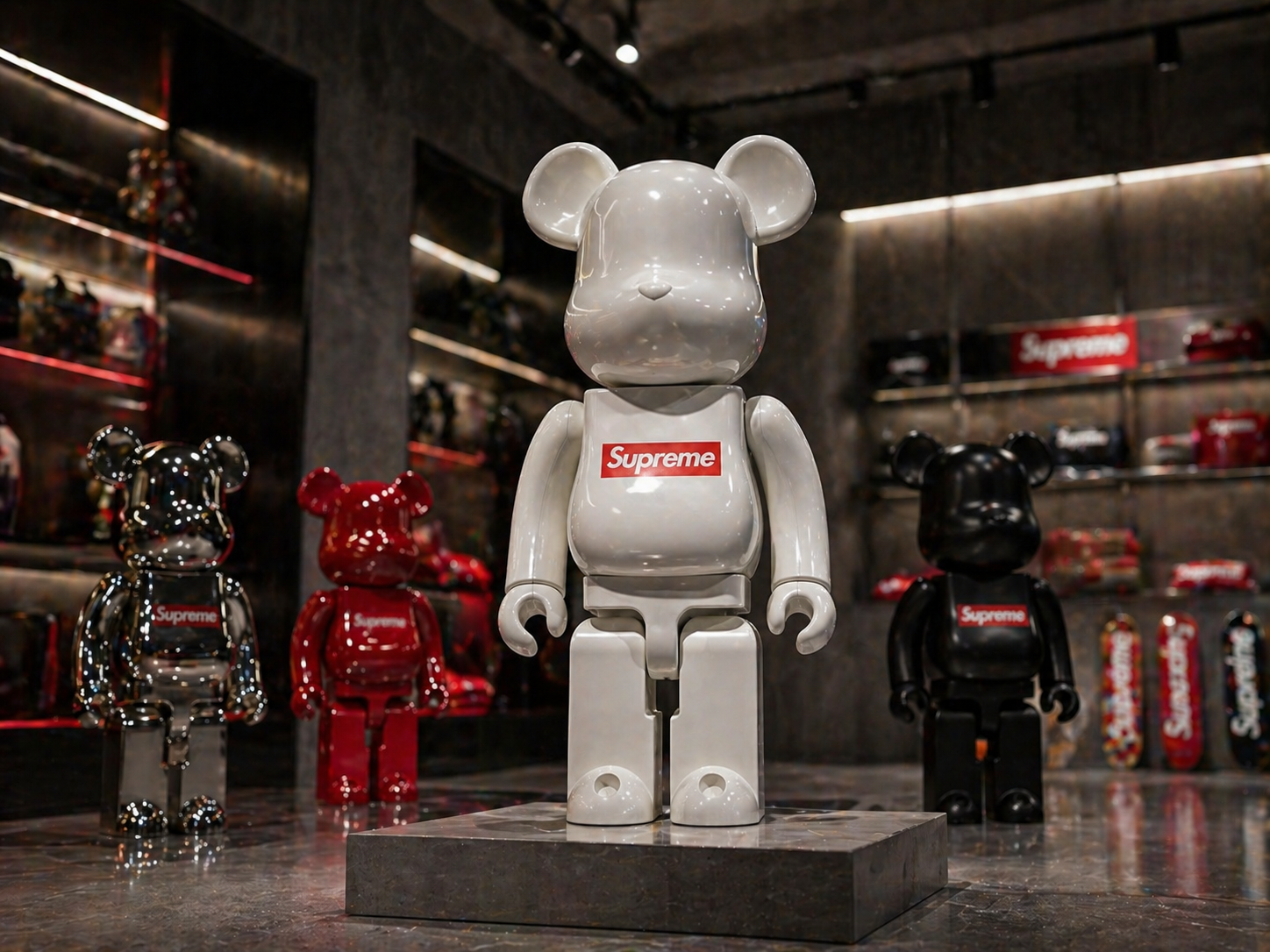
    There’s also the question of what the red box logo does to the Bearbrick format. The Bearbrick is — by design — a blank canvas. Its surface is smooth, rounded, and neutral. When you put Supreme’s red box logo on that surface, the result is immediately recognisable to two separate collector communities simultaneously. Bearbrick collectors see a sought-after Medicom collaboration. Supreme collectors see the logo they’ve been chasing since they first saw it on a sticker in downtown New York. The object works for both without needing to compromise for either.

    The Releases: What Supreme and Medicom Have Made Together

    The first Supreme Bearbrick was released in 2006. That’s five years into the Bearbrick format’s existence, which makes Supreme an early collaborator by any measure. The original figure carried the box logo prominently and sold through Supreme’s own channels in limited quantities.

    What followed was a pattern of sporadic releases across multiple years, each with slightly different design treatments but always anchored to the box logo as the primary visual element.

    The Box Logo Figures

    The standard Supreme Bearbrick is built around one thing: the red box with white text. It sounds simple. On the rounded surface of a 1000% Bearbrick at 70 centimetres tall, it reads differently than it does on a T-shirt. The scale changes the object. What’s a graphic on clothing becomes almost architectural on a large vinyl figure.

    The most in-demand Supreme Bearbrick designs include the Box Logo figures, the Motion Logo versions where Supreme text appears on the arms or head, and early KAWS-influenced designs featuring skull motifs. The Box Logo releases have appeared in multiple colourways across different years. Red on white is the classic. Other colourways have appeared as seasonal or event-specific variants.

    The Motion Logo Versions

    Some Supreme Bearbrick releases have featured the logo applied in motion — a repeating pattern across the surface of the figure, or text running around the body rather than confined to a single chest placement. These are visually more complex than the standard box logo figures and have generally held higher secondary market premiums, partly because the design is more labour-intensive and partly because they were produced in smaller numbers.

    The KAWS Connection

    KAWS has collaborated with Supreme on multiple projects. The crossover between KAWS, Supreme, and Medicom Toy creates a Venn diagram that serious collectors navigate carefully. Figures that carry KAWS design elements within the Supreme Bearbrick context are among the most sought-after in the catalogue. They appeal to three communities at once — KAWS collectors, Supreme collectors, and Bearbrick collectors — and that triple demand is reflected in secondary market prices.

    The Undercover Triple Collaboration

    Medicom Toy produced a Supreme x Undercover x Medicom Toy collaboration — the GILAPPLE — which sits as one of the more interesting three-way releases in either brand’s history. Jun Takahashi’s Undercover has its own long relationship with Medicom, and Supreme and Undercover have crossed paths repeatedly in the Japanese streetwear world. When all three come together, the result appeals to collectors who follow any combination of the three brands.

    The Crow Kubrick (2021)

    In Fall 2021, Supreme released a Crow-themed Kubrick — Medicom’s older format, distinct from Bearbrick — as part of their FW21 collection. This matters because it shows Supreme’s relationship with Medicom Toy is not limited to the Bearbrick format. They’ve worked across Medicom’s entire output, which gives the collaboration a depth that single-format partnerships don’t have. For collectors who track Supreme objects rather than specifically Bearbricks, the Kubrick releases are part of the same story.

    How Supreme Drops Work — and Why It Matters for Bearbricks

    To understand why Supreme Bearbricks are hard to get, you need to understand how Supreme actually releases products.

    Supreme’s limited-edition releases often sell out within minutes of going live online. This is not an accident or a production failure. It’s the entire point. Supreme manages its supply deliberately below demand, which is the same logic Nigo used at BAPE in 1998 when he pulled the brand from 40 stores and concentrated it in one. The shortage creates the desire.

    There is never an advance schedule for Supreme Bearbrick releases. New figures appear without announcement, drop without warning, and disappear quickly. Past release patterns suggest figures tend to appear in spring and December, but nothing is guaranteed.

    For collectors outside Japan and the US, this creates a specific problem. Supreme’s store network — with locations in Manhattan, Los Angeles, London, Paris, Tokyo (three stores), Nagoya, Osaka, Fukuoka, Berlin, Milan, Chicago, Seoul, and Shanghai — is significant, but it doesn’t include most of Europe. A Supreme Bearbrick drop at the London store or via the EU online channel is often the only legitimate retail access point for European collectors. Miss it, and the secondary market is the only option.

    The secondary market pricing reflects this access friction. Someone in Berlin or Amsterdam who wants a Supreme Bearbrick they missed at retail is competing with resellers who bought specifically to sell, with collectors in Japan who had easier access, and with other European collectors in the same position. The premium over retail is partly supply scarcity and partly geographic scarcity stacked on top of each other.

    The Prices: What Supreme Bearbricks Actually Trade For

    Supreme Bearbrick retail prices have ranged from around $59 for a 100% figure up to roughly $250 for a 1000% size. On the secondary market, prices can easily surpass $1,000 and reach five figures for extremely rare pieces. Resellers typically apply a 2x to 10x markup over retail depending on the specific figure and its scarcity.

    This range is wide, and intentionally so, because the Supreme Bearbrick market is not monolithic. Here’s how the tiers actually break down:

    Standard 100% and 400% box logo figures from recent years trade at modest secondary market premiums — typically $100 to $400 above retail depending on colourway. These are findable. They’re not cheap, but they’re accessible to collectors who are paying attention.

    1000% box logo figures are where the market gets serious. These don’t appear as frequently as the smaller sizes, and when they do, secondary market pricing often sits between $600 and $2,000 for standard releases. The large format amplifies the design in a way the smaller figures don’t, which creates a collector premium beyond the simple scarcity argument.

    Early releases — pre-2010 — command a retrospective premium that reflects both scarcity and historical significance. The first Supreme Bearbrick from 2006 is not particularly abundant on the secondary market, and when clean examples appear, prices reflect two decades of collector attrition.

    Triple collaboration releases and limited event exclusives sit at the top of the market. These were produced in genuinely small numbers, often through specific channels rather than general Supreme drops, and the combined brand premium of Supreme plus a third party pushes prices significantly above standard releases.

    The price ceiling is harder to define than it is for some other Bearbrick collaborations, partly because Supreme Bearbrick authentication is slightly more complex than it sounds. Supreme has been heavily counterfeited globally, and the combination of Supreme branding and Medicom Toy construction gives fakers two distinct logos to get right. More on this below.

    Supreme vs. Other Streetwear Bearbricks: How It Fits

    The collector market for streetwear Bearbricks essentially has three major players: BAPE, Supreme, and to a lesser degree, Stüssy and Fragment Design.

    BAPE has the longer and more formalised relationship with Medicom. BAPE Bearbricks come in multiple sizes annually, they have a documented anniversary series structure, and the BAPE community’s familiarity with Japanese streetwear culture means access and authentication are slightly better understood. The BAPE x Readymade 1000%, which reached $121,000 on the secondary market, is the outlier that proves what happens when extreme craft meets extreme scarcity.

    Supreme’s releases are less frequent and less structured. There’s no annual anniversary format, no scheduled drop calendar, no size progression that collectors can plan around. This irregularity keeps demand permanently elevated because collectors never know when the next figure will appear. It’s the same dynamic Supreme uses with their weekly drops — the uncertainty is the product.

    Fragment Design’s Bearbricks are quieter but significant for collectors who follow Hiroshi Fujiwara’s work. Comme des Garçons has appeared in the Medicom catalogue. Undercover’s releases carry their own collector community.

    Among all of them, Supreme occupies the most charged position in terms of cultural recognition. Put a Supreme box logo on anything and it communicates something immediately to a global audience. That’s not true of most other streetwear brands. It creates a Bearbrick that works as a communication object — you can put it on a shelf and it tells visitors something about who you are and what you know.

    The Barbara Kruger Angle — and Why It’s More Interesting Than It Sounds

    Here’s something worth knowing if you’re going to talk seriously about Supreme’s visual identity.

    James Jebbia was inspired by a book on Barbara Kruger’s artwork when designing Supreme’s red box logo. Kruger is an American conceptual artist known for her text-based works — bold white text on red backgrounds, often making statements about power, desire, and consumer culture.

    The irony is not subtle. Kruger’s work explicitly critiques the machinery of consumer desire. Supreme took her visual language and built a consumer brand around it that generates more desire than almost any other clothing company in history. Kruger noticed. She commented on it publicly, describing the Supreme community in terms that weren’t flattering.

    But here’s what makes it interesting for Bearbrick collectors specifically: when a Supreme Bearbrick sits on your shelf, you’re looking at an object that carries this entire argument inside it. It’s a Japanese vinyl toy wearing the logo of a New York skate brand that stole its visual language from a conceptual artist who was critiquing consumer culture. The layers are genuinely there if you want them.

    Most people don’t want them. They just like the way the red box looks against the bear’s rounded white chest. That’s fine too.

    Authenticity: The Specific Risks with Supreme Bearbricks

    Supreme is one of the most counterfeited brands in the world. Medicom Toy is also heavily counterfeited. A figure that combines both brand identities requires authentication at two levels simultaneously.

    The Medicom Toy base figure should show consistent vinyl quality — matte finish, smooth joints, clean moulding without seam issues or rough edges. The Medicom Toy stamp on the underside should be clear and properly formatted. Counterfeit Bearbricks often get the general form right while getting the surface quality wrong — the plastic feels slightly cheaper, the finish is slightly off.

    The Supreme branding needs to be correct in typeface, colour, and proportions. The Futura Heavy Oblique font in the box logo has very specific weight and spacing. On authentic figures, the print is sharp-edged and consistent. On fakes, the red is often slightly wrong — too orange, too dark, or with uneven printing that shows at the edges of the lettering.

    The packaging is documentation. Original Supreme Bearbrick boxes have specific construction and printing quality. Supreme packaging is generally well-made — they care about the presentation of objects — and reproductions tend to have slightly softer printing, lighter card stock, or misaligned elements.

    Buy from established sources. Supreme’s own channels (where you can access them) are the only guaranteed-authentic retail point. On the secondary market, StockX’s authentication process, established dealers with track records, and private collector sales with documented provenance are your options. Be cautious about figures offered significantly below the known secondary market range — the discount is usually there for a reason.

    Who Collects Supreme Bearbricks

    The Supreme Bearbrick collector sits at an intersection that’s worth understanding. This person is probably not primarily a Bearbrick collector in the way that someone who owns a KAWS Dissected Companion and a Chanel 1000% is a Bearbrick collector. They’re more likely primarily a Supreme collector — someone who buys weekly drops, who knows their Supreme history, who has box logo tees they’ve never worn.

    For that person, a Supreme Bearbrick is an extension of their existing collection into a different format. It’s the same brand, the same visual language, the same drop culture — just as a 70-centimetre vinyl figure instead of a T-shirt. It sits on a shelf next to Supreme accessories and other Supreme objects and reads as part of a coherent collection.

    The overlap with serious Bearbrick collectors is real but smaller. Someone who tracks Medicom’s entire output will include Supreme figures in their collection the way they include BAPE and Undercover — as part of the streetwear collaboration category within a broader collection. For them, the Supreme Bearbrick is interesting but not necessarily the priority.

    The sweet spot is the collector who follows both. Who knows Supreme’s drop calendar and also knows Medicom Toy’s release history. Who understands why the 2006 first release matters and also why the triple collaborations command different prices. These collectors are not common, but they exist, and they drive the upper end of the Supreme Bearbrick secondary market.

    Display and Practical Considerations

    A Supreme Bearbrick 1000% is 70 centimetres tall. It needs real floor or shelf space, and the red box logo reads well from a distance — this is one of the figures where display placement actually matters. Put it somewhere it can be seen clearly, because the design is too specific to work as a vague shape in the background.

    Keep it out of direct sunlight. The red pigment in Supreme’s box logo can fade over time under UV exposure, and the white vinyl base can yellow. Neither process is fast, but both are irreversible. Collectors who want to maintain the figure’s value long-term keep it in a stable environment away from windows.

    Store in original packaging when not displaying, for maximum protection. The box is not just packaging — it’s part of the object’s documented provenance. A Supreme Bearbrick without its original box is worth less than the same figure complete. This is true across essentially all Bearbrick releases, but it matters more with Supreme figures because authentication on the secondary market relies partly on the packaging’s consistency.

    Frequently Asked Questions

    When was the first Supreme Bearbrick released?

    The first Supreme Bearbrick was released in 2006, making Supreme one of the earlier streetwear collaborators in Medicom Toy’s catalogue.

    Are Supreme Bearbricks still being made?

    Yes. Supreme and Medicom Toy continue to produce figures sporadically. There’s no regular schedule. Releases appear without advance notice through Supreme’s own channels.

    Where can I buy a Supreme Bearbrick?

    At retail: directly from Supreme stores or supremenewyork.com during a drop. On the secondary market: StockX, established dealers, and private collector sales with documented provenance.

    How much does a Supreme Bearbrick cost?

    Retail prices range from roughly $59 for a 100% figure to $250 for a 1000%. Secondary market prices typically run 2x to 10x retail, with rare pieces reaching five figures.

    How do I know if a Supreme Bearbrick is real?

    Check the vinyl quality and surface finish on the Medicom base figure, the font weight and colour accuracy on the Supreme logo, and the construction and printing quality of the original packaging. Buy from sources with documented authentication processes.

    Are Supreme Bearbricks a good investment?

    Early releases and triple collaborations have shown meaningful appreciation. Standard recent releases hold value reasonably well but don’t show dramatic gains. As with any collector market, buying figures you genuinely want to own is safer than buying purely for appreciation.

  • BAPE Bearbrick: The Collaboration That Defined Streetwear Collecting

    Two Japanese Institutions That Were Always Going to Find Each Other

    A Bathing Ape was founded by Tomoaki Nagao — known to everyone as Nigo — in 1993, in the backstreets of Harajuku, Tokyo. The store was called NOWHERE. The name came from a Beatles song. Nigo produced about 50 T-shirts a week in the early days, sold half of them, and gave the rest away to people who mattered in Tokyo’s creative scene. This was not a marketing strategy at first. It was a budget constraint. But the scarcity it created — accidental, then deliberate — became BAPE’s entire identity. SideshoweBay

    Medicom Toy launched Bearbrick in 2001, eight years after BAPE opened its doors. Same city, similar logic: make things in small numbers, work with people who have their own audience, let the object carry the collaboration’s energy. Nigo understood this instinctively. He’d been doing it with T-shirts since 1993.

    The first BAPE Bearbrick came out in the early 2000s. It made sense immediately. Both brands were Japanese, both were running on scarcity and cultural credibility, and both had communities that collected obsessively. The only question was what they’d do together — and they’ve been answering that question ever since.

    This is the full story of the BAPE Bearbrick collaboration: the figures, the history, the prices, and what makes this particular partnership different from every other Bearbrick release.

    Who Built BAPE and Why It Matters to This Story

    You can’t really understand what a BAPE Bearbrick is without knowing what BAPE is — not the brand in the abstract, but the specific thing Nigo built in Harajuku and what made it unusual.

    Nigo was born Tomoaki Nagao in 1970. He studied at Bunka Fashion College and worked as an editor and stylist for Popeye magazine before opening NOWHERE with Jun Takahashi of Undercover in 1993. He was not from a fashion family. His parents were indifferent to what he was doing. What he had was taste, and a network — specifically, access to Hiroshi Fujiwara, the person most credited with bringing hip-hop culture to Japan, who became his mentor and gave the store early credibility.

    The BAPE name came from a graphic designer named SK8THING, who suggested the concept after a five-hour marathon of Planet of the Apes films. The name references a Japanese idiom about bathing in lukewarm water — an ironic jab at the overindulged young people who would become BAPE’s core customers. There’s something deliberately self-aware about that. Nigo was building a brand that charged high prices and produced low quantities, and he named it after the people who would pay those prices.

    By 1998, BAPE was selling through 40 stores across Japan. Nigo pulled it from all of them and concentrated everything back into one location in Shibuya. Sales stayed roughly the same. That decision — one store, controlled access, deliberate friction — became the formula that Supreme and every other scarcity-driven streetwear brand would follow for the next twenty years.

    Nigo met KAWS in 1996 and became an early supporter of his work. In 2005, he commissioned him a painting — which became the KAWS Album, eventually sold at Sotheby’s Hong Kong for $14.8 million in 2019. Nigo understood early that the interesting collision was between streetwear, art, and collectible culture. The BAPE Bearbrick is a direct expression of that understanding.

    In 2011, Nigo sold BAPE to Hong Kong fashion conglomerate I.T Group, staying on as creative director until 2013 before leaving entirely. He went on to build Human Made, then became artistic director at Kenzo. BAPE continued without him. The Bearbrick collaboration continued too — it’s been running consistently since 2009 regardless of who’s running the brand.

    The BAPE Bearbrick: What Makes It Instantly Recognisable

    There’s a specific visual language to BAPE Bearbricks that you’d recognise in a lineup of fifty figures. It’s not complicated — it’s BAPE’s own language, applied to the Bearbrick format with enough specificity that the bear clearly belongs to both parties simultaneously.

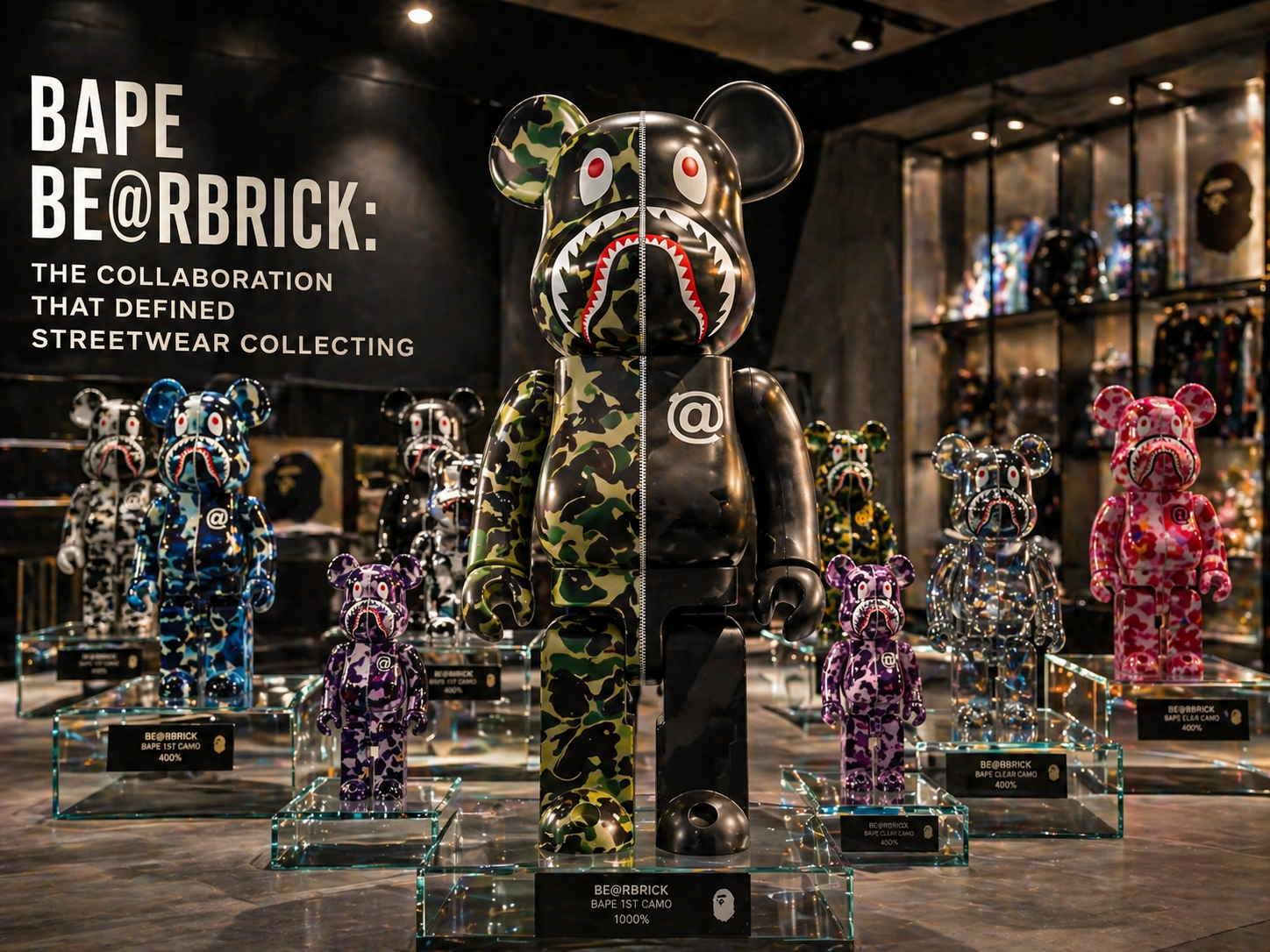
    The dominant element is camo. BAPE’s 1st Camo pattern — the one with the Ape Head hidden inside the camouflage — has appeared across essentially every BAPE Bearbrick release in some form. It works on the format because the Bearbrick’s smooth, rounded surface is close to a blank canvas, and the camo pattern reads clearly against it. You don’t need to see the BAPE logo to know what you’re looking at.

    The second signature element is the Shark Hoodie. In clothing form, BAPE’s shark hoodie is the piece the brand is most associated with globally — the one where the zipper pulls up over the face to reveal teeth printed on the hood. In Bearbrick form, Medicom and BAPE have done something genuinely clever with this: the 400% and 1000% figures can wear a miniature functional version of the hoodie, sewn from fabric with the same camo details as the clothing version. The 1000% variant often comes with felt eyes and teeth to complete the effect.

    This is different from most character Bearbricks, where the “costume” is painted directly onto the vinyl. A BAPE Shark Hoodie Bearbrick is wearing actual fabric. That’s a manufacturing choice that costs more and takes longer, and it’s why certain BAPE Bearbricks sit at a different price point from standard releases.

    The third signature is Baby Milo — BAPE’s cartoon monkey character, used across their more playful releases. Baby Milo Bearbricks tend to be smaller (100% and 400%) and skew toward the lifestyle side of the market rather than the serious collector end. They’re more approachable entry points into the BAPE Bearbrick catalogue.

    The Releases: A Timeline of BAPE × Medicom Toy

    Early 2000s — The First Wave

    BAPE and Medicom Toy have been collaborating on Bearbricks since 2009 as an annual anniversary item. Before that, earlier releases existed but were less formalised. The very early BAPE Bearbricks from the 2003-2005 period — including the Play Camo versions — are now genuinely difficult to source. A 2003 BAPE Play Camo 400% in good condition with original packaging commands serious secondary market interest, not because it was produced in tiny numbers, but because two decades of handling, storage variation, and collector turnover have winnowed the supply of clean examples.

    These early figures established the visual template that every subsequent release would build on: the 1st Camo pattern, the Ape Head, the specific BAPE colourways. They’re reference points more than just collectibles.

    The Anniversary Series (2009 Onwards)

    Starting in 2009, BAPE formalised its Bearbrick collaboration as an annual anniversary release. Each year, they produce figures tied to the brand’s founding year — 28 colourways for the 28th anniversary, for example. These releases are structured as series, with multiple waves throughout the year, and they cover 100% and 400% sizes in the standard anniversary format.

    The anniversary series is where casual BAPE fans enter the Bearbrick world. The figures are produced in larger quantities than the flagship shark hoodie versions, retail at accessible price points, and represent clean, wearable BAPE design applied to the bear format. They’re not the rarest BAPE Bearbricks — but they’re the most consistent.

    The Shark Hoodie Versions — Core of the Collection

    These are the figures serious collectors focus on. In 2016, BAPE released a full collection of 1st Camo Shark Hoodie Bearbricks in 100%, 400%, and 1000% sizes, in red, black, and blue colourways. The drop hit BAPE stores, Project 1/6, Medicom Store Skytree Soramachi, and Medicom’s online store simultaneously.

    The Shark Hoodie 1000% is the figure that sits at the centre of the BAPE Bearbrick market. At 70 centimetres tall, wearing a fabric shark hoodie with functioning zipper and camo detailing, it’s a display piece that communicates BAPE’s identity clearly even to people who don’t know the brand well. The shark face hood pulled up over the Bearbrick’s head reads as a costume — which is essentially what it is.

    Multiple colourways have been released across different years. Grey, navy, red, black — each with slightly different camo pattern applications and hoodie detailing. Collectors who focus on BAPE Bearbricks often pursue specific colourways rather than just one of everything.

    The Mastermind Japan Triple Collaboration (2021 and 2024)

    In 2021 and again in 2024, BAPE collaborated with both Medicom Toy and Mastermind Japan on a triple collaboration 1000% Bearbrick. The figure carries Mastermind’s skull and crossbones alongside BAPE’s shark motif, applied to BAPE’s 1st Camo pattern in a special edition that combines the visual identity of all three parties.

    This is a figure that appeals to collectors across three communities simultaneously: BAPE collectors, Mastermind Japan collectors, and Bearbrick collectors. The overlap between those three groups is not enormous, which is part of what makes the figures interesting. You’re not buying something with universal recognition — you’re buying something specific to a particular intersection of taste.

    The 2024 version also appeared in Chogokin form — a die-cast alloy version produced in collaboration with Bandai, available in green and yellow colourways. The alloy construction means no visible screws or joints, just a clean weighted form in metal rather than vinyl. This is not something Medicom Toy does often. The material is completely different from standard Bearbrick production, and the result is an object that feels more like sculpture than toy.

    The BAPE Flyer Pattern / Legacy Camo Shark (2025)

    In 2025, BAPE and Medicom released the “Legacy Camo Shark” collection — a full set of 100%, 400%, and 1000% figures using BAPE’s Flyer Pattern as the main design. The 400% and 1000% versions come with a special Shark Hoodie, with the 1000% including felt eyes and teeth.

    The Flyer Pattern is inspired by the visual of a wall covered in promotional flyers — applied across the entire surface of the bear, with the shark hoodie switching to the standard camo pattern on part of the hood. This is a 2025 release, which means it’s recent enough that secondary market prices haven’t fully settled yet. For collectors looking to enter the BAPE Bearbrick market at the high end without paying premium retrospective prices, the Legacy Camo Shark 1000% is the most logical current entry point.

    Baby Milo Figures

    Scattered through the BAPE Bearbrick history are Baby Milo releases — the brand’s cartoon monkey applied to the 100% and 400% format. These are lighter in tone than the shark hoodie and camo releases, aimed at a broader audience, and retail at more accessible prices. The early Baby Milo figures from the Pepsi NEX collaboration (produced with Medicom and Pepsi as a promotional item) are small and often appear in blind box format, which makes them collectible in a different way from the flagship figures.

    Baby Milo figures are a good place to start if you’re new to BAPE Bearbricks and want to understand the aesthetic before committing to a 1000% shark hoodie version.

    The Readymade Collaboration: The Most Extreme BAPE Bearbrick Ever Made

    This one deserves its own section because it’s a different category from everything else.

    In 2018, Medicom Toy produced a triple collaboration with BAPE and Readymade — the brand founded by Japanese designer Yuta Hosokawa, known for working with deconstructed military materials. The result was a 1000% Bearbrick dressed in a real, functional BAPE shark hoodie made from Readymade’s signature vintage military fabric. Functioning zipper. Real ribbed hems. Chenille patches. A tiny working pocket.

    It retailed for around $2,700. On the secondary market, StockX has seen it reach $121,000.

    The gap between those two numbers — roughly 4,400% — is one of the most dramatic resale premiums ever recorded for a Bearbrick. The reasons are specific: the triple collaboration was produced in genuinely small numbers; the Readymade involvement gave it appeal beyond the standard BAPE and Bearbrick collector bases; and the physical craftsmanship of the hoodie is legitimately unusual for a toy. This figure is not primarily a Bearbrick — it’s a wearable garment on a Bearbrick chassis, and the garment was made by a serious designer with a serious material commitment.

    Most collectors who know the BAPE Bearbrick market rank the Readymade collaboration as the single most significant figure in the catalogue. Finding one with verified provenance and original packaging is not easy. When they appear, the prices reflect that.

    Prices: What the BAPE Bearbrick Market Actually Looks Like

    The BAPE Bearbrick market is tiered, and the tiers are distinct.

    At the entry level — recent anniversary series figures in 100% and 400% — prices run from $30 to $250 on the secondary market depending on colourway and condition. These are accessible. They’re not particularly scarce. They represent the aesthetic clearly and work as shelf pieces.

    For standard shark hoodie figures in 400% from the 2016-2021 releases, secondary market prices generally sit between $200 and $600 depending on colourway. The rarer colourways (certain grey or special edition runs) push higher.

    The shark hoodie 1000% versions are the core market. Clean examples from the 2016-2021 period trade between $600 and $2,000 depending on colourway, condition, and whether the original box is present. The Mastermind Japan triple collaboration versions sit at the higher end of this range or above it, given the three-way brand premium.

    The Readymade collaboration is its own category. $10,000 minimum for a clean authenticated example; considerably more for exceptional provenance.

    The Chogokin metal versions from 2024 are too recent for secondary market prices to have settled clearly, but initial secondary listings suggest a 200-300% premium over retail.

    Early 2000s figures — the original Play Camo, Baby Milo Pepsi releases — sit in the $200-$500 range for clean examples in original packaging, which isn’t actually that expensive given their age. The BAPE collector base has grown significantly since those figures were produced, and the market hasn’t fully caught up with the historical significance of the earliest pieces.

    BAPE Bearbrick vs. Other Major Collaborations

    Where does BAPE sit in the broader Bearbrick collector hierarchy?

    It’s not KAWS. The KAWS Bearbrick market is deeper, older, and more connected to the fine art world — figures like the Dissected Companion have a decade of auction house records behind them and collectors from completely separate communities competing for the same pieces. A rare KAWS 1000% Dissected will typically command more than any standard BAPE shark hoodie.

    It’s not Chanel. The Chanel Bearbrick has 1,000 numbered pieces in existence total, a Karl Lagerfeld story attached to it, and a fashion collector community with different spending patterns from the streetwear world. The price floor on a Chanel Bearbrick is higher than almost any BAPE Bearbrick except the Readymade.

    But BAPE has something neither of those collaborations has: an ongoing relationship with Medicom Toy that produces new figures regularly. KAWS and Chanel are largely historical — you’re buying the past. BAPE and Medicom are actively making new things, which means the market refreshes, new collector entry points appear, and the catalogue keeps growing.

    The BAPE Bearbrick also has a specific cultural context that the art collaborations don’t: it exists inside the streetwear world. Buyers are often people who also own BAPE clothing, who follow Bearbrick drops the same way they follow sneaker releases, who understand the BAPE camo as a cultural reference rather than just a design. That specificity makes the collector community cohesive and invested.

    How to Collect BAPE Bearbricks Without Making Expensive Mistakes

    The BAPE Bearbrick market has fakes. Not crude ones — the prices justify quality counterfeiting at the shark hoodie and Readymade end of the market. Here’s what separates authentic from fake.

    The fabric on shark hoodie versions is the first test. Authentic BAPE Bearbrick hoodies use specific materials with consistent stitching quality, proper zipper movement, and camo patterns that align correctly at the seams. Cheap reproductions get the general look right but the stitching density wrong.

    The vinyl quality on the figure itself matters. BAPE and Medicom’s authentic figures have a specific surface finish — matte where it should be matte, with clean paint application on the camo pattern. Fakes often show paint bleed at pattern edges or a slightly off finish on the vinyl surface.

    The packaging is documentation, not decoration. BAPE Bearbrick boxes have specific construction — material weight, printing quality, the way the Medicom and BAPE logos are reproduced. An authentic figure in a reproduction box is worth considerably less than the same figure in an original box. A reproduction box next to a reproduction figure is a problem.

    For the Readymade collaboration specifically: provenance documentation is essential. At these prices, you need to know where the figure came from and be able to verify it. Established dealers, auction houses with authentication processes, or direct purchase from original owners with documentation are the only safe options.

    Buy from people with track records. The BAPE community — on Reddit, on Discord, on platforms like StockX — is well-connected and has seen enough fakes to know what to look for. New sellers with no history and prices that seem low for what they’re offering are sellers to avoid.

    Display and Care

    A 1000% BAPE Bearbrick in a shark hoodie needs space and consideration. The vinyl responds to temperature variation and direct sunlight the same way all Bearbricks do — gradual yellowing, potential paint fading, stress on the joint areas if the figure is moved repeatedly. The fabric hoodie adds complexity: it accumulates dust, and on rare figures, even dust is a problem because cleaning requires care.

    Most serious collectors keep shark hoodie figures in their original boxes when not displayed, and display smaller sizes out of box. The box isn’t just packaging — it’s part of the object, and the secondary market reflects this clearly. A 1000% Readymade collaboration without its original box is worth significantly less than the same figure with everything intact.

    If you’re going to display out of box: stable temperature, no direct light, a surface that won’t scratch the base. These figures are not fragile in normal handling, but they’re also not toys in the everyday sense. Treat them like the objects they are.

    Frequently Asked Questions

    When did the BAPE Bearbrick collaboration start?

    The formal annual anniversary collaboration with Medicom Toy started in 2009, though earlier BAPE Bearbrick figures were produced in the early 2000s. The relationship has been continuous since.

    What is the rarest BAPE Bearbrick?

    The 2018 BAPE x Readymade 1000% is the rarest and most valuable, with secondary market prices reaching $121,000. Among standard shark hoodie figures, early colourways from the 2016 release and the Mastermind Japan triple collaboration versions are the hardest to find in clean condition.

    What sizes do BAPE Bearbricks come in?

    100% (7cm), 400% (28cm), and 1000% (70cm) are the main sizes. Some BAPE Bearbrick releases also include 70% novelty figures bundled with clothing purchases. The Chogokin metal versions also exist in 1000% scale.

    How do I know if a BAPE Bearbrick is authentic?

    Check fabric quality on shark hoodie versions, paint application on the camo pattern, vinyl surface finish, and original packaging. Buy from sellers with documented track records and, for high-value pieces, ask for provenance documentation.

    Are BAPE Bearbricks a good investment?

    The Readymade collaboration has appreciated dramatically. Standard shark hoodie releases have held value and shown moderate appreciation. Anniversary series figures are accessible and liquid but don’t show significant appreciation. As with any collector market: buy what you find genuinely interesting, not what you hope will appreciate.

    What’s the difference between a BAPE Bearbrick and a regular Bearbrick?

    Beyond the design, the main difference on shark hoodie and higher-end releases is the fabric hoodie — an actual sewn garment rather than painted-on design. This makes certain BAPE Bearbricks more technically complex to produce than standard vinyl figures.

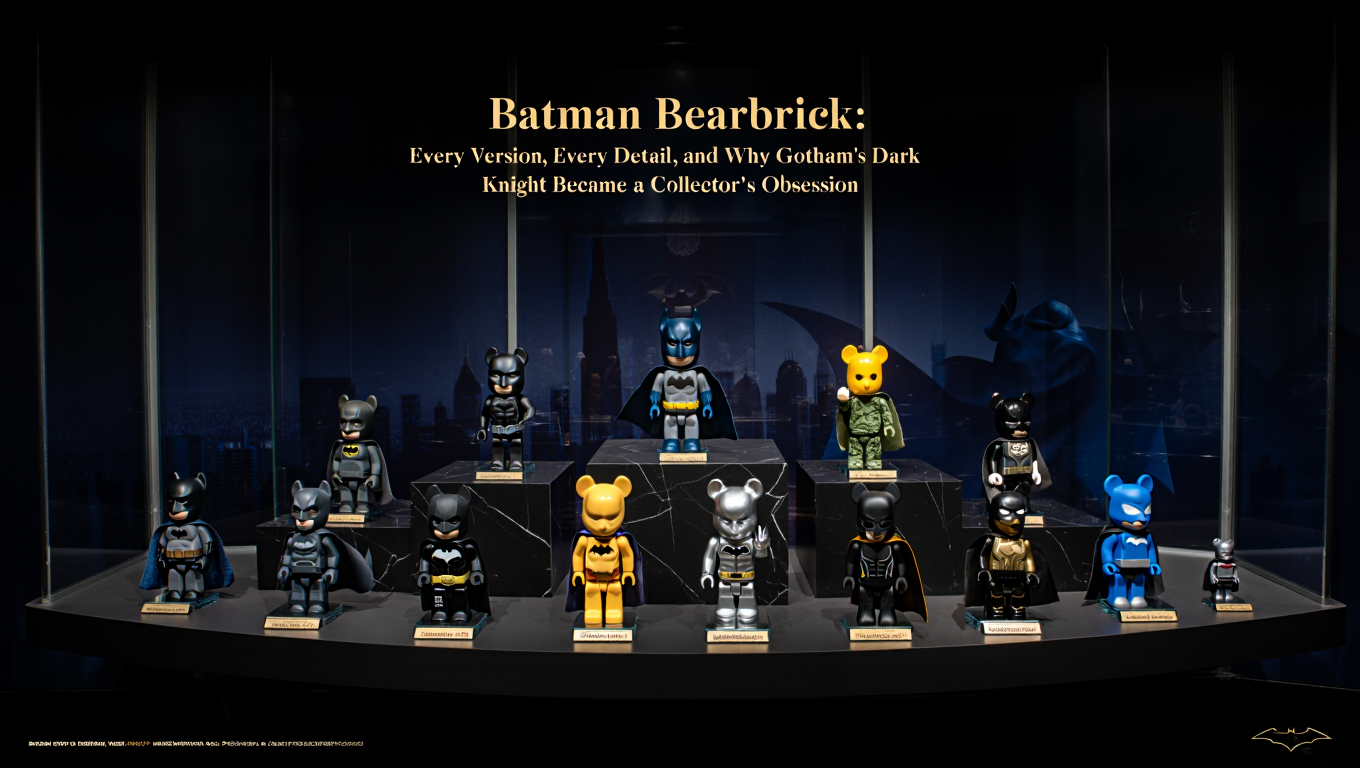
  • Batman Bearbrick: Every Version, Every Detail, and Why Gotham’s Dark Knight Became a Collector’s Obsession

    A Character Built for the Dark — And for Display Cases

    Batman has been reimagined more times than almost any other fictional character. He’s been a campy TV star in the 1960s, a gothic anti-hero in Tim Burton’s hands, a tactical realist in Nolan’s trilogy, and a rage-fuelled loner in everything that came after. Every decade, someone takes the bat symbol and does something different with it.

    What Medicom Toy did in 2003 was different in a specific way. They didn’t just slap a Batman logo on a bear-shaped vinyl figure. They looked at what the character actually is — the silhouette, the suit, the unsmiling presence — and figured out how to make that work within the Bearbrick format. The result was the first Batman Bearbrick, and it sold well enough to start something that’s now been running for over twenty years.

    This is the complete guide to Batman Bearbricks: every major version, what makes each one distinct, how the collector market has developed, and what you need to know before buying one.

    Why Batman Works as a Bearbrick

    Most character Bearbricks face the same challenge: the format is round, friendly, and cartoon-like, and the character being applied to it has its own visual language. Sometimes the two things fight each other. Sometimes they work.

    Batman works for a few reasons. The costume is iconic at the silhouette level — pointed ears, cape, chest symbol, utility belt — and those elements translate well onto the Bearbrick’s rounded form. The dark colourway, usually grey, black, or dark blue, makes the figure feel less like a toy than many other Bearbricks do. And Batman as a character has no face visible under the mask, which means the blank Bearbrick face doesn’t create the uncanny valley problem it creates with human characters. The mask is the face. The figure reads as Batman immediately.

    The Joker figures in the same lineup benefit from the opposite logic: maximum colour and detail against the Bearbrick’s neutral geometry. Purple suit, green hair, the specific wide-mouth grin from the animated series. The contrast between the figure’s rounded shape and the Joker’s inherently angular character design creates something genuinely interesting.

    Both characters — Batman and the Joker together — represent the fullest version of what the Bearbrick format can do with a superhero property. You’re not just buying a toy. You’re buying a design exercise in how far two completely different aesthetic systems can be pushed toward each other.

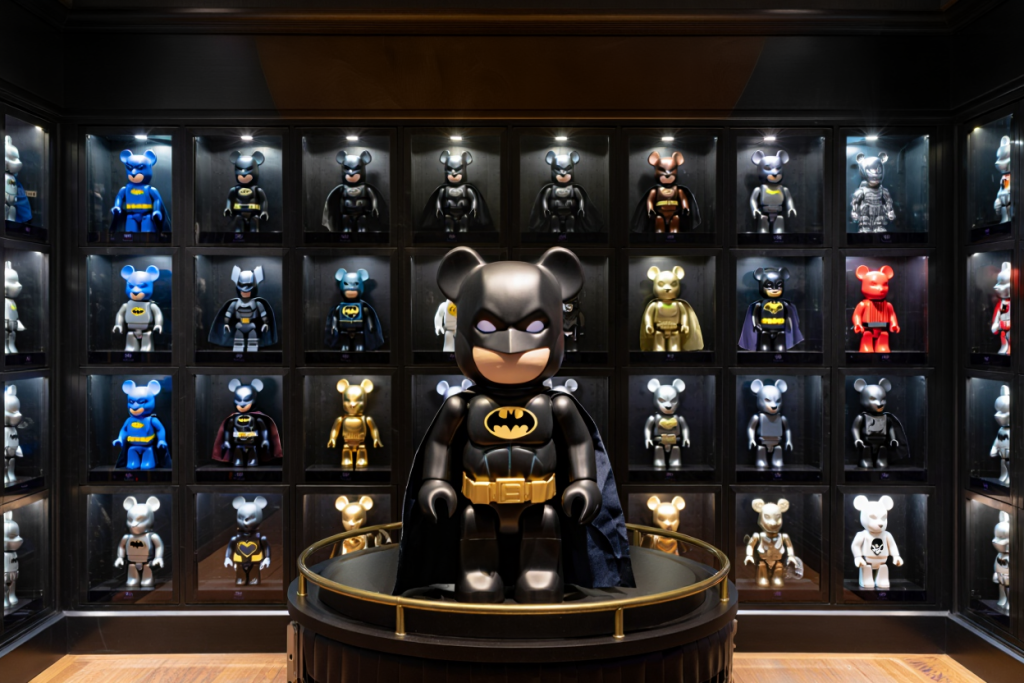
    Batman and Joker Bearbrick figures from Batman The Animated Series — Medicom Toy 400% collectible set display


    The Versions: What Medicom Toy Has Released

    Medicom Toy has produced Batman Bearbricks across multiple series, versions, and source materials since 2003. Not every release is equally significant, and the collector market treats them very differently.

    The Original Batman (2003)

    The first Batman Bearbrick came out in 2003, just two years after Medicom launched the format. It was one of the earliest brand character collaborations the company had done, and its success helped establish that DC Comics properties could work in this space. The figure drew from the classic Batman costume — grey and blue suit, pointed ears, yellow belt — and sold through specialty retailers in Japan and the US.

    Condition and original packaging matter a lot for this one. It predates the period when Medicom’s distribution in Europe was well-established, which means fewer examples reached European collector markets at the time. Authenticated examples with original boxes are not common.

    Batman: The Dark Knight Returns Version

    Based on Frank Miller and Klaus Janson’s 1986 graphic novel, which remains the defining version of Batman for an entire generation of readers. The Dark Knight Returns reinvented the character as a fifty-something vigilante coming out of retirement, darker and more brutal than anything the mainstream Batman comics had shown before. The Joker in that story is equally disturbing — and Medicom’s Joker Bearbrick based on the Dark Knight Returns artwork is one of the stranger figures in the DC lineup. It was limited to 2,000 pieces outside Asia when it released, making it relatively scarce in European markets from the start.

    The artwork evokes Miller and Janson’s specific line work — angular, heavy, nothing like the cleaner animation style versions — which makes it visually unlike anything else in the Batman Bearbrick range.

    Batman: The Animated Series Version

    Released in multiple formats including 100%, 400%, and 1000% scales. The Animated Series — which ran from 1992 to 1995 — is widely considered the best Batman adaptation ever made, animation or otherwise. It was darker and more complex than a cartoon for kids had any right to be, and its design language, heavily influenced by 1940s film noir, has never quite been replicated.

    Medicom’s Animated Series Batman captures that aesthetic. The colour palette is specific to the show: darker blues, muted greys, the kind of palette that looks like a shadow is always falling across it. The 1000% version stands 70 centimetres tall and works as a statement piece for anyone who grew up watching the show and now has the wall space for something that size.

    The Joker from the same series is the version most people think of when they picture the Joker at all. Green hair, orange vest, bright purple suit, blue hands, thin black shoes. The figure is almost cheerful-looking, which makes it unsettling in the way the character always was. Both Batman and Joker from this series were released around the same period, and they work together as a paired display — which is how many collectors approach them.

    Batman: Hush Version (2022)

    The most accessible and most currently available major Batman Bearbrick release. Batman: Hush is a 2002-2003 comic storyline written by Jeph Loeb with artwork by Jim Lee — the artwork that defined what a lot of collectors think a Batman comic should look like. Lee’s style is detailed, muscular, and cinematic. His Batman has weight and physicality that many other artists don’t convey.

    The Hush Bearbrick version captures that. The figure has sharp white eyes, a grey and blue suit, the yellow utility belt, and a general feeling of presence that other Batman figures don’t quite match. It released in January 2022 at a retail price of $560 for the 1000% version, and in May 2022 as a 100% and 400% set for $125.

    A black version also exists — the Hush Black Version, which drops all the colour and renders the figure in a near-monochrome palette. It’s more severe than the standard version and appeals to collectors who want something that works with a minimal, dark aesthetic.

    Medicom also released a Superman from the same Hush storyline — because the Hush arc involves Batman’s entire rogues gallery and several allies — at a retail price of $555 for the 1000% version.

    The Batman (2022 Film Version)

    Tied to Matt Reeves’ 2022 film, which gave Robert Pattinson the role and stripped the character back to something almost procedural. The film’s Batman is less invulnerable and more obsessive — a detective first, a fighter second, someone who looks like he hasn’t slept in months. The costume is specifically different from any previous version: darker, more improvised-looking, less superhero and more something someone actually built in a basement.

    Medicom’s The Batman figure captures that specific design. It was distributed through Sideshow Collectibles in the US market, which meant Western collectors could access it relatively easily. The 100% and 400% set came in at $160 retail; the 1000% solo figure was $446.

    Batman: Knightmare Version (2017)

    Based on the brief Knightmare sequence in Batman v Superman: Dawn of Justice, which shows a possible dystopian future where Superman has turned. Batman in this version wears a trenchcoat and goggles over his standard suit — it’s a brief scene but a visually distinctive one. The 400% version released in 2017. It’s a figure that appeals specifically to collectors who track Bearbricks by DC property rather than just the classic Batman character, because the Knightmare design is genuinely unusual.

    Batman and Joker: The Case for Collecting Both

    Several Medicom releases have treated Batman and Joker as a paired set rather than separate figures, which makes sense given the characters. The most notable is the Batman & Joker Set that released as a 100% pair in 2009 — a rare and early example of Medicom packaging the hero and villain together as a deliberate pairing.

    More recently, Tom and Jerry entered this dynamic in an unlikely way. Medicom released a figure where Tom is dressed as Batman and Jerry is dressed as the Joker, a 100% and 400% set at $165 retail. It’s a collision of three different cultural properties — Warner Bros animation, DC Comics, and the Bearbrick format — that either appeals to you immediately or doesn’t at all. For collectors who follow Medicom Toy’s stranger output, it’s exactly the kind of unexpected release that makes this market interesting.

    The Joker from Batman: The Animated Series deserves attention on its own. The figure is genuinely well-designed. Medicom got the specific colour palette right — the purple suit with orange vest and green hair is a specific combination that’s easy to get wrong — and the figure has the right proportions to look like the character rather than a generic approximation. It’s sold separately from the Batman figure in most releases, which means building the pair requires deliberate effort. That effort is part of the appeal for collectors building a full Gotham display.

    What These Figures Cost on the Secondary Market

    Batman Bearbricks occupy a specific price band in the Medicom Toy secondary market. They’re not at the extreme end — you’re not looking at KAWS Dissected Companion prices or Chanel Bearbrick territory — but they’re not cheap either, and the rarer versions are genuinely hard to find.

    For the Hush Version, which is the most recent major release: the 1000% version retails at around $560 and has held its value on the secondary market without large premiums. It’s available enough that you don’t pay a significant mark-up for it. The 100% and 400% set is similarly accessible.

    For the Animated Series versions — Batman and Joker — secondary market prices run from around $300 to $900 depending on size and condition. These aren’t the most expensive figures Medicom has ever made, but they’re also not reissued regularly, so clean examples with original packaging are worth holding.

    For early releases — the 2003 original, the Dark Knight Returns Joker — prices reflect genuine scarcity. These figures predate Medicom’s current global distribution infrastructure, fewer examples were produced for Western markets, and the secondary market has absorbed a lot of them into collections where they stay. When they surface, expect to pay a meaningful premium.

    The Knightmare Version and other film-tied releases sit somewhere in the middle — produced in enough quantity to be findable, but not so abundant that secondary market prices are low.

    One consistent pattern: Batman Bearbricks with original boxes and in pristine condition hold their value better than figures that have been displayed out of box for years. The vinyl doesn’t yellow quickly, but the painted details on the costume can show wear over time, and the box is part of what a collector is buying.

    Collecting Batman Bearbricks: How to Build a Meaningful Display

    There are a few different ways to approach Batman Bearbricks as a collection, and they lead to very different results.

    The character collection approach means buying every version of Batman across different Medicom releases — Animated Series, Hush, Dark Knight Returns, The Batman film — and displaying them together. This reads as a visual history of how the character has been interpreted across different eras of DC media, which is more interesting than it sounds. The design differences between the 2022 Hush version and the 2003 original, for example, reflect twenty years of how Batman has been drawn and filmed.

    The Gotham display approach means building a collection that includes both heroes and villains. Batman and Joker as a primary pair, perhaps with other DC characters Medicom has released over the years. This requires more research and more patience, because not every character from the DC lineup has received equal treatment from Medicom. The Batman and Joker figures are the most developed; other characters exist but in fewer versions.

    The size-focused approach means picking a version you love and collecting it across all available sizes. The Animated Series Batman in 100%, 400%, and 1000% displayed together creates a visual scale progression that works well in larger spaces. The 1000% figure at 70 centimetres dominates a room in a way the smaller versions don’t.

    Whichever approach you take: buy authenticated figures from sources with documented provenance. Batman is one of the most collected character properties in the world, and the market for Medicom figures with his image has attracted counterfeit production at the lower price points. The tells are usually in the paintwork — slightly off-colour utility belt, imprecise bat symbol proportions, vinyl quality that doesn’t feel right — but they’re not always obvious without comparison to a documented authentic piece.

    Who Actually Buys These

    The Batman Bearbrick collector is often a different person from the collector buying KAWS or Chanel figures. There’s less overlap with the fine art world and more with the comics and superhero culture community — people who grew up reading Batman: Hush when it first came out in 2002, who watched the Animated Series as children and still know the Joker’s voice in their heads, who followed the Nolan films closely enough to recognise the specific Knightmare costume design.

    That’s not to say serious Bearbrick collectors ignore Batman figures. Many collection-builders include them precisely because the character versions sit alongside artist collaborations in a way that provides contrast. A shelf with KAWS Dissected Companion, Chanel Bearbrick, and Batman Animated Series 1000% tells a more complete story about what the format has done over twenty years than any single category alone.

    The price point also matters. Batman Bearbricks — the Hush version in particular — are accessible enough that they work as a starting point for someone new to Medicom Toy collecting who wants to buy something significant without the four-figure commitment that KAWS or Chanel require. The character is familiar. The figure is well-made. The format is approachable.

    Frequently Asked Questions

    When did the first Batman Bearbrick come out?

    Medicom Toy released the first Batman Bearbrick in 2003, two years after the format launched, making it one of the earliest major character collaborations in Bearbrick history.

    What’s the most sought-after Batman Bearbrick?

    Among current collectors, the Batman and Joker figures from the Animated Series are the most consistently referenced, followed by the Hush version for its Jim Lee artwork. Early releases from 2003 and the Dark Knight Returns Joker are harder to find and command higher premiums on the secondary market.

    How much does a Batman Bearbrick 1000% cost?

    The Hush Version 1000% retailed at $560. Secondary market prices for most 1000% Batman figures run between $400 and $900 depending on version and condition. Rarer early releases can go higher.

    Are there Joker Bearbricks too?

    Yes. Medicom has released Joker figures as part of the Batman: The Animated Series lineup, as a Dark Knight Returns version, and in paired sets with Batman. The Animated Series Joker is the most visually distinctive and most sought-after.

    What’s the difference between the Hush Black Version and the standard Hush Version?

    The standard Hush Version uses the classic Batman colour palette — grey and blue suit with yellow utility belt and white eyes. The Black Version removes most of the colour, rendering the figure in near-monochrome. Both are based on Jim Lee’s artwork from the 2002-2003 comic arc.

    Is the Batman Bearbrick a good first figure for new collectors?

    The Hush Version 1000% is a reasonable entry point — it’s well-made, clearly documented, available at retail price without significant secondary market premium, and unmistakably Batman. For collectors new to Medicom Toy, it’s a lower-risk starting point than rarer artist collaborations.

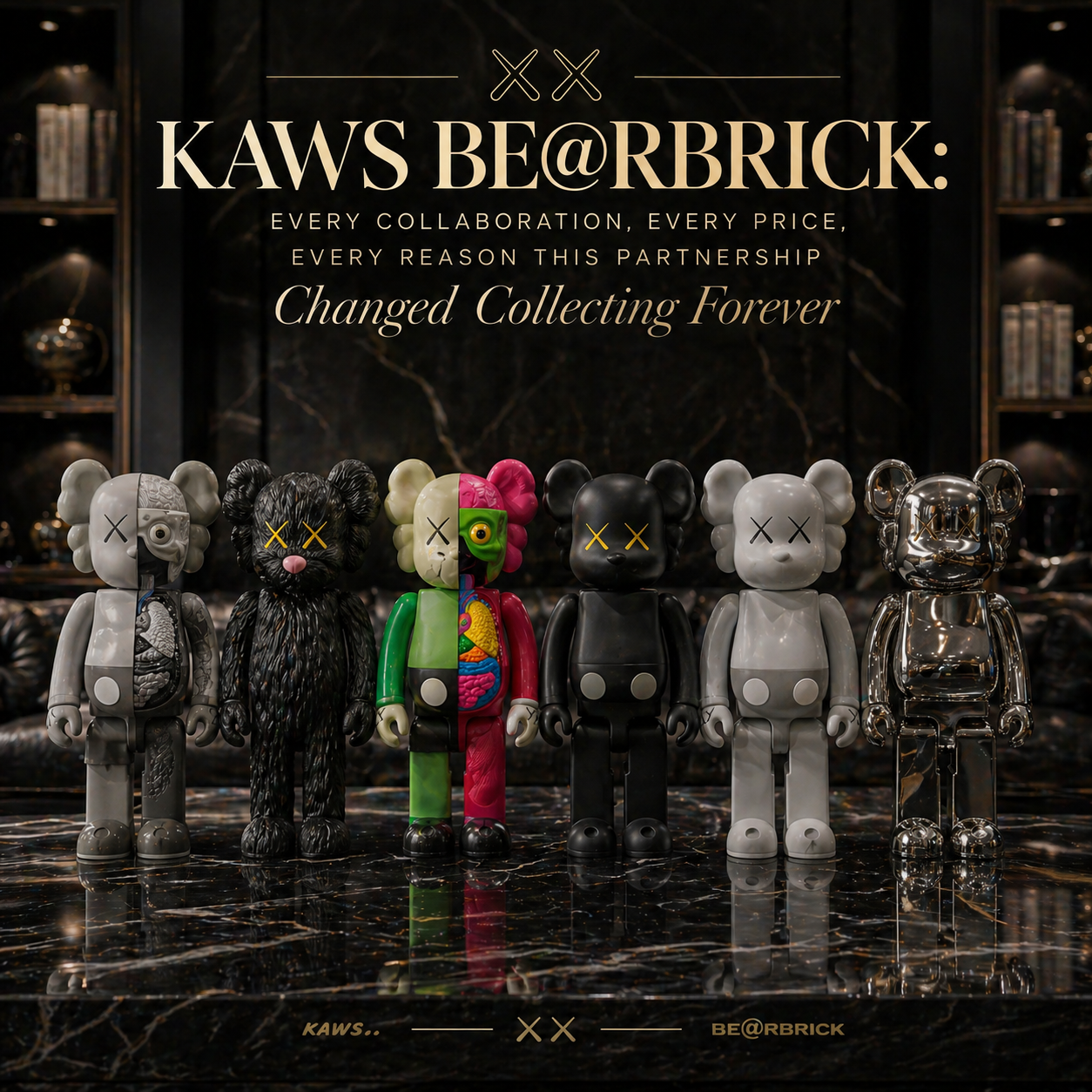
  • KAWS Bearbrick: Every Collaboration, Every Price, Every Reason This Partnership Changed Collecting Forever

    Before the Bear, There Was a Kid with a Skeleton Key

    Brian Donnelly grew up in Jersey City, New Jersey, in a house where his parents were, by his own description, completely indifferent to his graffiti. His father was a stockbroker. His mother was a homemaker. Neither of them particularly cared that their son had started painting his tag — four letters, K-A-W-S, chosen because he liked the shapes — on a rooftop he could see from his high school classroom.

    That indifference probably helped. KAWS kept going.

    By the early 1990s, he’d moved to New York, graduated from the School of Visual Arts with a BFA in illustration, and picked up a day job at Disney doing background animation for 101 Dalmatians, Daria, and Doug. The day job paid. The nights were for something else. A fellow graffiti artist gave him a skeleton key that opened bus shelter panels and phone booths. He’d break in, paint over the advertisement inside, put everything back, and disappear. Fashion ads — DKNY, Calvin Klein — became something weirder and more interesting. His Companion figure started appearing in places where it wasn’t supposed to be.

    People noticed. Then people started removing the panels just to keep them.

    In 1999, he produced his first vinyl toy through Japanese clothing brand Bounty Hunter. It sold. He followed it with more. By the time Medicom Toy came looking for a collaboration in 2001 — the year they launched Bearbrick at the World Character Convention in Tokyo — KAWS was already building something with a collector market behind it. The first KAWS Bearbrick came out in 2002.

    What happened over the next two decades is one of the stranger and more interesting stories in the history of collectible culture.

    What Makes a KAWS Bearbrick Different

    There’s a specific look to every KAWS figure, and it doesn’t change much regardless of what it’s applied to.

    The Companion is his main character — a figure that started as a riff on Mickey Mouse but became something entirely its own. Rounded ears. A clown-like silhouette. And the eyes: crossed-out Xs where pupils should be, which KAWS has used since his earliest street work. On the Bearbrick format, those Xs sit above the standard bear face, and the result is something that simultaneously reads as playful and slightly off. The figure is happy in the way that a person smiling while clearly exhausted is happy. You’re not entirely sure what you’re looking at.

    That ambiguity is intentional. KAWS has talked about wanting his work to function for people who know the references and people who don’t. A kid can look at a KAWS Companion and see a funny cartoon character. A collector sees twenty years of street art, vinyl toys, museum shows, and auction records. Both readings are valid, and the figure doesn’t foreclose either.

    The Dissected Companion takes this further. Split down the middle, it shows what would notionally be inside the bear — organs, structure, the interior of something that was always presented as solid and complete. It’s a genuinely strange design, and it stuck. The Dissected series is probably the most sought-after across the KAWS Bearbrick catalogue.

    The Collaborations: Year by Year

    2002 — The First KAWS Bearbrick

    Medicom reached out to KAWS just one year after launching the format. The result was the first KAWS Companion Bearbrick — the Xs over the eyes, the rounded ears, the silhouette that would become one of the most recognisable in the designer toy world. It released in 100% and 400% sizes. At the time, it sold to a small community that understood what they were getting. Most of the people who most want one today had no idea it existed.

    2003 — The Chomper

    The second collaboration, and the one Sotheby’s has described as the figure that set the stage for the high-end Bearbrick market. Released in an edition of only 500, the Chomper came as a set — a 100% and 400% in the same box, in a vivid blue colourway. It’s a specific, unusual piece in the KAWS catalogue because the design leans into something almost aggressive, the mouth wide open in a way the Companion rarely shows. Clean examples with original boxes are hard to find. When they appear, prices are in the several-thousand-dollar range.

    2005 — Karimoku Wood BBWT

    A version of the KAWS Bearbrick produced in collaboration with Karimoku — the same Japanese furniture company that would later produce their own standalone wood Bearbricks at $22,000 a piece. The BBWT is made from natural wood rather than vinyl, which changes the object entirely. It’s heavier, warmer to the touch, and visually quieter than the painted vinyl versions. Artsy lists it among KAWS’s most sought-after figures. It’s the kind of piece that appeals to collectors who don’t usually buy designer toys, which extends the demand base significantly.

    2008–2010 — The Dissected Companion Series

    This is probably where serious KAWS Bearbrick collecting starts for most people. The Dissected Companion series across these years produced figures in multiple colourways — grey, black, brown — in 100%, 400%, and 1000% sizes. The 1000% Dissected is 70 centimetres of painted vinyl that somehow manages to look both like a toy and a medical specimen simultaneously. Grey versions trade consistently above $8,000. Rare colourways push significantly higher. The design is distinctive enough that it appears in mainstream contemporary art references, which is not something most designer toys can claim.

    2012 — OriginalFake 6th Anniversary

    OriginalFake was KAWS’s own retail brand, operating from a store in Aoyama, Tokyo, from 2006 until it closed in 2013. The 6th Anniversary Bearbrick was released exclusively through Ambush, a single retailer in Singapore. The figure carries KAWS’s signature monogram pattern on fabric that unzips to reveal the bare vinyl beneath. Edition size was small. Geographic distribution was essentially nonexistent for most of the global collector market. It now trades around $8,000, and the fact that it was exclusively available in Singapore — in a single store — on a specific date means most people who wanted it simply couldn’t get it.

    The BBWW Tour figure from the same year also commands consistent secondary market interest, released to coincide with KAWS’s “Seeing/Watching” exhibition tour.

    2013–2020 — Ongoing Companion Releases

    Throughout this period, KAWS and Medicom continued releasing Companion Bearbricks in different colourways and configurations. Not every release became a grail — some are relatively straightforward to source on the secondary market at modest premiums. The ones that appreciate most consistently are those with very small edition sizes, specific geographic exclusives, or unusual materials. Standard 1000% Companions from this era typically trade in the $3,000–$8,000 range depending on colourway and condition.

    2019 — The KAWS Album Connection

    April 2019 was a specific moment in KAWS’s market history. His painting The KAWS Album — a riff on the Sgt. Pepper’s Lonely Hearts Club Band cover, with Simpsons characters in place of the original figures, all with Xs for eyes — sold at Sotheby’s Hong Kong for $14.8 million. The room was full of people in hoodies. The auction house sold roughly $28 million of KAWS work in a single session.

    That sale pushed awareness of KAWS into a completely different register. People who hadn’t been paying attention to the designer toy market started paying attention. Secondary market prices on older Bearbrick releases moved upward over the following months. The Dissected Companion series, already valuable, became noticeably harder to source.

    2020s — Continued Releases

    New KAWS Bearbrick releases continue to appear. The format hasn’t changed, but the context has. Each new release now enters a market where the historical record is documented, where auction results are public, and where the collector community is international and well-funded. Retail prices for new releases are higher than they were in 2002. Secondary market premiums are still significant.

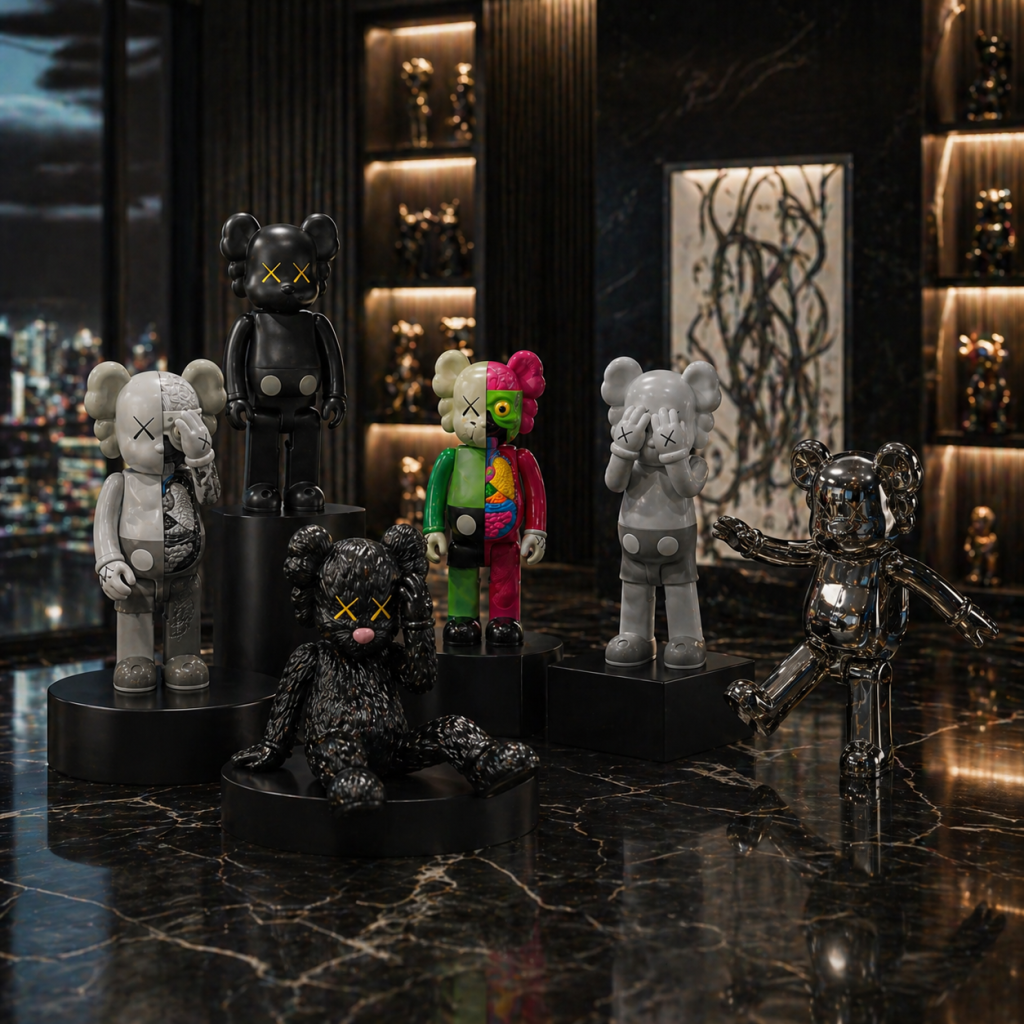
    KAWS Bearbrick Companion 400% and 1000% figures collection display — rare limited edition Medicom Toy releases 2002 to 2020


    The Prices: What They’ve Actually Sold For

    Here’s the part most people come for first, so let’s be direct about it.

    Standard 100% and 400% KAWS Bearbricks — figures from recent releases in colourways that aren’t particularly rare — trade from around $600 to $2,000 on the secondary market, depending on colourway and edition. These are not especially hard to source.

    1000% Companion figures from the 2008–2020 period — the larger, more display-focused releases — generally trade between $3,000 and $12,000, with premium colourways and mint condition examples pushing toward the higher end.

    Dissected Companion 1000% in grey or black — consistently above $8,000, with some examples significantly higher. These are the figures most frequently referenced in editorial coverage and most likely to appear at established auction houses.

    The Chomper (2003, 500-edition set) — trades in the $5,000–$15,000 range for authenticated examples with original packaging. Genuinely hard to find.

    OriginalFake 6th Anniversary — around $8,000 for clean examples.

    Rare colourways and extremely small editions — these don’t have fixed market prices because they don’t trade frequently enough. When they appear, they’re typically offered through specialist dealers or in private collector sales, and pricing reflects whatever the specific parties involved agree to.

    For context: the $14.8 million KAWS Album sale in 2019 is the top of the KAWS market, not the Bearbrick market. But the auction record affected Bearbrick prices because it shifted the general perception of KAWS as a collectible artist. Figures that had been trading at one level moved to another, and they didn’t move back.

    Why This Collaboration Keeps Working

    Twenty-plus years is a long time for any creative partnership. Most brand collaborations have a shelf life measured in releases. The KAWS x Medicom Toy relationship has produced figures every few years across two decades, and the new releases still generate genuine collector interest rather than the fatigued shrug that greets many long-running collaborations.

    Part of the reason is that KAWS’s own market has continued to develop rather than plateau. His work is in the permanent collections of the High Museum of Art in Atlanta and the Modern Art Museum of Fort Worth. His public installations have appeared in Hong Kong Harbour, in parks across Europe, and in the Brooklyn Museum’s main exhibition space. The KAWS Album sale at Sotheby’s put him in a different category than most artists who started in designer toys.

    Every time KAWS’s fine art profile rises, it reflects back onto the Bearbricks. The figures aren’t just collectibles — they’re the most accessible physical objects produced by an artist with a documented auction track record in the tens of millions. That’s a specific and unusual position for a toy to occupy.

    The other reason is that the KAWS Companion design genuinely works in the Bearbrick format. Some artist collaborations feel like a licensing deal — the artist’s imagery applied to the surface of a bear, nothing more considered than that. The KAWS Companion, with its own ears, its own eyes, its own silhouette, creates something more complicated. The Bearbrick and the Companion are two distinct design languages that happen to share a space, and the tension between them is more interesting than either would be alone.

    KAWS Bearbrick vs. Other KAWS Figures

    KAWS produces vinyl figures that aren’t Bearbricks — the standalone Companions, the BFF, the SHARE figure that appeared in his Skarstedt London show. These are in some ways more purely KAWS than the Bearbricks, because they don’t carry the Medicom format as a constraint.

    But the Bearbricks have their own logic. They’re part of a wider collector ecosystem. Owning a KAWS Bearbrick connects you to the Medicom Toy universe — to the Chanel Bearbricks, the BAPE releases, the Andy Warhol series — in a way that standalone KAWS figures don’t. For collectors who are building across multiple categories rather than focusing exclusively on KAWS, the Bearbrick format is often the more sensible entry point.

    For collectors who are exclusively KAWS-focused, the Bearbricks represent some of the most affordable and most historically significant pieces in his output. The 2002 and 2003 releases predate almost everything in his current market. They were produced when the collector community was small and prices were modest. The people who bought them then were buying because they found the work interesting, not because of auction records.

    That’s generally a decent sign in any collector market.

    How to Collect KAWS Bearbricks Without Getting It Wrong

    The KAWS Bearbrick market has fakes. Not crude fakes — convincing ones, because the prices justify the effort. Here’s what to actually check.

    The packaging. Authentic KAWS Bearbricks come in a clear plastic box with specific printing — font, layout, placement. Reproductions often get the general appearance right while getting the details slightly wrong. Compare against documented authentic examples from Sotheby’s, 1stDibs, or similar platforms before buying anything significant.

    The X-eyes. The crossed X motif on authentic figures is precise and consistent. On fakes, the proportions are often slightly off — too large, too small, not centred in quite the right way. Print quality matters here. The Xs on cheap knock-offs often look printed rather than applied.

    The underside stamp. Authentic figures are stamped on the underside with production information. The stamp should be clean, legible, and consistent with other documented authentic pieces from the same release.

    Provenance. Where did the figure come from? Who owned it before? Is there documentation? For older and rarer releases — the 2003 Chomper, the 2005 wood version, anything from the early Dissected series — provenance documentation matters enormously. A seller who can’t explain where the figure came from is a seller to approach very carefully.

    Buy from people with track records. The Bearbrick market runs on reputation. Established dealers, auction houses with authentication processes, platforms with money-back guarantees for inauthenticity — these are where the risk is lowest. The cheapest listing for a rare KAWS Bearbrick is almost never the right listing.

    Display, Storage, and the Practical Side

    A 1000% KAWS Bearbrick is 70 centimetres tall and made of painted vinyl. It needs space, stable temperature, and protection from direct sunlight, which yellows vinyl and fades paint over time. Most serious collectors keep their figures out of direct light and in spaces where temperature doesn’t fluctuate much.

    Whether to keep figures in box is a personal choice that affects resale value. Out of box, displayed, the figure is more present in a room and more subject to environmental effects. In box, it retains the original packaging that the secondary market values. Many collectors who own multiple sizes display the 400% and keep the 1000% boxed, which splits the difference.

    The 100% and 400% figures are simpler. They go on shelves, in cases, alongside other pieces. They’re less demanding physically, and the collecting logic around them is straightforward — you want specific colourways, specific releases, specific series. Building a comprehensive KAWS Bearbrick collection across all sizes and releases is a project that would take years and significant resources. Most collectors focus on a narrower range and go deep within it.

    Browse Our Authenticated Collectibles

    KAWS Bearbricks appear in our collection when we can source authenticated examples with documented provenance. If you’re looking for a specific release or want to discuss what’s currently available, you’ll find our verified collectible figures in the shop. Every piece we list has been sourced and checked before it reaches the site — and if we can’t verify it properly, we don’t sell it.

    Other limited edition Bearbricks worth exploring: our limited edition Bearbrick guide covers the thirteen rarest figures in the format’s history, including prices and authentication advice.

BE THE FIRST

Be the first to discover our latest arrivals, exclusive deals, and exciting updates.

Free Shipping On orders over 450€

Thank you for your order!

We’re excited to get it ready for you. You’ll receive an email confirmation and tracking details soon. If you have any questions, we’re here to help. Thanks again for choosing us!