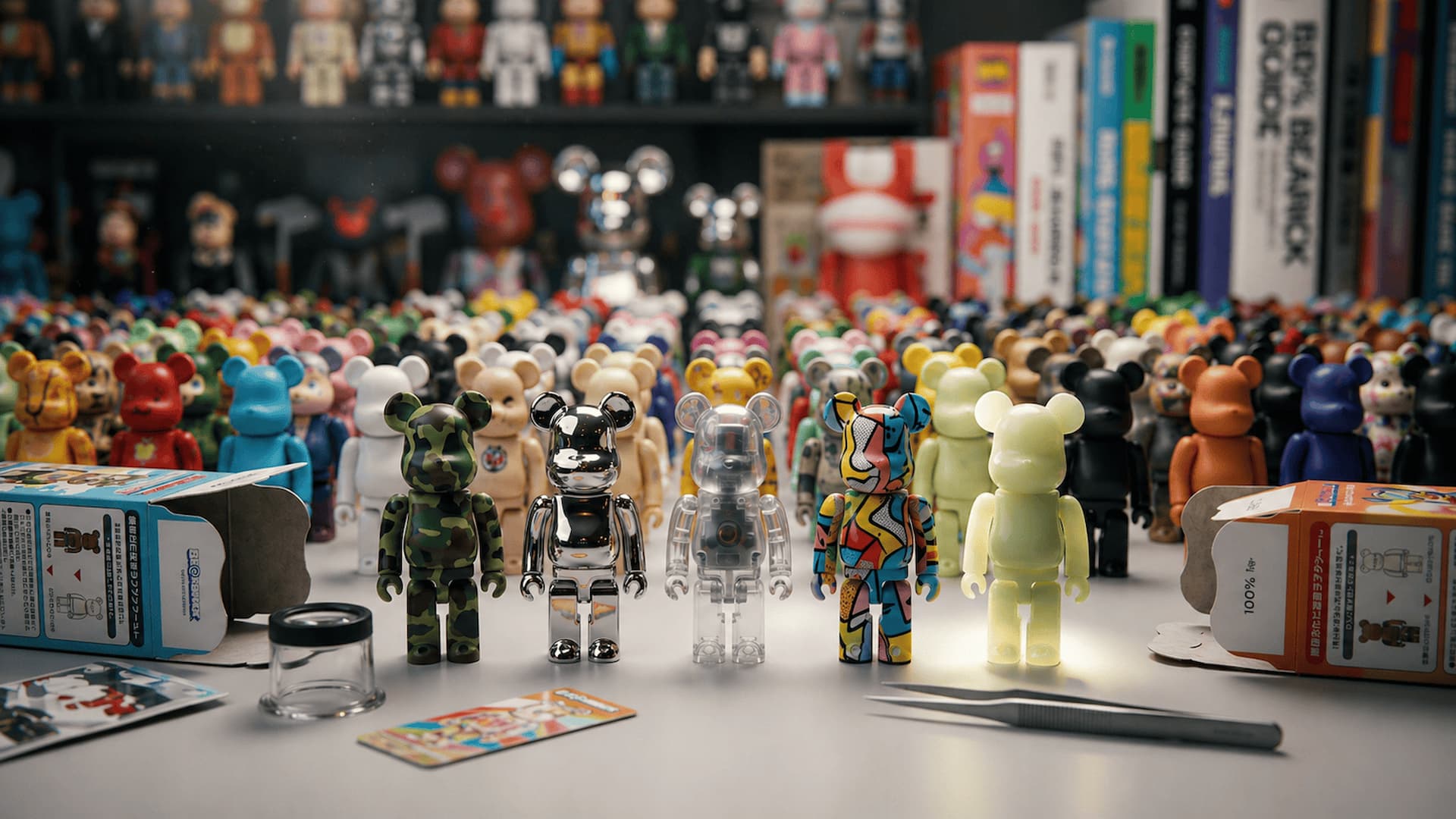
Seven Centimetres. Fifty Series. A Rabbit Hole With No Bottom.
The first Bearbrick was released on May 27, 2001, as a free gift to attendees of the World Character Convention in Tokyo. It was a simple white bear featuring the Bearbrick logo — a blue bear shape with a red @ enclosed within. It measured 70 millimetres tall. That measurement became the standard — the 100%.
Nobody kept it. Why would you? It was a handout at a convention, a piece of branded plastic nobody expected to see again. The people who pocketed one and forgot about it are probably still finding them in old jacket pockets somewhere in Tokyo. The people who kept them in the original sleeve, in a box, in a cool dark place — those people are now sitting on something with a very different value.
That’s the thing about the 100% Bearbrick. Seven centimetres tall, made of ABS plastic, sold in a sealed foil bag so you don’t know what you’re getting until you open it. At that size and that price point, it doesn’t demand to be taken seriously. And yet across more than fifty numbered series, two drops per year, and collaborations spanning Andy Warhol to Sonic the Hedgehog to the Hieronymus Bosch triptych from the Museo del Prado, it has built one of the most active collector communities in the designer toy world.
This is the complete guide to the 100% Bearbrick — what the series structure actually means, how rarity works, which figures matter, and why a 7-centimetre toy has developed a secondary market with its own economics.
What a 100% Bearbrick Actually Is
Before anything else, let’s get the basics right, because there’s genuine confusion around the percentage system.
The first Bearbrick measured 70 millimetres and became the 100% — the baseline. All subsequent sizes follow the same system: 400% is roughly four times the size (280mm), and 1000% is ten times (700mm).
The 100% is the format all Bearbrick series are built around. Every Bearbrick series is released in 100% form and sold in blind boxes — each box contains one figure, and the only way to know which you’ve received is to open it. The 400% and 1000% figures exist in series format too, but more sporadically, and they’re sold openly rather than blind. The 100% blind box is the heartbeat of the Medicom Toy release calendar.
There are two drops per year — a summer release and a winter release. Each series is consecutively numbered. As of 2025, Medicom reached Series 51. Fifty-plus series, twice a year, consistently, for over two decades. The discipline of that release calendar is part of what built the collector community — you always know when the next one is coming, even if you never quite know what will be in it.
Each series contains 24 unique figures. Each figure comes in a sealed foil bag with an artist card providing details about the specific bear inside. The card is part of the package — it provides context for the design, often with a small backstory about the character or collaboration, written in the slightly oblique style that Medicom Toy has maintained since the beginning.
The Category System: What You’re Actually Chasing
This is where most new collectors get lost, and where experienced collectors find their focus. Every 100% Bearbrick series is structured around recurring categories, each with a fixed rarity percentage built into the production. Understanding the categories is the foundation of collecting seriously.
Basic — The Letter Bears
Basic figures are solid-colour Bearbricks with a letter from the word “BEARBRICK” on their chest. There are nine varieties in each series, one for each letter. When you line them up correctly, they spell the word out. Basic is the most common category, appearing at a rate of 14.58% in a standard case.
The Basic bears are divisive in the collector community. Some people find them boring — a solid colour and a letter, minimal design, maximum frequency. Others build complete sets across multiple series, treating the colour progressions as a collection in themselves. The bubble gum pink from Series 45, the bold magenta from Series 50 — each Basic tells you something about what Medicom Toy was thinking about that season, even if the design is deliberately minimal.
The backstories on the artist cards are where Basic gets interesting. Medicom writes genuinely strange micro-fiction for each Basic figure — the Series 47 off-white tote bag Basic has a story about mountaineers and pepper spray that makes no obvious sense, and that’s entirely intentional. The cards have their own following among collectors who appreciate the absurdist writing alongside the figures themselves.
Jellybean — Translucent and Candy-Bright
Jellybean figures are solid-colour Bearbricks moulded in translucent plastic, appearing at a rate of 11.44% per case. They’re immediately recognisable — hold one up to light and it glows slightly, the translucent material catching and filtering what comes through. The name is accurate: they look like oversized sweets, and they come in whatever colour palette Medicom has chosen for that series.
Series 47’s Jellybean was a Konpeitou candy design — a Japanese confection in pastel shades. Series 46 used rice as its concept. Series 50 went light blue. The Jellybean is the category where Medicom can play freely with colour and material without the constraint of licensing or character design. The result is usually one of the most photogenic figures in each drop.
Pattern — All-Over Design
Pattern Bearbricks feature all-over printed designs ranging from classic polka dots to complex artistic patterns, with a rarity of 11.45%. The Pattern category has a significant history: early series featured designs by Charles Eames — yes, the Eames of the lounge chair — which gave the format an early connection to the design world that established its credibility beyond pure toy collecting.
Later Pattern figures have included Kintsugi (the Japanese art of repairing pottery with gold, applied across the bear’s surface), jungle prints, snowflakes, and graphic geometric designs that could pass as independent art prints. The Pattern category is where you’ll often find the most design-forward figures in a series, made for collectors who care about surface design as much as character.
Flag — National Colours on Bear Form
Flag figures represent different countries’ national flags at a rarity of 9.37%. Simple concept, clean execution: the bear is painted in the colours and pattern of whichever national flag Medicom has chosen for that series. Austria for Series 47 — red and white horizontal stripes. Ukraine for Series 46 — blue and yellow, a release that carried a specific weight given when it appeared.
Flag Bearbricks appeal to collectors who have personal connections to specific countries, which creates an interesting secondary market pattern: the rarity percentage is fixed, but the demand for any given flag is wildly variable depending on the collector base for that country. An Austrian flag Bearbrick trades differently in Vienna than it does in Tokyo.
Horror — Genre Cinema on Vinyl
Horror category figures are based on well-known horror films or other horror sources, appearing at 9.37% in each case. This is consistently one of the most anticipated categories among collectors who follow genre cinema. The Bearbrick format does something interesting to horror characters — the rounded, friendly silhouette creates contrast with disturbing source material that’s genuinely striking.
Series 47’s Horror entry was M3GAN from the 2022 film of the same name — the horror android translated onto the bear’s surface, maintaining the character’s unsettling doll-like precision. Previous Horror figures have included Beetlejuice, characters from The Boys, Emily the Strange, and other genre staples. Horror collectors and Bearbrick collectors form a surprisingly large intersection.
SF (Science Fiction) — Anime, Space, and Beyond
The Science Fiction category covers characters and themes from popular sci-fi franchises, appearing at around 9.37-10.41% per case. The range here is deliberately broad. SF can mean Hollywood blockbuster (Star Wars Stormtrooper, widely considered a landmark Series figure), Japanese anime (Ghost in the Shell’s Motoko Kusanagi in Series 47), or video game characters (Sam Porter Bridges from Death Stranding 2 in Series 50).
The anime collaborations are particularly significant for the Japanese market, where Bearbrick has its deepest roots. A Motoko Kusanagi Bearbrick bridges the collector communities for Ghost in the Shell and Medicom Toy in a way that appeals to both simultaneously. These tend to perform well on the secondary market because both fan bases are active.
Cute — Kawaii Culture Meets Collector Design
The Cute category, appearing at 13.54% — one of the higher rarity rates — covers figures capturing Japanese kawaii aesthetics. This is where Medicom Toy connects most directly to mainstream Japanese pop culture. Sonic the Hedgehog appeared in Series 46 under Cute, not SF. Series 50 included a patchwork teddy bear and a pastel-coloured Furby under the Cute theme. Monchhichi — a Japanese plush toy franchise that has been running since 1974 — made its Bearbrick debut in this category.
Hero — Superheroes in Bear Form
The Hero category, introduced in Series 21, covers DC Comics superheroes at a rarity of 7.29%. Batman and The Flash appeared together in Series 47, both maintaining recognisable design details within the Bearbrick’s rounded silhouette. The Hero category is one of the more recent additions to the standard series structure and has established its own collector following among DC fans who collect Bearbrick figures specifically for the character representation.
Artist — The Category That Changes Everything
The Artist category features designs by famous artists, adding high art to the collection. There are typically two Artist figures per series: the first at approximately 4.16% rarity and the second at 1.04% — the rarest standard category in the entire series.
This is where the 100% Bearbrick connects directly to the art world. Artist figures have included works by Jackson Pollock, Keith Haring, Jean-Michel Basquiat, and a collaboration with the Museo del Prado featuring Hieronymus Bosch’s triptych “The Garden of Earthly Delights” in Series 46. A reproduction of a 15th-century Flemish masterpiece, rendered on a 7-centimetre vinyl bear and packed in a sealed foil bag — that’s a sentence that should be stranger than it sounds.
Series 47’s Artist category included a figure based on the Metropolitan Museum of Art’s Auguste Renoir painting “A Young Girl with Daisies.” Series 47 also featured Jackson Pollock and the Japanese creative house LAND. The Artist category is where serious art collectors occasionally intersect with the Bearbrick world for the first time.
Secret and Super Secret — The Chase Figures
The Secret Bearbrick is a hidden figure not shown on the box or in any advertisements. These chase figures are the ultimate prize for Bearbrick hunters. The chance of getting a Secret figure is rated at 0.52% — the highest level of rarity in any standard series.
This single number — 0.52% — is the engine of the entire 100% blind box secondary market. A case of 24 blind boxes statistically contains approximately one Secret figure. Buy a single box and your odds are roughly 1 in 192. The Secret is announced only after the series launches, sometimes through collector forums, sometimes through Medicom Toy’s own channels. Until someone opens one and posts it, nobody knows what’s inside.
Series 50, the anniversary edition, included a particularly rare Commemorative Edition and a David Guetta Secret figure. The David Guetta reveal generated the kind of collector reaction that only figures with genuine cultural weight produce. Music fans who had never bought a Bearbrick started looking at secondary market pricing. Existing collectors who pulled one felt the specific satisfaction of a collector who found something genuinely valuable.
The Rarity Economics: Why a $15 Blind Box Turns Into a $300 Secondary Market Purchase
Understanding why 100% Bearbrick prices are what they are on the secondary market requires understanding how the production numbers and distribution work together.
Many retailers sell Bearbricks in blind boxes at a fixed price regardless of which figure is inside. Other retailers calculate the frequency of figures and sell them at prices that vary accordingly — the Basic figure at the lowest price (most common), the second Artist figure at the highest (rarest).
When a series sells out at retail, the secondary market takes over. Figures that were inside sealed foil bags for the same retail price now separate into dramatically different values based purely on which design was inside. A Basic from Series 51 might trade at or below retail on eBay or StockX. A second Artist from the same series might trade at 5x to 10x retail. A Secret, when authenticated, can trade at 20x retail or more depending on the design and collector interest.
Series releases happen twice yearly, summer and winter. Between releases, the secondary market for older series stabilises around documented rarity percentages. You can calculate, given a known production run and a known rarity percentage, approximately how many of any given figure exist. That number only decreases over time as figures are damaged, lost, or absorbed into permanent collections. The Secret from Series 42 is rarer in 2026 than it was in 2019. It will be rarer still in 2030.
For collectors who buy at retail: the system rewards patience and luck. Opening fifty blind boxes across multiple series, you’ll statistically land one Secret, about two second Artist figures, and a full range of everything else. Some collectors approach this systematically — buying full cases of 24, tracking what they pull, trading duplicates. Others buy singles, accepting the odds.
For collectors buying on the secondary market: you’re paying for certainty. You know exactly which figure you’re getting. The premium over retail reflects the value of that certainty plus the scarcity of figures that have left the original distribution channel.
The Most Significant 100% Bearbrick Series and Figures
Series 12 — The Andy Warhol Banana
One of the most historically significant 100% figures: the Andy Warhol Banana Bearbrick, featuring the banana artwork from The Velvet Underground’s 1967 debut album, appearing in Series 12’s Pattern category. It’s a figure that connects Warhol’s most recognisable pop art object, one of rock music’s most iconic album covers, and the Bearbrick format — three separate cultural references collapsed into 70 millimetres.
Series 42 — The Warhol and Basquiat Artist Category
Series 42 featured an Andy Warhol x Jean-Michel Basquiat 100% figure in the Artist category. The combination of two major estate collaborations in a blind box format, at a retail price accessible to any collector, made this one of the more widely discussed Series 42 releases. Finding the Warhol x Basquiat in a sealed box feels different from buying the same figure openly on the secondary market — the blind box format preserves the discovery element that some collectors value as much as the object itself.
Series 45 — Kintsugi Pattern
The Kintsugi Pattern Bearbrick is consistently cited by design-oriented collectors as one of the best executed Pattern figures in the series history. The concept — the Japanese art of repairing broken pottery with gold lacquer, making the repair itself the aesthetic — applied to the Bearbrick’s surface creates something that reads simultaneously as toy and art object. The gold repair lines crossing the bear’s body are visually exact. The concept is precise. It’s the kind of figure where Medicom Toy’s design intelligence is most visible.
Series 46 — Hieronymus Bosch and the Museo del Prado
Series 46, released in July 2023, featured a collaboration with the Museo del Prado in Madrid — Hieronymus Bosch’s triptych “The Garden of Earthly Delights” applied to a 100% Bearbrick as an Artist category figure. This is worth pausing on. The Prado is one of the world’s great art museums. Bosch painted the Garden of Earthly Delights approximately 500 years ago. Medicom Toy took that painting, licensed it with the museum, and put it on a 7-centimetre vinyl figure sold in a sealed foil bag for a few dollars. Either this is absurd or it is exactly what art in the 21st century looks like. Probably both.
Series 47 — Ghost in the Shell and Renoir
The Artist x Renoir figure from Series 47 — the Met collaboration putting “A Young Girl with Daisies” on a Bearbrick — and the SF category’s Motoko Kusanagi from Ghost in the Shell bracket two entirely different collector communities in the same series. Someone who bought Series 47 for the Ghost in the Shell figure might open a Renoir and not know what to do with it. Someone who bought for the Renoir might not know who Motoko Kusanagi is. The secondary market handles the redistribution.
Series 50 — The Anniversary
Series 50, released in July 2025, celebrated Medicom Toy’s 50th Bearbrick series with an impressive mix of pop culture, music, and nostalgia. Highlights included Young-Hee from Squid Game, Megan 2.0, HIDE by X JAPAN, Bring Me the Horizon, Monchhichi, Furby, Sam Porter Bridges from Death Stranding 2, and the David Guetta Secret figure.
Anniversary series tend to be more ambitious in their licensing scope, and Series 50 delivered on that — the combination of horror, gaming, music, nostalgia, and anime in a single series is a summary of everything the 100% format has tried to be across its history.
Series 51 — Iron Maiden and Chupa Chups
Released in December 2025, Series 51 included the iconic Eddie from Iron Maiden — an absolute must-have for metal fans — and colourful Chupa Chups designs adding retro playfulness. The Eddie figure is particularly significant: Iron Maiden’s zombie mascot, rendered at 70 millimetres, maintaining the specific visual details that make Eddie immediately recognisable to decades of metal fans. The collision of heavy metal album art iconography and the Bearbrick format is the kind of unexpected combination that defines what the series does best.
How to Collect 100% Bearbricks Without Getting Lost
The 100% Bearbrick world is big enough that you need a strategy. Here are the approaches that actually work.
Focus on a category. Trying to collect everything from every series is an expensive and eventually impossible project. Collectors who find genuine satisfaction tend to focus — all Horror figures across every series, or all Artist figures, or complete Basic sets in specific colour families. A focused collection has internal logic that a completist collection rarely achieves.
Understand which figures you’re chasing before you buy blind. The secondary market means you can always buy specific figures openly once a series has been released and collectors have documented its contents. Buying blind is a gamble that’s part of the experience for many collectors. Buying what you actually want, at the secondary market premium, is a different but equally valid approach.
Track the series structure. Knowing that Artist figures appear at 4.16% and 1.04% means knowing what secondary market pricing is likely to look like. Figures that appear at 1.04% in a case will trade at meaningful premiums. Figures at 14.58% will trade near retail. The rarity percentages are published by Medicom Toy — use them.
Store properly. A 100% Bearbrick in original foil packaging and with its collector card is worth more than the same figure loose. The card and packaging are part of the object. If you open blind boxes, keep everything — the foil, the insert, the card — alongside the figure.
Buy from authenticated retailers. The 100% Bearbrick market has counterfeit blind boxes, particularly for popular series. Sealed foil bags can be resealed. Authenticated retailer stock — distributors with Medicom Toy supply agreements — is the only guaranteed-original source at retail. On the secondary market, check that figures come with original cards and that the condition matches what’s represented.
The 100% Within the Larger Bearbrick World
The 100% figure is the entry point into the Bearbrick collector world for most people. It’s affordable enough to buy without serious deliberation, small enough to display anywhere, and varied enough across fifty-plus series that there’s always something you don’t have yet.
But it’s also the format that reveals the most about what Medicom Toy is actually doing. The 1000% Bearbrick is a statement piece — it commands space, demands attention, signals to visitors what you know and what you value. The 100% blind box is where the collecting logic lives. The randomness, the rarity percentages, the Artist category’s art world connections, the seasonal release structure, the secondary market that emerges from all of it — this is the format that built the community.
Collectors who want specific designs without the blind box risk can buy individual figures from retailers that calculate frequency and price accordingly, with the rarest figures at the highest prices and the Basic figures at the lowest. The market makes the rarity legible.
What it can’t make legible is why a Hieronymus Bosch painting, a Ghost in the Shell character, Eddie from Iron Maiden, a Japanese candy reference, and a David Guetta likeness can coexist in the same 24-unit case and make sense. But they do. That’s what fifty series of consistent, obsessive curation looks like when you put them all together.
Frequently Asked Questions
What size is a 100% Bearbrick?
A 100% Bearbrick measures 70 millimetres (7 centimetres / approximately 2.75 inches) tall. This is the baseline size from which all other Bearbrick percentages are calculated.
How many figures are in each 100% Bearbrick series?
Each series contains 24 unique figures across the standard categories. A full case of blind boxes contains 24 units — statistically one of each design, though the randomisation means duplicates are common.
What is a Secret Bearbrick?
A Secret Bearbrick is a hidden figure not advertised on the box or in promotional materials. It appears at a rate of 0.52% — statistically one per case of 192 units — making it the rarest figure in any standard series.
How often are new 100% Bearbrick series released?
Twice per year — a summer release and a winter release. Each is consecutively numbered.
Are 100% Bearbricks a good starting point for new collectors?
Yes. The price point is accessible, the categories help you understand what you’re chasing, and the blind box format adds the discovery element that many collectors find genuinely enjoyable. Starting with a current series in blind box form, then exploring the secondary market for specific figures from older series you want, is the standard path.
What’s the most valuable 100% Bearbrick?
Condition matters more than series number at this size. A Secret figure from a recent popular series in original sealed packaging with card is the upper end of 100% pricing. Artist category figures from well-documented artist collaborations (Warhol, Basquiat, Renoir at the Met) trade at meaningful premiums. First series Bearbricks — approaching twenty-five years old — command retrospective value if in clean condition.