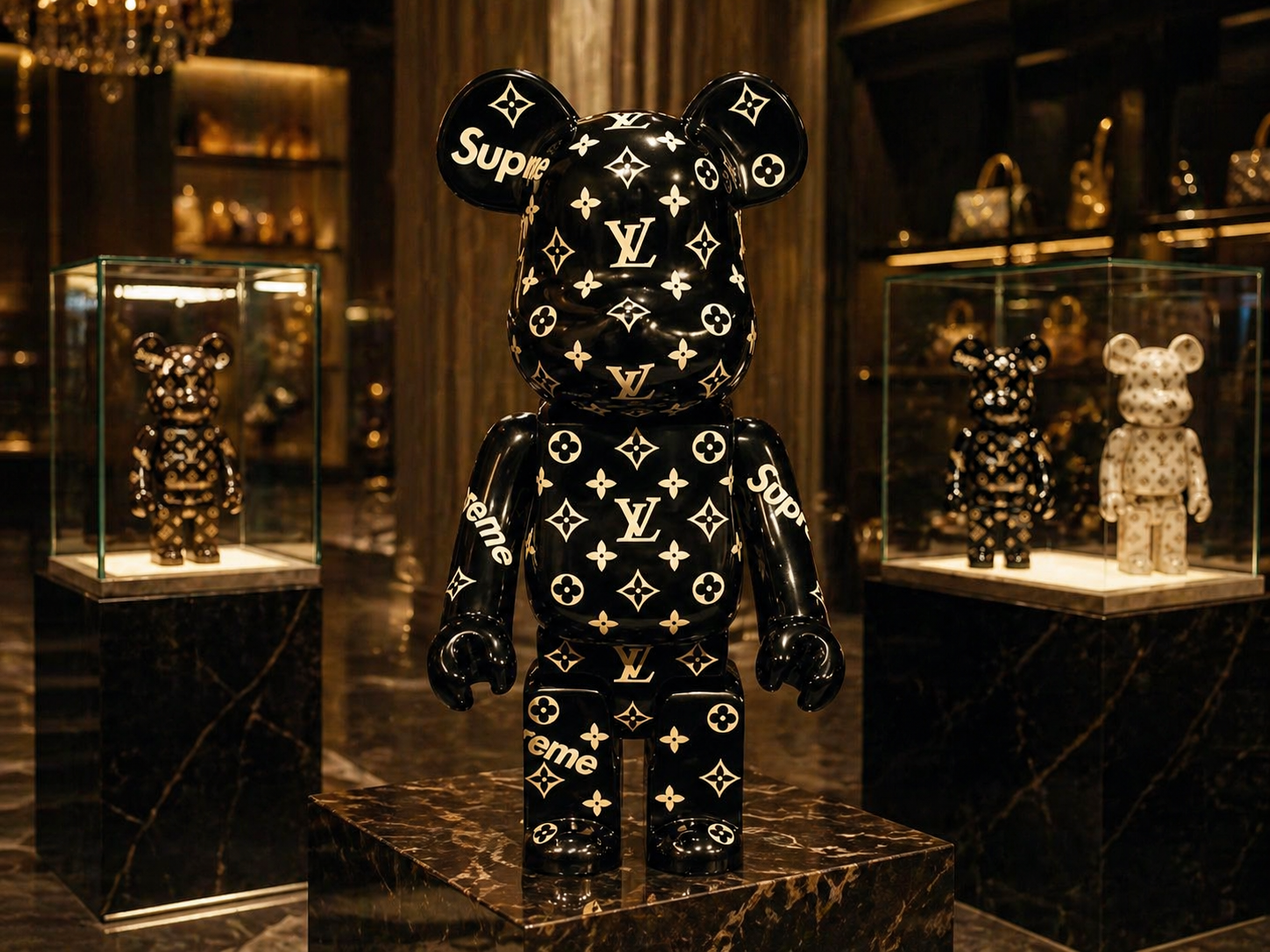
Two Icons, One Impossible Object
The Louis Vuitton Monogram was created in 1896 by Georges Vuitton as a tribute to his father and a shield against counterfeiters — a pattern of interlocking LV initials and stylised flowers, inspired by Neo-Gothic ornamentation and Japanese aesthetics. It was one of fashion’s earliest acts of brand defence. Georges didn’t invent it to be beautiful, exactly. He invented it to be unmistakeable.
One hundred and thirty years later, that pattern is on handbags in Tokyo, luggage in Dubai, sneakers in Paris, and — if you look hard enough — on a 70-centimetre vinyl Bearbrick that technically shouldn’t exist.
Here’s the thing about the Louis Vuitton Bearbrick: there is no official collaboration between Louis Vuitton and Medicom Toy. No numbered limited edition, no official release event, no authenticated production run with both logos on the box. What exists instead is something more complicated and, honestly, more interesting. A gap in the market — between what luxury fashion does officially and what collector culture does anyway — filled by custom artists, unofficial pieces, and a level of demand so consistent that it shows up in search data across multiple languages and markets every single month.
This article is about that gap. About why the Louis Vuitton Bearbrick is one of the most searched objects in the designer toy world despite not officially existing. About what the LV monogram does when it lands on a vinyl bear. About the history of two institutions — one founded in Paris in 1854, one in Tokyo in 1996 — that have never formally worked together but belong in the same conversation.
And about what that means for collectors who want one.
Why Louis Vuitton and Bearbrick Belong Together
Before getting into what actually exists in the market, it’s worth sitting with the question of why this pairing feels so inevitable.
Marc Jacobs arrived as Louis Vuitton’s first creative director in 1997 and ushered the monogram into a more provocative cultural life through artist collaborations, beginning with Stephen Sprouse’s spring 2001 graffiti bags. That move — taking a 100-year-old luxury symbol and letting a downtown New York artist draw all over it — was the moment Louis Vuitton decided that its identity was strong enough to absorb disruption. Strong enough to be played with.
Jacobs attributed the success of these designs to their being “disrespectful and respectful at the same time.”
That phrase could describe the Bearbrick format itself. A vinyl toy shaped like a cartoon bear, wearing Chanel’s pearls or KAWS’s X-eyes or Supreme’s red box logo — the format is simultaneously irreverent toward its source material and deeply respectful of it. The whole point is the tension between the prestigious and the playful.
Louis Vuitton understood this tension earlier than most luxury houses. In 2003, Takashi Murakami was invited to reinterpret the Monogram Canvas, introducing the Multicolore Monogram in 33 vibrant colours. The collaboration generated sales of several hundred million dollars. A Japanese pop artist turning the brown and beige monogram into a rainbow. Disrespectful and respectful at the same time.
Later collaborations included Richard Prince in 2008, Yayoi Kusama in 2012 and again in 2023, and Jeff Koons in 2017, who used the Masters series to add his pop spin on the LV initials.
In 2017, Louis Vuitton partnered with Supreme — a streetwear brand — which was groundbreaking, merging the worlds of high fashion and street culture and injecting Supreme’s red and white brand identity directly into the Monogram.
Every one of these collaborations is essentially a version of the same idea: take the most recognised luxury symbol in the world, give it to someone from outside luxury, and see what happens. Each time, the monogram survives. Each time, it becomes more culturally loaded than it was before.
A Louis Vuitton Bearbrick is the logical endpoint of that trajectory. A Japanese designer toy company, born the same decade Jacobs arrived at LV, making the same argument about the relationship between high culture and collector culture that Murakami and Sprouse and Supreme made through canvas and clothing. The collaboration doesn’t officially exist. But the idea of it is completely coherent.
What the LV Monogram Does on a Bearbrick
The visual logic here is specific and worth spending a moment on.
The LV monogram is so identifiable today that almost no one says Louis Vuitton anymore, they say LV. The pattern functions as a standalone language — you don’t need the brand name to know what you’re looking at. Put four LV monogram tiles on a surface and it communicates immediately, regardless of whether that surface is a canvas bag, a sneaker, or a vinyl toy.
The Bearbrick’s rounded surface is particularly well-suited to all-over pattern designs. The monogram was designed for trunks and bags — three-dimensional objects with curved surfaces and edges. It wraps. It tiles. It doesn’t need a flat rectangle to work. When you see the classic brown and beige LV pattern flowing across a Bearbrick’s chest, arms, and head, it reads immediately because the monogram was built to do exactly this kind of thing — cover a surface completely and remain legible.
The Damier check — LV’s other signature pattern, the brown and tan or grey and white grid — works on the Bearbrick for different reasons. The grid is inherently geometric, which plays off the Bearbrick’s angular joints and rounded panels in an interesting way. Where the monogram flows, the Damier sits. Two different visual arguments about what the LV universe looks like on a toy.
The multicolour Murakami version — if it were ever to appear on a Bearbrick officially — would be the most visually dramatic. Thirty-three colours in the monogram pattern, wrapping a 70-centimetre figure. It would be immediately recognisable from across a room. This is exactly why the demand exists even in the absence of an official product.
The Market That Formed Anyway
Here is what actually exists when you search for a Louis Vuitton Bearbrick in 2026.
Custom artist pieces. Several artists have built practices around creating LV-themed Bearbricks using authentic Louis Vuitton materials — vintage towels, canvas offcuts, fabric sourced from deconstructed LV products. Artists like Etai Droi have produced 1000% figures made from authentic Louis Vuitton Vintage Towels, each one described as a limited edition handcrafted object. These are not counterfeit products in the conventional sense — they’re art objects using real LV materials, closer in spirit to the kind of fabric art that sits at the intersection of fashion and collectible culture. They come with certificates from the artist, not from Medicom Toy or Louis Vuitton, and they’re priced accordingly.
Custom-painted figures. A different category: standard Medicom Toy Bearbrick blanks painted or printed with LV-inspired patterns. These range enormously in quality, from skilled custom artists who produce objects genuinely worth collecting to cheap knock-offs using inaccurate monogram reproductions. The distinction matters both aesthetically and commercially. A well-executed custom on an authentic Medicom base is a different thing from a mass-produced copy on a generic vinyl figure.
Unofficial fantasy releases. The Supreme x Bearbrick x Louis Vuitton concept appears regularly on Pinterest, in street art contexts, and in digital renders — three-way collaborations that exist as images rather than objects. These function as a kind of cultural speculation: what would this look like if it existed? The images circulate because people respond to them. The response is the evidence of demand.
The secondhand authentication problem. The absence of an official product creates a specific authentication challenge. There’s no authorised source to verify against, no official documentation, no factory specifications. When someone sells a “Louis Vuitton Bearbrick” without being explicit about whether it’s a custom artist piece, an unofficial manufacture, or something else entirely, the buyer is working without the usual collector tools. This is the most significant practical issue for anyone interested in acquiring one.
Louis Vuitton’s Real Relationship With the Collector World
To understand why an official LV x Medicom collaboration would make complete sense — and why it hasn’t happened yet — you need to understand how Louis Vuitton has historically engaged with the collector and designer toy space.
The Monogram has appeared on Vivienne dolls, pinball machines, popcorn boxes and pétanque sets, proving that true icons never stand still. Louis Vuitton is not a brand that avoids unusual objects. It has produced skateboard decks, chess sets, ping-pong tables, and a football for the 2022 World Cup. The idea that it would avoid a designer toy format is not supported by its behaviour.
The Murakami Multicolore Monogram, introduced in 2003, generated sales of several hundred million dollars and redefined what luxury could look like in the 21st century. Murakami was already established in Japan’s designer toy and collectible figure world before the LV collaboration — his figures and prints were part of the same collector culture that Medicom Toy was building simultaneously in Tokyo. The conceptual distance between a Murakami x LV bag and a Murakami-aesthetic Bearbrick is smaller than most people realise.
Virgil Abloh, who became Louis Vuitton’s Men’s artistic director in 2018, came from a world explicitly adjacent to streetwear collecting, sneaker culture, and designer toys. His Off-White brand had collaborated extensively with Nike, with Jordan Brand, with figures from the streetwear world that overlapped heavily with the Bearbrick collector community. Under Abloh, Louis Vuitton produced objects and experiences aimed at exactly the collector demographic that buys limited edition Bearbricks. His tragically early death in 2021 removed the person most likely to have formally connected these worlds.
Nicolas Ghesquière, LV’s current Women’s creative director, has shown less interest in the streetwear and toy collector space. But the brand’s Men’s division, under various creative directions since Abloh, continues to engage with the collector culture that produces demand for a Louis Vuitton Bearbrick. The infrastructure for the collaboration exists. The demand clearly exists. The official product doesn’t yet.
The Chanel Comparison: What an Official LV Bearbrick Would Mean
The closest reference point is the Chanel Bearbrick — designed by Karl Lagerfeld in 2006, produced in an edition of approximately 1,000 numbered figures, and now trading on the secondary market at prices between $8,000 and $62,000 depending on condition and provenance.
The Chanel Bearbrick became what it is because of three factors working simultaneously: genuine scarcity (only 1,000 pieces), a specific historical moment (it was the first luxury fashion house to use the Bearbrick format), and a creative authority behind it (Lagerfeld designed it himself, which means it carries his specific vision rather than a licensing team’s approximation).
An official Louis Vuitton Bearbrick would enter a different environment — one where the Chanel figure already exists as the reference point, where the secondary market for luxury fashion Bearbricks is established, and where collector awareness of Medicom Toy’s luxury collaborations is significantly higher than it was in 2006.
It would also benefit from Louis Vuitton’s existing relationship with artist collaborations. The brand has demonstrated, across twenty-five years of Murakami, Kusama, Koons, and Supreme, that it knows how to take its visual identity and hand it to someone else without losing what the monogram means. A Bearbrick collaboration could follow the same logic: give Medicom Toy the monogram, or give a specific artist the brief, and let the format’s logic do the rest.
What would it be worth? The Chanel figure, at $8,000–$62,000 for an edition of 1,000, is the data point. A Louis Vuitton Bearbrick from an official collaboration, designed with the creative authority of the house behind it, in genuinely limited numbers — the collector market would price it at least comparably. Possibly more, given that Louis Vuitton has a broader global recognition than Chanel in several key markets, particularly in Asia, where the Bearbrick secondary market is most active.
Custom Art Bearbricks and the Ethics of the Unofficial Market
The existence of a robust unofficial market for Louis Vuitton Bearbricks raises questions worth addressing directly, because collectors navigating this space deserve clarity.
There are three meaningfully different categories of object and the ethical and legal status of each is different.
Artist-made objects using authentic LV materials. When an artist sources genuine Louis Vuitton fabric, canvas, or other materials — either vintage or otherwise — and uses those materials to create a custom Bearbrick, the resulting object occupies an interesting legal and artistic space. The artist is not counterfeiting LV products; they’re making something new from existing materials. The Bearbrick base, if purchased authentically from Medicom, carries its own legitimacy. The combination is an original art object. These pieces carry the artist’s own documentation and value proposition, not a false claim to being an official collaboration.
Custom-painted Bearbricks inspired by LV aesthetics. An artist who paints a Bearbrick in a pattern inspired by the LV monogram, but doesn’t use actual LV materials or falsely claim an official collaboration, is making art. The line gets blurry if the reproduction is close enough to the actual monogram to constitute trademark infringement, but the concept of artist interpretation is well-established. These objects should be presented honestly and priced according to the artist’s skill and the object’s actual nature.
Counterfeits presented as official collaborations. Objects sold with false claims of being an official Louis Vuitton x Medicom Toy collaboration — with fabricated documentation, fake box designs claiming both logos, or explicit misrepresentation — are a different matter entirely. These are fakes in the meaningful sense, and the consequences for buyers are both financial and legal if they attempt to resell claiming authenticity.
The practical advice: if you’re interested in a Louis Vuitton Bearbrick, understand exactly what you’re buying. An artist custom with honest documentation is a legitimate collector object. A fake official collaboration is a problem. Know which you’re looking at before you spend.
The Collector Psychology: Why People Want the Thing That Doesn’t Exist
There’s something interesting in the persistent demand for an unofficial Louis Vuitton Bearbrick, and it’s worth examining rather than just noting.
Part of it is simple: two globally recognised brands whose visual identities work together, in a format that has established itself as the meeting point of fashion, art, and collector culture. The conceptual fit is obvious. When something is obviously a good idea and hasn’t been done officially, collectors fill the gap with imagination and then with purchases.
But there’s another layer. The Louis Vuitton monogram has always functioned as a signal — of taste, of resources, of cultural positioning. The same is true of a serious Bearbrick collection. Someone who owns a Chanel Bearbrick, a KAWS Dissected Companion, and a 1000% BAPE Shark Hoodie is communicating something specific about their relationship to fashion, art, and collector culture simultaneously. An LV Bearbrick fits that communication perfectly.
The absence of an official product also creates a specific collector psychology: the thing you want but cannot buy officially is always more desirable than the thing you can. The gap generates desire. Every time a collector searches for a Louis Vuitton Bearbrick and doesn’t find an official product, the desire for one increases. This is not a niche phenomenon — it shows up consistently in search data across multiple markets and multiple languages.
When the official product eventually exists — and it is a when, not an if, given the cultural logic — the demand will be enormous and the secondary market premium will be immediate.
What to Look For If You’re Collecting Now
Given that official LV x Medicom figures don’t exist, what does a serious collector do?
The most intellectually honest approach is to collect artist custom pieces from documented, transparent sources. Artists who produce LV-themed Bearbricks using authentic materials, who sign their work, who provide their own certificates of authenticity, and who don’t misrepresent the objects as official collaborations — these are making legitimate collector objects that occupy a clear and honest space.
The evaluation criteria for these pieces are different from standard Bearbrick authentication:
Artist track record. What has this artist made before? Is there a documented history of work? Do they have a consistent practice and a collector base that has verified their pieces? An artist whose custom Bearbricks appear in documented private collections is different from an anonymous seller on a secondary marketplace.
Material authenticity. If the piece uses actual LV materials, can those materials be verified? Vintage Louis Vuitton canvas and fabric have specific characteristics — material weight, pattern precision, hardware details — that experienced collectors can evaluate. An artist claiming to use authentic LV vintage towels in a 1000% figure should be able to demonstrate those materials convincingly.
Honest documentation. The certificate should come from the artist, not claim to be from Medicom Toy or Louis Vuitton. It should document what the piece is, who made it, and what materials were used. This is honest documentation. A certificate falsely claiming official collaboration status is a red flag.
Price relative to what it actually is. A custom artist piece is worth what the artist’s work is worth, plus the material value, plus any collector premium for the artist’s reputation. It is not worth what an official Medicom Toy x LV collaboration would be worth, because it isn’t that. Sellers pricing customs at official-collaboration levels are either confused about what they have or hoping buyers will be.
The Broader Luxury Fashion Bearbrick Landscape
The Louis Vuitton gap exists within a larger picture of how luxury fashion has engaged with the Bearbrick format.
Chanel led, in 2006. The figure exists, it’s authenticated, it’s traded actively on major platforms. Hermès followed — one of the rarest fashion house collaborations in Bearbrick history, produced as part of a charity auction alongside other luxury brands. Fendi has appeared in the Medicom Toy catalogue. Comme des Garçons has collaborated repeatedly.
The Medicom Toy collaboration list includes Chanel, Fendi, Supreme, Comme des Garçons, and others in the streetwear and fashion world. Louis Vuitton is conspicuously absent from that list, which makes its absence both more notable and more interesting. The other major luxury houses have crossed into Medicom Toy’s world. LV has not, officially, despite being the luxury brand most aligned — through its history of artist collaborations, its engagement with streetwear culture, and its global recognition in the markets where Bearbrick is most actively collected — with doing exactly that.
The Fendi Bearbrick is documented. The Comme des Garçons figures are available. The Chanel 1000% sits in private collections across Europe, Asia, and the US and trades at five-figure prices. Louis Vuitton is the biggest name in luxury fashion. Its absence from the official Medicom Toy catalogue is anomaly, not inevitability.
Frequently Asked Questions
Is there an official Louis Vuitton Bearbrick?
No. As of 2026, there is no official collaboration between Louis Vuitton and Medicom Toy. No official LV Bearbrick has been produced, announced, or distributed through either company’s channels. What exists are custom artist pieces, unofficial figures, and significant market demand for an official product that does not yet exist.
What are Louis Vuitton Bearbricks that appear for sale?
These are typically either custom artist pieces made from authentic LV materials, custom-painted figures inspired by LV aesthetics, or unofficial mass-produced items. None are official Medicom Toy x Louis Vuitton collaborations. Understanding which category a piece falls into is essential before purchasing.
Why is there so much demand for an LV Bearbrick if it doesn’t officially exist?
The visual and cultural fit between Louis Vuitton and the Bearbrick format is obvious — two globally recognised visual languages that work together naturally. The absence of an official product doesn’t suppress demand; if anything, it amplifies it. Collectors want the thing they can’t officially have.
Which luxury fashion Bearbricks do officially exist?
The Chanel Bearbrick (2006, ~1,000 numbered pieces, designed by Karl Lagerfeld) is the most significant official luxury fashion Bearbrick. Hermès, Fendi, and Comme des Garçons have also appeared in the Medicom Toy catalogue. Hermès examples are among the hardest to find.
Would an official LV Bearbrick be valuable?
Based on the Chanel Bearbrick precedent — currently trading at $8,000 to $62,000 for authenticated examples — an official Louis Vuitton Bearbrick from a genuine collaboration, produced in limited numbers with creative authority behind the design, would likely command comparable or higher secondary market prices given Louis Vuitton’s broader global recognition.
How do I avoid buying a fake?
Understand precisely what you’re purchasing. Official-looking documentation claiming a Medicom Toy x Louis Vuitton collaboration is false documentation — no such official collaboration exists. Custom artist pieces are legitimate if sold as such, with honest artist documentation rather than false official credentials. When in doubt, consult established dealers or platforms with authentication guarantees.