A Kid in Hong Kong and 99 Action Figures That Changed Everything
Michael Lau was born in Hong Kong in 1970, at the peak of the city’s industrialisation, when it was exporting toys to chain stores around the world. As a child he collected every toy he could get his hands on. After graduating from art school in 1992 he made paintings, held exhibitions, kept working. Then in 1999 he did something nobody had done quite the same way before.
He merged his creativity and passion for art, toys and action figures and created the Gardener series — 99 twelve-inch action figures juxtaposing G.I. Joe figures with street culture, shown in a solo exhibition at the Hong Kong Arts Centre.
Ninety-nine pieces. A solo show. Street style applied to the kind of figures kids played with. Nothing about this sounded like a revolution.
But the people who saw those figures understood immediately that something had shifted. The objects were simultaneously toys and not toys. Too expensive to play with, too deliberately designed to ignore, too specific in their references to the world outside any gallery to belong purely inside one. Collectors massed, a market sprouted, and other art toy creators — Eric So, Jason Freeny, Kidrobot, and eventually KAWS — followed.
That was 1999. Today, Pop Mart’s valuation recently hit $40 billion, eclipsing giants like Hasbro and Mattel, with annual sales climbing to approximately $1.8 billion in 2024. The designer toy market has a dedicated presence at Sotheby’s. KAWS sells paintings at auction for millions of dollars. Medicom Toy’s Bearbrick appears in private collections alongside Warhols and Basquiats.
Whatever Michael Lau started in Hong Kong with 99 action figures has not stayed small.
What a Designer Toy Actually Is
Before tracing how this market developed, it helps to be clear about what the term actually means — because it gets used loosely.
Art toys, also called designer toys, are toys and collectibles created by artists and designers that are either self-produced or made by small, independent toy companies, typically in very limited editions. Artists use a variety of materials such as ABS plastic, vinyl, wood, metal, latex, plush, and resin. Creators often have backgrounds in graphic design, illustration, or fine art.
The key distinction from standard toys is authorship. A mass-market toy is designed by committee to appeal to the broadest possible audience, produced in the millions, and priced to be disposable. A designer toy is made by a specific person with a specific vision, produced in limited quantities, and priced — in some cases — like the art object it is. The manufacturing process is often the same: injection-moulded vinyl, the same material as children’s toys. But the intent, the edition size, the distribution, and the cultural context are entirely different.
The underlying ideas behind the designer toy movement have largely remained the same since they were first introduced in Asia in the mid-1990s: create a character that would be popular with kids, and twist it into something more edgy, more adult. Then curb availability by releasing limited editions — make them precious.
That last phrase is the whole business model. Scarcity creates desire. Desire creates a secondary market. The secondary market creates documentation of value. Documentation of value attracts serious collectors. Serious collectors attract auction houses. And the whole thing feeds back on itself.
The Origins: Hong Kong, Japan, and the Birth of Urban Vinyl
The first art toys appeared in the 1990s in Hong Kong and Japan. The cultural conditions that produced them are specific and worth understanding.
Hong Kong in the 1990s was a city in transition — British colonial rule ending, handover to China approaching, a generation of artists processing what their identity meant in that context. The street culture that had been absorbing influences from American hip-hop and skateboarding had developed its own distinct flavour: technically accomplished, fashion-conscious, referencing both Eastern and Western visual traditions simultaneously.
The urban vinyl trend was initiated by artist Eric So and Michael Lau, who first created urban vinyl figures in Hong Kong in the late 1990s. The term “urban vinyl” captures something important: these weren’t figures that came from the toy industry tradition. They came from urban culture — from the streets, the music, the fashion, the graffiti — and they used vinyl as their medium because vinyl was cheap enough to produce in small quantities and durable enough to display.
Japan was developing its own parallel tradition. Origins of designer toys can also be traced to Japan, where artists like Takashi Murakami and Yoshitomo Nara started producing vinyl figures based on their own characters and styles. These figures were influenced by Japanese subcultures of kawaii, otaku and anime, as well as by the American pop art movement of the 1960s and 1970s.
The two strands — Hong Kong’s urban street tradition and Japan’s kawaii and otaku culture — fed each other. Artists were travelling between cities, attending toy fairs, seeing each other’s work. The internet was beginning to make collector communities global rather than local. What had been a niche activity in a few Asian cities started to become a worldwide conversation.
The Pivotal Figures: Who Built This World
Michael Lau — The Godfather
Known as the Godfather of Designer Toys, Michael Lau is widely credited as the founder of the urban vinyl style within the designer toy movement. His work has had a significant effect on toy manufacturers as well as street culture including artists and musicians throughout the world.
At his exhibition at Christie’s Hong Kong in 2018, after more than twenty years in the field, Lau made the statement that captures everything about this movement: “All art are toys, all toys are art.”
That’s not a clever marketing phrase. It’s a genuine position about what these objects are and what they do. A toy that you never play with, that you display on a shelf or in a glass case, that appreciates in value and eventually gets sold at auction — at what point does it stop being a toy? Lau’s answer is that the question is wrong. The categories were never as separate as we thought.
KAWS — The Bridge Between Worlds
KAWS, born Brian Donnelly in 1974 in Jersey City, New Jersey, is a world-renowned artist whose work straddles the line between fine art and global commerce. In 1999, his career took a significant turn when he visited Japan at the invitation of Bounty Hunter, a cult toy and streetwear brand. It was during this trip that he created his first toy, the Companion, which became an instant hit in the global art toy collecting community.
KAWS represents the moment the designer toy crossed from collector culture into the mainstream art market. His figures — particularly the Companion, with its X-eyes and rounded silhouette — had been selling to collectors for years when Sotheby’s started paying attention. When The KAWS Album sold at Sotheby’s Hong Kong for $14.8 million in 2019, it wasn’t just a moment for KAWS. It was a signal to the entire art market that the objects produced by this tradition had arrived somewhere new.
In May 2017, when the MoMA Design Store released a series of 11-inch vinyl Companions for $200 apiece, the flood of traffic crashed their website. The Museum of Modern Art selling designer toys. Sotheby’s handling multimillion-dollar KAWS paintings. These things would have been inconceivable when Michael Lau showed his Gardener figures in Hong Kong in 1999.
Takashi Murakami — The Art World Crossover
Murakami occupies a specific position in this history because he came from the fine art world rather than from street culture or toy collecting. His Superflat movement — which argued that the hierarchy between high art and popular culture was itself an artificial Western imposition — gave the designer toy movement intellectual and critical legitimacy it might not have claimed for itself.
Takashi Murakami, a Japanese artist known for his colourful and playful designs, contributed significantly to the designer toy movement, often blending fine art with pop culture. His Bearbrick collaborations with Medicom Toy, his figures produced through his own Kaikai Kiki company, and his relationship with Louis Vuitton — which put his work on luxury bags sold globally — all demonstrated that the line between designer toy and fine art was genuinely permeable.
Paul Budnitz and Kidrobot — The Western Translation
Inspired by what he had seen in Tokyo and at toy conventions in Hong Kong, Paul Budnitz founded Kidrobot in 2002. The manufacturing process for vinyl toys, in which moulds degrade over time, presented an opportunity to create limited-edition collectibles — making the toys from plastic kept production costs low and price points accessible.
Kidrobot translated the Hong Kong and Tokyo designer toy tradition into something accessible to Western collectors. The Dunny — an anthropomorphic rabbit figure used as a blank canvas for artist collaborations — and the Munny — the same concept sold unpainted for collectors to customise themselves — created a format that invited participation rather than just collection. You could own a Dunny covered in a specific artist’s design, or you could buy a blank and become the designer yourself.
Through toy brands, artists can design the same character in different sizes that sell for different price points, from the standard 8-inch figure under $100, to a 3.5-inch mini at $10-$15, to a mystery blind box for $5-$10. This tiered pricing was crucial. It meant that the same collector community could contain someone spending $10 and someone spending $10,000, both engaging with the same artists and the same culture.
Medicom Toy and the Bearbrick Phenomenon
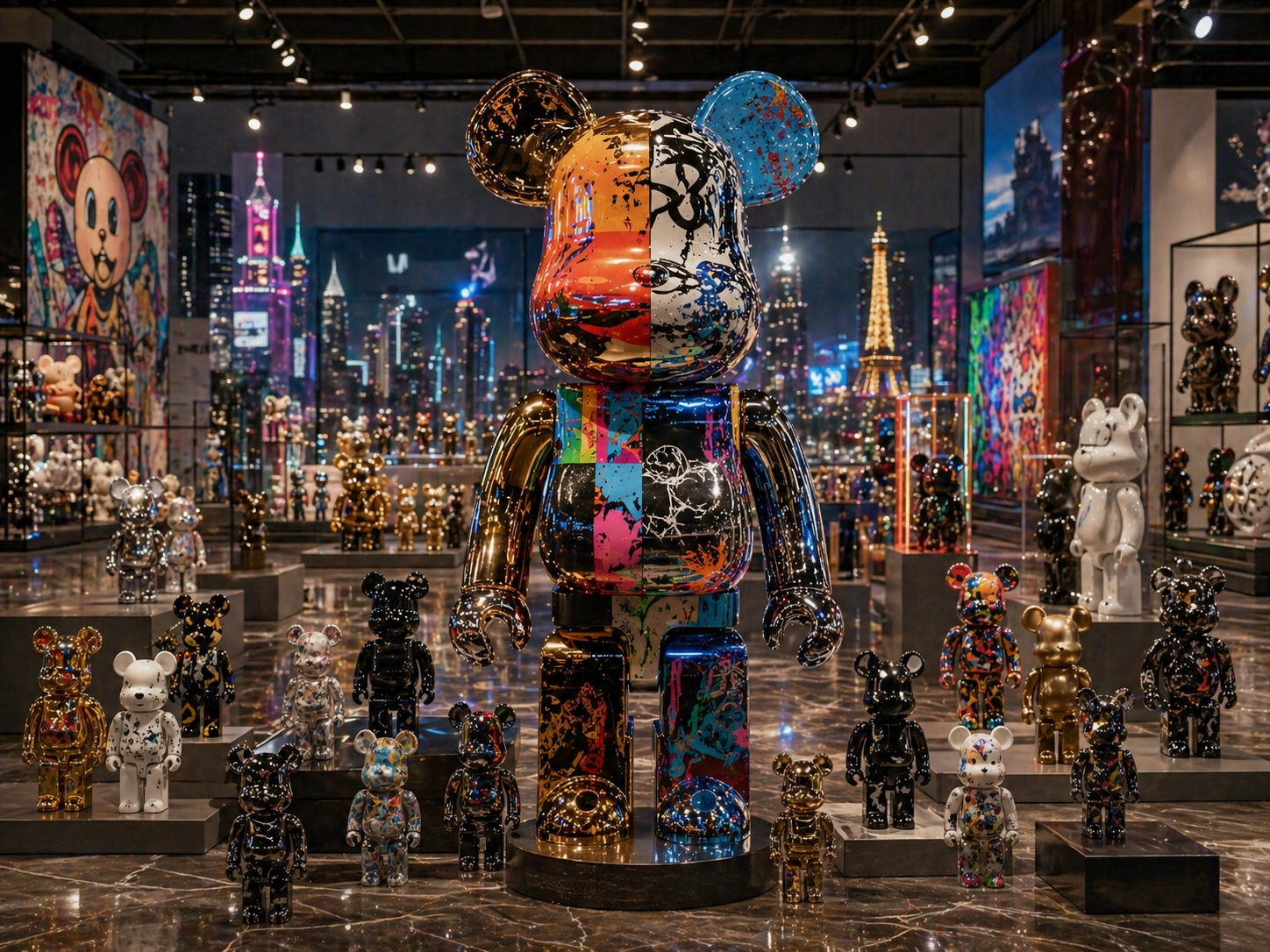
No account of designer toys is complete without Medicom Toy and the Bearbrick. Founded in Tokyo in 1996 by Tatsuhiko Akashi, Medicom Toy took the designer toy format and turned it into the most systematic and globally recognisable collectible figure format in the world.
The Bearbrick launched in 2001 as a free giveaway at a Tokyo convention. By 2026 it has become the format through which some of the most important collaborations in the designer toy world have been produced. Chanel. KAWS. Andy Warhol. Keith Haring. BAPE. Supreme. Jean-Michel Basquiat. Karl Lagerfeld designed one. Medicom Toy has collaborated with the Warhol Foundation, the Keith Haring Foundation, and the estates of Basquiat.
What makes the Bearbrick format interesting from a designer toy perspective is how deliberately it functions as a blank canvas. The figure’s rounded, simplified form imposes constraints that force designers to work within a consistent visual language. Every KAWS Bearbrick is still recognisably a Bearbrick. Every Chanel Bearbrick is still recognisably a Bearbrick. The format persists through the collaboration rather than being overwhelmed by it.
This is why the Bearbrick has become the reference point for the whole designer toy conversation with the luxury fashion world. It was the format that Chanel chose in 2006 — the first luxury fashion house to work with Medicom Toy — and the precedent that figure set has shaped how every subsequent fashion-designer toy collaboration has been evaluated.
Blind Boxes: The Mechanics of Desire
One of the most powerful and most discussed mechanics in the designer toy world is the blind box — a sealed package whose contents are unknown until opened.
Medicom Toy uses it for their Series Bearbricks, where twenty-four figures with different rarity levels are produced for each release and sold in sealed packaging. You might get a common Basic figure or a Secret figure appearing at 0.52% probability. The uncertainty is the product. Pop Mart has built an entire company around this mechanic.
Pop Mart tapped into something simple but powerful: the thrill of surprise. The blind box format made buying toys feel like an experience, not just a transaction. That sense of discovery, paired with strong in-house IP development and a savvy retail strategy including vending machines and vibrant store displays, turned toys into lifestyle products.
The psychology is worth examining directly because it explains a lot about why the designer toy market has grown the way it has. The blind box mechanic borrows from trading card collecting — the same thrill of not knowing whether you’ll pull the rare card — but applies it to three-dimensional objects designed by artists. The surprise is not just which card you pulled but which character, in which colourway, designed by which person you specifically wanted.
Pop Mart’s digital membership ecosystem had over 46 million registered users as of December 2024, accounting for approximately 90% of total sales. Forty-six million people with accounts linked to a company that makes designer toys. This is not a niche hobby anymore.
Labubu and the New Wave: 2024 and Beyond
The designer toy world in 2024 and 2025 was dominated by one story: Labubu.
Labubu began as an “ugly-cute” elf-like character created by artist Kasing Lung in 2015, and was first released as a collectible toy in 2019. A key catalyst for its explosion was celebrity endorsements — BLACKPINK’s Lisa showed off a Labubu bag charm on social media in April 2024, sparking a viral trend among her 100+ million followers.
Pop Mart’s revenue doubled in 2024 to nearly $2 billion, driven largely by Labubu’s fame. In the first half of 2025, sales absolutely skyrocketed: revenue hit 13.88 billion yuan, up 204% year-on-year, while net income rose even faster — up 397%.
The most expensive Labubu doll sold at auction was a life-sized piece that fetched over $170,000 at auction in June 2024. The same dynamic that turned KAWS figures from collector objects into auction house lots is playing out again, faster and at larger scale, with a plush toy designed by a Dutch artist living in Hong Kong and produced by a Chinese company that was founded in 2010.
What Labubu represents in the broader designer toy story is interesting. It’s not a vinyl figure in the tradition Michael Lau established. It’s a plush toy — a different material, a different aesthetic, a different collector demographic. Kasing Lung’s character, with its mischievous expression and art toy credibility, taps into a mindset where collecting is less about nostalgia and more about aesthetics and personal identity. The “ugly-cute” aesthetic — figures that are deliberately slightly wrong, slightly unsettling, that create a tension between attractive and disturbing — is its own tradition within designer toys, one that KAWS explored with the Companion and that Labubu has brought to a global mass audience.
The Collector Market: From Hobby to Investment
The transition of designer toys from hobby to investment asset is one of the more significant cultural developments of the past decade. It didn’t happen suddenly. It happened through a series of moments that each shifted the perception of what these objects were.
The Sotheby’s KAWS sale in 2019 was one. The Chanel Bearbrick trading at $62,000 on StockX is another. The $170,000 Labubu auction result is a third. Each time an object from the designer toy world reaches a price point associated with the fine art market, the category gets more serious attention from collectors who had previously ignored it.
Designer toys are poised to function as the “new print market” for 2025: accessible, collectible, and culturally significant. For collectors, they offer the dual thrill of ownership and investment. For artists, they represent a medium through which creative expression intersects with commerce. And for galleries, they provide a dynamic avenue to engage a younger, digitally connected audience.
The “new print market” comparison is useful. Prints occupy a specific position in the art market: they’re editions, not unique works, but they’re made by artists whose unique works sell for much more. They democratise access to specific artists without devaluing the original work. Designer toys function similarly — a KAWS Bearbrick is not a KAWS painting, but it’s made in the same tradition, references the same visual language, and appreciates in value through the same collector mechanisms.
The difference is that prints have a long history and an established auction infrastructure. Designer toys are still developing theirs. The secondary market platforms — StockX, Grailed, specialist dealers, Sotheby’s dedicated designer toy sales — are relatively recent. The authentication infrastructure is still being built. The scholarly attention to the history and significance of these objects is just beginning.
The Material Range: Vinyl, Resin, Plush, Wood, and Metal
One of the things that makes the designer toy world impossible to reduce to a single description is the range of materials involved.
The vinyl tradition — injection-moulded ABS plastic — is the foundation. It’s the material KAWS uses for his Companions, that Medicom uses for Bearbricks, that Michael Lau used for his Gardener figures. Vinyl is cheap to produce at scale, durable, takes paint and print well, and has a specific aesthetic quality — slightly hollow, slightly lightweight, that particular surface quality — that has become associated with the format.
Resin is different. Resin toys are more labour-intensive and time-consuming than industrialised vinyl toy production. Resin casting allows artists to produce toys in small numbers. Unlike most vinyl toys, resin toys are usually sculpted, cast, and painted by a single artist. A resin toy is closer to traditional sculpture than it is to a manufactured product. The edition sizes are tiny — sometimes single figures, sometimes a handful — and the objects carry the physical traces of the artist’s hand in a way that vinyl doesn’t.
Wood brings craft traditions into the designer toy world. Medicom Toy’s Karimoku Bearbricks — made from genuine walnut wood by an 80-year-old Japanese furniture company — trade at prices up to $22,000 because the object is genuinely handcrafted in a way that mass-produced vinyl isn’t. The wood grain runs across the bear’s surface. You pick it up and feel its weight differently.
Metal takes this further. The Chogokin (超合金, “super alloy”) Bearbricks produced with Bandai are made from die-cast metal — the same tradition as vintage Japanese robot toys — at 200% scale. They weigh significantly more than vinyl versions. They have a different sound when you set them down. The material changes the object’s relationship to the collector completely.
Plush is the newest frontier at scale. Labubu’s success has demonstrated that the designer toy tradition — artist-created character, limited editions, blind box distribution, secondary market appreciation — works just as well applied to stuffed toys as to vinyl figures. The material democratises the price point while maintaining the mechanics.
DesignerCon, Art Basel, and Where the Community Gathers
The designer toy world has its own calendar of events that parallel the art fair system.
DesignerCon — held annually in Anaheim, California — is the largest dedicated designer toy convention in the world. Artists release exclusive figures available only at the event or in limited online quantities through the convention’s platform. The figures that appear exclusively at DesignerCon are among the most geographically restricted in the entire market, which is why they command secondary market premiums for collectors who weren’t able to attend.
Medicom Toy’s own annual exhibition — the Medicom Toy Exhibition in Tokyo — serves the same function for the Japanese market. Exclusive Bearbrick figures appear only at this event, and the same pattern applies: release at the event, disappear, resurface on the secondary market at a premium.
Art Basel and Frieze have increasingly hosted designer toy works alongside traditional fine art, reflecting the art world’s gradual acceptance of these objects as legitimate participants in the contemporary art conversation. KAWS has shown at Art Basel. Takashi Murakami’s work appears in both toy collector and gallery contexts without friction.
Why Adults Collect Designer Toys: The Psychology Behind the Market
The question that gets asked most often about designer toys — usually by people who don’t collect them — is why adults spend serious money on what are, materially, objects made of the same stuff as children’s toys.
The answers are multiple and not always comfortable.
Nostalgia is real. These objects often blend cartoon aesthetics with adult themes, creating something that resonates with people who grew up with toy culture and want to maintain a connection to it as adults. The designer toy market grew up with the generation that experienced the commercialisation of childhood in the 1980s and 1990s — the toy lines tied to every animated series, the collector’s editions, the figures you couldn’t find. That generation is now in its thirties and forties, with disposable income and a collector instinct that was installed when they were young.
Cultural signalling is also real. A display of KAWS figures, rare Bearbricks, and Labubu bag charms communicates something specific about a person’s relationship to contemporary art, streetwear, and collector culture — and it communicates this to people who will recognise the references. These objects function as identity markers in the same way that a specific sneaker or a specific brand of watch does.
Then there’s the purely aesthetic dimension. Some of these objects are genuinely beautiful, or genuinely strange, or genuinely interesting as design objects. A Medicom Toy Bearbrick covered in Keith Haring’s dancing figures, or a KAWS Dissected Companion exposing its interior, or a Karimoku wood Bearbrick with the grain running across the bear’s surface — these are objects that reward looking at. The fact that they’re toys doesn’t diminish the quality of the design.
And finally, investment. Early KAWS pieces now fetch tens of thousands of dollars at auctions. This aspect turned collecting into not just a hobby but also a potential investment opportunity, appealing to adults who saw the financial as well as the emotional value in these toys.
The Bearbrick as the Centre of the Designer Toy Universe
Within the broader designer toy world, the Bearbrick occupies a specific and important position. It’s the format most collectors encounter at some point — either as an entry point or as a specific focus of collection. It’s the format that has attracted the widest range of collaborators, from luxury fashion houses to fine art estates to streetwear brands to film franchises. And it’s the format that, through its consistent release structure, has built the most documented secondary market in the designer toy world.
The Bearbrick’s relationship to the broader designer toy world is both representative and unique. Representative because it uses all the same mechanics — limited editions, artist collaborations, blind boxes at the 100% scale, size tiers at different price points — that define the designer toy market generally. Unique because the format has maintained its visual consistency across fifty-plus Series and decades of collaborations in a way that no other format has managed.
Collecting Bearbricks is, in one sense, collecting the history of how art, fashion, streetwear, and pop culture have intersected since 2001. Each collaboration is a document of that intersection at a specific moment. The KAWS figures from 2002 are there. The Chanel figure from 2006 is there. The Andy Warhol Foundation series is there. The Miles Morales Spider-Man from 2022 is there. Taken together, they’re a twenty-five-year archive of what the world paid attention to.
How to Start Collecting: What Actually Matters
The designer toy world can feel overwhelming from outside — too many formats, too many brands, too many artists, too many releases. But the collectors who find genuine satisfaction in it usually start from the same place: a specific object that interests them, purchased because they find it genuinely compelling rather than because it might appreciate.
The Bearbrick is a reasonable starting point for most people because the format is so well-documented. The release calendar is consistent. The secondary market prices are tracked on established platforms. The authentication markers are clear. You can spend $15 on a 100% blind box or $5,000 on a 1000% limited edition, and both are legitimate entries into the same world.
The art toy world more broadly rewards learning. Understanding why Michael Lau matters, what KAWS’s work is actually about, why the Karimoku collaboration is priced differently from the vinyl versions, what the Andy Warhol Foundation’s involvement in Medicom’s releases means for authenticity — this knowledge makes the collecting more interesting and makes it easier to avoid the category’s most common pitfall, which is paying a premium for something whose value is difficult to verify.
Buy what you find genuinely interesting. Display it well. Keep original packaging. Document provenance. These principles apply whether you’re spending $30 or $30,000.
Frequently Asked Questions
What are designer toys?
Designer toys are collectibles created by artists and designers in limited editions, using materials including vinyl, resin, wood, metal, and plush. They are distinguished from mass-market toys by authorship, limited production, and their position within art and collector culture rather than the conventional toy industry.
Who started the designer toy movement?
Michael Lau of Hong Kong is widely credited as the pioneer of the urban vinyl movement, with his 1999 Gardener series marking the beginning of the designer toy as a serious collector category. The movement developed simultaneously in Japan through artists including Takashi Murakami and through figures like KAWS in New York.
What is urban vinyl?
Urban vinyl is a term for vinyl figures designed primarily by illustrators, graffiti artists, musicians and DJs from urban areas, rooted in hip hop and youth-oriented popular culture, originating in Hong Kong and Japan in the 1990s.
How big is the designer toy market?
Pop Mart alone reached approximately $1.8 billion in revenue in 2024, with projections exceeding $4 billion for 2025, driven largely by Labubu’s success. The broader designer toy market, including Medicom Toy, Kidrobot, and independent artists, is significantly larger.
What is a blind box?
A sealed package containing one figure from a series where the specific figure inside is not revealed until the package is opened. Figures within a blind box series have different rarity probabilities, creating a collector mechanic similar to trading card packs.
Are designer toys a good investment?
Early KAWS pieces now fetch tens of thousands of dollars at auction, and the category has attracted increasing attention from serious collectors and institutions. As with any collector market, figures with genuine scarcity, documented provenance, and original packaging hold value better than those without. Collecting what you find genuinely interesting produces better results than collecting purely for appreciation.