Chalk, Subways, and a Decision That Changed Everything
In 1980, Keith Haring found a highly public venue in the unused advertising panels in the New York City subway. The panels were covered in black matte paper — meant to cover empty ad spaces between campaigns — and Haring started drawing on them with white chalk. Not tags, not letters. Figures. A crawling baby with lines radiating from its body. A barking dog. Humans in motion, stacked and interlocked, dancing or falling or running from something. Every morning, commuters in the New York subway encountered new drawings they hadn’t seen before.
Between 1980 and 1985, Haring produced hundreds of public subway drawings in rapid rhythmic lines, sometimes creating as many as forty in a single day. He was arrested multiple times for vandalism. He kept going.
Haring described these encounters: “I was always totally amazed that the people I would meet while I was doing them were really, really concerned with what they meant. The first thing anyone asked me, no matter how old, no matter who they were, was what does it mean?”
That question — what does it mean — is part of why Keith Haring’s work has never really left public consciousness. The images are simple enough for a child to understand and complex enough that art historians still argue about them. And when Medicom Toy eventually put those images on a Bearbrick — a format that is itself caught between toy and art object — the result made a strange kind of sense. The artist who drew on subway walls because he wanted everyone to see his work has ended up on one of the most collected objects in the designer toy world. He would probably find this funny.
Who Keith Haring Actually Was
Haring was born on May 4, 1958, in Reading, Pennsylvania. His father was an engineer whose hobby was cartooning, and Haring spent his childhood drawing alongside him, absorbing the cartoon aesthetics of Dr. Seuss and Walt Disney. He moved to New York in 1978, enrolled in the School of Visual Arts, and almost immediately found the city’s underground art scene more interesting than the classroom.
He became a fixture at Club 57, where he organised shows and made connections with fellow artists like Kenny Scharf and Jean-Michel Basquiat, and experienced his identity as a gay man in an environment that celebrated queer culture. New York in the early 1980s was a specific and unrepeatable moment — punk was giving way to hip hop, the gallery system was being disrupted by graffiti, and AIDS was beginning its devastating passage through the communities Haring was part of.
By the mid-1980s, Haring’s work increasingly addressed socio-political themes: anti-Apartheid, AIDS awareness, the crack cocaine epidemic. He wasn’t making work that commented on these things from a safe distance. He was inside them. In 1986, he painted a 300-metre mural on the Berlin Wall using red, yellow and black paint — the colours of the German flag — representing the hope for unity between East and West Germany. That same year he opened the Pop Shop in SoHo, selling T-shirts, posters and magnets with his images. The New York Times wrote, critically, that Haring “used to offer his art free on subway walls. Now he sells it for five-figure sums.”
Haring disagreed with the framing. For him, the Pop Shop was a continuation of the same project — getting the work out, making it accessible, refusing the idea that art should only exist in galleries for people who could afford to enter. He’d been doing that in the subway since 1980. The Pop Shop was just a different distribution channel.
Haring was diagnosed with AIDS in 1988. In 1989, he established the Keith Haring Foundation to provide funding and imagery to AIDS organisations and children’s programmes. He died on February 16, 1990, of AIDS-related complications. He was 31.
Pop Shop opened the door for later crossovers between fine art and mass-market items by celebrated artists such as Murakami, Koons, and even Banksy. The Bearbrick collaboration, managed through the Keith Haring Foundation and licensed by Artestar New York, is the most consistent and extensive of those crossovers currently running. Twelve numbered series and counting.
Why Haring’s Visual Language Translates So Well to Bearbrick
Before getting into specific figures, it’s worth pausing on why this collaboration works as well as it does.
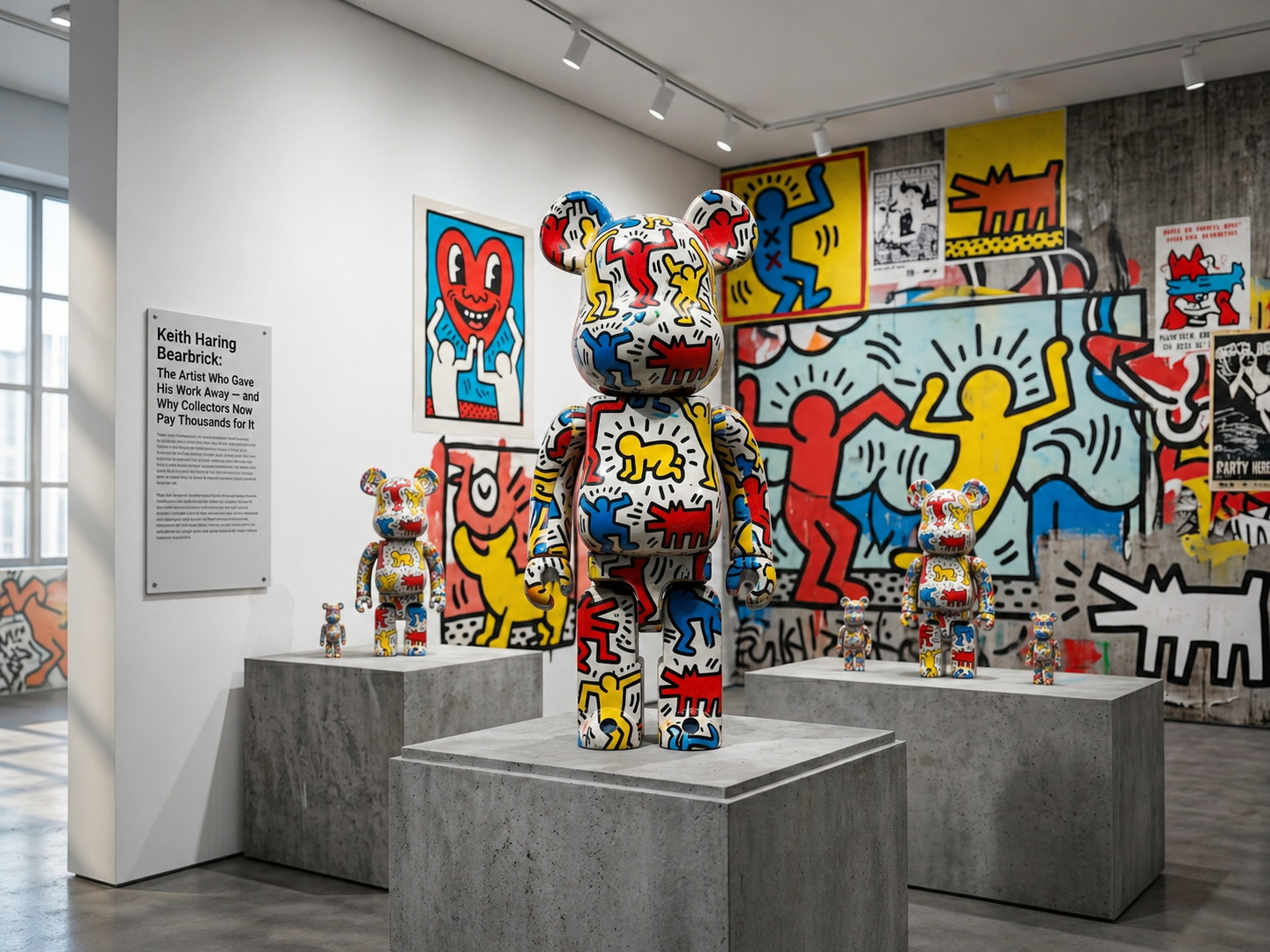
Haring developed a visual language of simplified, anonymous figures without fixed age, race, or identity. His people are outlines — no faces, no details — defined purely by posture and motion. They run, dance, fall, embrace, bark, crawl. The meaning is carried entirely by body language and composition.
This is almost exactly what the Bearbrick format requires. The Bearbrick is itself an outline — a bear-shaped silhouette with no face beyond a minimal moulded nose, nine articulated parts, and a smooth surface. Most of what makes a Bearbrick distinct from another Bearbrick is surface design. Haring’s work is surface design by nature. He drew on walls, panels, floors, cars, people’s bodies. Every surface was a canvas and every mark had to be legible at a distance, immediately, without explanation.
When his figures wrap around a 70-centimetre vinyl bear, the energy translates perfectly. The dancing figures don’t need a flat rectangular canvas — they navigate the bear’s rounded surfaces as naturally as they navigated subway walls. The bold outlines, the colour blocking, the sense of figures in constant motion — all of it works at 1000% scale as clearly as it did at chalk-drawing scale. This is not true of every Bearbrick collaboration. Some artist work shrinks or distorts when it hits the rounded form. Haring’s expands.
The Series: Every Major Keith Haring Bearbrick Release
The Keith Haring Bearbrick collaboration has been running across multiple numbered series for years, with additional special releases, event exclusives, and crossover figures. Here’s what the catalogue actually contains.
Series #1 — The First Numbered Release
The foundation. The first Keith Haring Bearbrick established the template: bold figures in motion, Haring’s signature graphic vocabulary, applied across the full surface of the bear. It set the colour language that many subsequent releases would return to — black outlines on vivid grounds, the figures in mid-gesture, the sense of energy barely contained by the vinyl.
First series figures are the hardest to find in clean condition. They predate much of the current global Bearbrick distribution infrastructure, and collector attrition over a decade has reduced the number of pristine boxed examples. When they appear on the secondary market, prices reflect both the rarity and the historical significance.
Series #2 — The Pink Base
The Bearbrick Keith Haring #2 1000% released in October 2018. It features a pink base with blue and black lines and squiggles, with Haring’s signature printed on the back. Retail price was $429.
The pink ground shifts the emotional register considerably from earlier releases. Haring used colour not decoratively but functionally — different grounds change the meaning of the same figures. A pink ground pushes the dancing figures toward something more celebratory, more overtly joyful. The #2 is one of the most visually appealing figures in the series and one of the most consistently traded on the secondary market.
Series #4 — Water Transfer Print and Monochrome
The Keith Haring #4 design features a monochromatic design with an all-over water transfer print process — meaning no two figures are identical since each unit receives a unique pattern sequence.
This is technically interesting. The water transfer (or hydrographic) printing process is used for complex three-dimensional objects where conventional flat printing can’t maintain consistency around curves. Because the pattern flows rather than being stamped, every figure is genuinely unique. A 100% and 400% set at Pamono recently listed at $1,364.
Series #5 — Hydro Dipped
The Keith Haring #5 1000% uses hydro dipping to create a pattern on the figure — the same process as #4, resulting in unique surface decoration across each individual unit. Vol.5 at retail was around $675 for the 1000% version. The hydro dip process gives these figures a slightly more complex visual texture than the painted versions — the pattern has depth because it follows the surface contours of the vinyl.
Series #6 — Chromatic Colour Shifts
The #6 series brought a different approach to colour — more saturated grounds, more complex figure arrangements. The 1000% version has traded between $2,000 and $4,000 on the secondary market for clean examples, reflecting the combination of limited production and collector demand for earlier series numbers.
Series #8 — White Ground with Hearts
The Bearbrick Keith Haring #8 1000% features an all-white Bearbrick with the iconic Keith Haring movement figure throughout the silhouette, and hearts throughout. It released in 2021 at a retail price of $450.
The white ground with black figures is probably the most formally similar to Haring’s original subway drawings — white chalk on black paper, but inverted here. The hearts are a recurring Haring motif, appearing throughout his work from the subway drawings through to his final paintings. On a white bear at 1000% scale, surrounded by moving figures, they read as a benediction.
The #8 is one of the more accessible Haring 1000% figures — it appeared in reasonable supply through standard distribution channels. Secondary market prices typically sit in the $500–$800 range for clean boxed examples.
Series #9 — Dancing Dogs
The ninth Keith Haring Bearbrick features the “Dancing Dogs” motif — colourful dogs dancing across the surface. The barking dog is one of Haring’s most recognisable symbols. His signature images from the subway included crawling babies, a barking dog, flying saucers, and figures with televisions for heads. The dog in particular recurs throughout his career — agitated, in motion, its energy ambiguous. It might be playful. It might be aggressive. That ambiguity is part of what made Haring’s imagery interesting.
On a Bearbrick with a full-colour palette, the dancing dogs become unambiguously festive — which is its own kind of visual argument about how context changes meaning.
Series #11 and #12 — World Wide Tour Exclusives
A Keith Haring #12 Bearbrick was released as a World Wide Tour 3 exclusive for the Bangkok stage of the tour. Event exclusives occupy a specific position in the Bearbrick collector market. They were produced for a specific location, available for a limited time, and then gone. Collectors who weren’t at BWWT 3 in Bangkok have to find the secondary market, which means paying whatever the market has settled on since the event.
The BWWT releases represent the most geographically restricted Keith Haring figures in the catalogue. For European collectors in particular, these figures never had any official retail pathway. Everything is secondary market.
Special Figures: Andy Mouse, Coca-Cola, DesignerCon, Mickey Mouse
Beyond the numbered series, the Keith Haring Bearbrick catalogue includes several figures that sit outside the standard progression.
Andy Mouse
Keith Haring’s “Andy Mouse” is a figure combining the iconic characters of Andy Warhol and Mickey Mouse. Haring, greatly influenced by both Warhol and Disney, created a unique depiction of Mickey Mouse with the distinct features of Andy Warhol — his glasses and hairstyle. The artwork pays homage to both artists while exploring themes of consumerism, popular culture, and the blurring of high and low art.
The Andy Mouse Bearbrick exists in multiple colourways (blue, pink, red) in both 400% and 1000% sizes. It’s the most conceptually dense figure in the Keith Haring Bearbrick catalogue — carrying Haring’s visual language, Warhol’s likeness, Disney’s most famous character, and the Bearbrick format all simultaneously. For collectors who track the intersection of these worlds, it’s a grail piece.
Andy Mouse combines the icons of Mickey Mouse and Andy Warhol. Haring and Warhol were friends, and Warhol approved of the character. This friendship — which included collaboration on a poster for the 1986 Montreux Jazz Festival — gives the Andy Mouse figure a documentary dimension. It’s not a licensing arrangement between two estates. It’s a record of an actual creative relationship.
Coca-Cola Collaboration
Medicom Toy produced a Keith Haring x Coca-Cola Bearbrick — one of those three-way collaborations where the figure carries Haring’s graphic vocabulary applied to the Coca-Cola visual identity. Red and white with the Coke branding woven into Haring’s figures. It’s the kind of release that appealed to collectors who follow both brands, expanding the potential audience beyond the standard art collector market.
DesignerCon Exclusive
The DesignerCon Keith Haring 100% and 400% set features Haring’s iconic figures in motion dancing across an American flag background, released on November 13, 2020. DesignerCon is the Los Angeles designer toy convention where Medicom Toy regularly releases exclusive figures available only at the event or in limited quantities through the convention’s online channel. For collectors who couldn’t attend, these figures go directly to the secondary market and carry the premium of geographic restriction.
Sister Cities — The 1985 Connection
Keith Haring created the colourful work “Sister Cities” in 1985 to celebrate the 25th anniversary of the sisterhood between New York and Tokyo. Haring first visited Tokyo in 1983 and returned multiple times throughout the 1980s. In this work Haring depicts the two cities dancing together under one heart. He gifted the painting to Tokyo City Hall; it later sold at Sotheby’s in New York in November 2018 for $4.5 million.
The Sister Cities Bearbrick — released as a Special version — uses the water transfer print process, meaning no two figures have identical pattern sequences. The Tokyo connection gives it a specific resonance: a painting Haring made for the city that Medicom Toy calls home, now wrapped around Medicom’s most famous format.
The Superalloy Metal Version
Medicom and Bandai produced a Chogokin Superalloy Keith Haring Bearbrick — die-cast metal at 200% scale. The Keith Haring 200% Superalloy version retailed for $450 in 2021. The metal construction changes the object entirely. Haring’s bold outlines and colour blocking read differently in metal than they do on vinyl — the surface is harder, cooler, more solid. It’s the same images but it feels like a different argument about what they are.
The Prices: What the Keith Haring Bearbrick Market Actually Looks Like
On 1stDibs, the average selling price for Keith Haring Bearbricks in their inventory is $565, with the lowest at $370 and the highest reaching $4,200. That range reflects the breadth of the catalogue — from accessible recent releases to early series figures with genuine scarcity.
For the standard numbered series in 100% and 400%: most sets trade between $150 and $400 on the secondary market, close to retail for recent releases, with premiums on earlier or rarer colourways. The #2 pink set, which has collector appeal beyond standard demand, consistently trades above its retail price.
For the 1000% figures: recent releases like the #8 sit in the $500–$800 range. The #2 1000% in multi retailed at $429 in October 2018 and now trades at a significant premium. Earlier series 1000% figures — particularly the first three numbered releases — trade in the $2,000–$4,000+ range when clean examples with original packaging appear.
For special releases and event exclusives: pricing is less predictable because supply is thin. The DesignerCon and BWWT exclusives don’t appear frequently, and when they do, the price reflects whatever a small number of sellers have decided to ask. The Andy Mouse 1000% figures trade in the $1,500–$3,000 range depending on colourway.
What distinguishes the Keith Haring Bearbrick market from the Warhol market: the numbered series structure, with twelve-plus releases and counting, means there’s always a range of price entry points. You can start with a recent 100% and 400% set at a reasonable secondary market premium and work your way into earlier series as you understand the catalogue better. The Warhol market has a similar logic. The Haring market has more numbered series to navigate.
Haring, the Foundation, and Why the Licensing Matters
Every Keith Haring Bearbrick is licensed through the Keith Haring Foundation and Artestar New York. This isn’t background information — it’s part of what the object is.
In 1989, Haring established the Keith Haring Foundation, its mandate being to provide funding and imagery to AIDS organisations and children’s programmes, and to expand the audience for Haring’s work through exhibitions, publications, and the licensing of his images.
When the foundation licenses Haring’s images for Bearbrick production, the proceeds fund organisations that Haring specifically designated in his final year of life. Buying an officially licensed Keith Haring Bearbrick connects, through the foundation, to the AIDS and children’s organisations that Haring cared about enough to establish a legal structure for before he died.
This isn’t a sales pitch. It’s context. The Keith Haring Foundation is selective about its licensing — they don’t say yes to everything, and they’re consistent about maintaining the integrity of Haring’s visual vocabulary. When Medicom Toy produces a new series, the designs are developed with the Foundation’s involvement. That oversight is part of why the series has maintained coherence across twelve-plus releases — the figures feel like Haring because people who knew his work are making decisions about how it appears.
For collectors, this also means authentication is relatively straightforward. Official Keith Haring Bearbricks carry Foundation and Artestar licensing credits on their packaging and on the Medicom Toy stamp on the figure’s foot. Counterfeit Haring Bearbricks exist — the simpler graphic style makes them easier to fake than some more complex designs — but the licensing documentation on authentic pieces is specific enough to verify.
Why Keith Haring and Bearbrick Are Both Saying the Same Thing
Here’s the thing about the Keith Haring Bearbrick that doesn’t get discussed enough.
Haring opened the Pop Shop in 1986 because he wanted his work accessible to people who couldn’t afford gallery prices. He decorated the interior himself, made the products affordable, and took the criticism from the art world that came with it. He considered the shop to be an extension of his work, and received strong support from friends, fans and mentors including Andy Warhol.
Pop Shop opened the door for later experiments and crossovers to mass-scale or low-cost retail items from the hands or minds of celebrated fine artists. The Bearbrick collaboration is the direct heir to that impulse — a format that takes an artist’s work and produces it as an object that can be owned by someone who isn’t buying a painting.
The irony, of course, is that some Keith Haring Bearbricks now trade for thousands of dollars. The democratising logic of the Pop Shop has, through scarcity and time, produced a collector market with its own hierarchy and premium pricing. This is not Haring’s fault. It’s what happens when limited editions age. But it’s worth sitting with the tension: the artist who literally gave his work away in public spaces has become the subject of a collector market that the subway riders of 1980 could never have accessed.
Maybe that’s just what happens to all art eventually. Haring would probably make a drawing about it.
How to Collect Keith Haring Bearbricks Without Making Expensive Mistakes
The Keith Haring Bearbrick catalogue is long enough that a focus helps. Some collectors pursue the complete numbered series — every volume in 100%, 400%, and 1000% — which is a significant project given the early series numbers and their scarcity. Others focus specifically on 1000% figures across selected series. Others build around specific artworks or colour palettes — all the white-ground figures, or all the water transfer versions.
Authentication basics. Check the Medicom Toy foot stamp — present on all authentic figures. Check the Foundation and Artestar licensing credits on the packaging. Haring’s graphic style is simple enough that crude fakes are common; look for print sharpness on the figure’s surface — authentic prints are consistent and clean-edged. The water transfer series (volumes #4 and #5) are harder to fake convincingly because the process produces organic variation that’s difficult to replicate through conventional printing.
Original packaging is not optional at the upper price levels. An early series 1000% Keith Haring Bearbrick without its original box is worth considerably less than the same figure complete. The box isn’t decoration — it’s part of the documented object.
Buy earlier series from sources with track records. The secondary market for the #1 and #2 releases has enough history that prices are predictable. Sellers asking substantially below the established range for clean examples should be approached with caution.
The numbered series structure is your guide. Earlier is harder to find, which is why the prices are higher. Later releases are more accessible. If you’re starting out, the #8 or #9 figures in 1000% are reasonable entry points — well-made, clearly documented, and available without extreme secondary market premiums.
Frequently Asked Questions
How many Keith Haring Bearbrick series exist?
At least twelve numbered series as of 2026, plus special releases including the Andy Mouse figures, the Coca-Cola collaboration, the Sister Cities Special, the DesignerCon exclusive, the Mickey Mouse version, and the Superalloy metal figure. The series continues to expand.
Which Keith Haring Bearbrick is the rarest?
Early numbered series — particularly #1, #2, and #3 in the 1000% format — are the hardest to find in clean, boxed condition. The World Wide Tour event exclusives (#12 for Bangkok, others for different stops) are also genuinely scarce outside their release markets.
Are Keith Haring Bearbricks official?
Yes. All official releases are licensed through the Keith Haring Foundation and Artestar New York, and carry their licensing credits on packaging and foot stamp. Proceeds from licensing go to Foundation-supported AIDS and children’s organisations.
What is the Andy Mouse Bearbrick?
A figure featuring Keith Haring’s “Andy Mouse” character — a fusion of Mickey Mouse and Andy Warhol that Haring created as a tribute to his friend and mentor. Available in multiple colourways in 400% and 1000% sizes. One of the most conceptually layered figures in the catalogue.
What are the water transfer Keith Haring Bearbricks?
The #4 and #5 series use a hydro-dipping (water transfer) process that means no two figures have identical surface patterns. The design flows around the three-dimensional surface organically, producing genuinely unique variations within each edition.
Are Keith Haring Bearbricks a good investment?
Early numbered series figures have shown consistent appreciation. The broader catalogue trades close to retail, with moderate secondary market premiums on most recent releases. The Foundation’s active licensing means new series will continue to appear, which keeps the earlier series historically positioned rather than simply scarce.