The Man Who Said Art Should Look Like the Thing Itself
Andy Warhol was born in Pittsburgh in 1928 and died in New York in February 1987. Between those two dates he managed to rewrite what art was allowed to be — not through manifestos or theory, but through soup cans, silkscreen prints, Marilyn Monroe’s face repeated fifty times on a single canvas, and a studio full of people he called Superstars. He also said things like “If you want to know all about Andy Warhol, just look at the surface of my paintings and films and me, and there I am. There’s nothing behind it.”
He was probably lying about that last part. But it’s a good line.
In 1962, Warhol received sudden notoriety when he exhibited paintings of Campbell’s soup cans, Coca-Cola bottles, and wooden replicas of Brillo soap pad boxes. The art world didn’t know whether to be offended or impressed, so it was both. A gallery in Los Angeles displayed the soup can paintings on narrow ledges like supermarket shelves. Some visitors thought it was a joke. Others thought it was the most honest thing anyone had done with a paintbrush since the Abstract Expressionists stopped trying to put their feelings onto canvas and just made a mess.
What Warhol understood — better than almost anyone of his generation — was that the thing you were looking at and the way it made you feel were connected in a way no one had formally explored. A Campbell’s soup can wasn’t neutral. It was loaded with memory, familiarity, domestic comfort. Put it on a canvas in a gallery and it became strange. Strange enough to be interesting. Strange enough to make people argue.
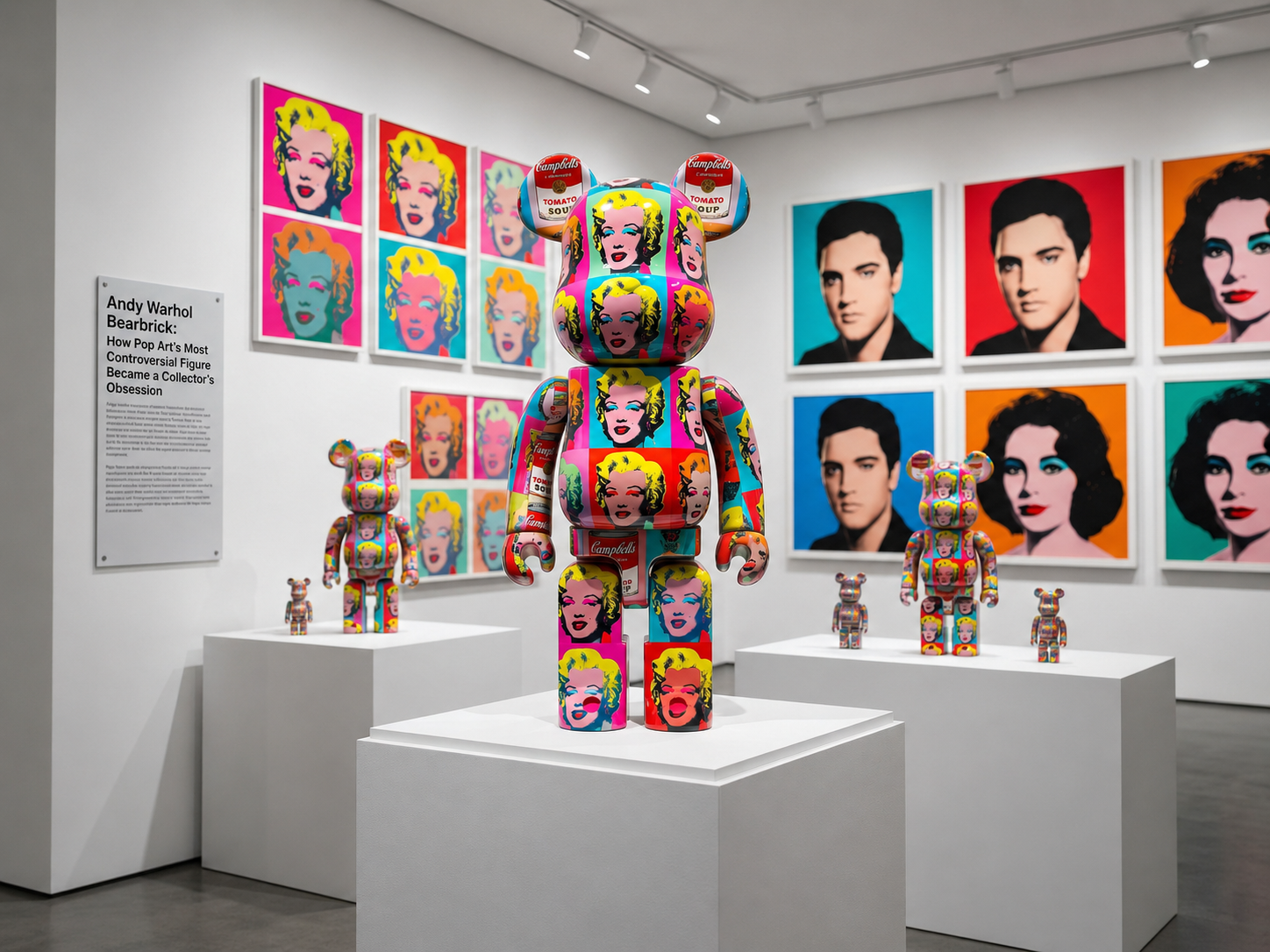
That same logic — the familiar made strange by context — is exactly why the Andy Warhol Bearbrick works as well as it does. A vinyl toy shaped like a bear isn’t neutral either. Put Warhol’s Marilyn on it, or his Brillo box, or his Elvis, and something happens. You’re looking at an icon of Pop Art on an icon of collectible culture, and neither one is quite what it was alone.
Why Warhol and Medicom Toy Were Always Going to Find Each Other
Medicom Toy launched Bearbrick in 2001 — fourteen years after Warhol’s death. The Andy Warhol Foundation for the Visual Arts, which manages his estate and licenses his work, has been one of the most active art foundations in the licensing space since the mid-1990s. They’ve put Warhol’s images on everything from Absolut vodka bottles to Uniqlo T-shirts, and they’re careful about it. They don’t say yes to everything.
They said yes to Medicom Toy. And the collaboration has been running ever since, producing one of the deepest and most varied bodies of work in the Bearbrick catalogue. What started as individual releases around specific Warhol artworks has expanded into multiple ongoing series, Basquiat crossovers, Rolling Stones figures, and specialty releases through World Wide Tour events.
The alignment makes sense on a formal level. Warhol mass-produced purposely banal images using photographic silkscreen prints, and began printing endless variations of portraits of celebrities in garish colours. That’s basically the Bearbrick model applied to fine art. Both Warhol and Medicom Toy are in the business of taking a specific image — a face, a logo, a pattern — and repeating it across a surface until it stops being wallpaper and starts being something you look at. The medium is different, the scale is different, but the logic is identical.
There’s also something genuinely interesting about putting Warhol’s work on a three-dimensional object. His paintings and prints are flat by design — silkscreen on canvas, surface all the way through. When Medicom wraps his Marilyn around a 70-centimetre vinyl bear, the image has to navigate curves, joints, edges. The familiar becomes unfamiliar again. Warhol would have appreciated that.
The Artworks: What Each Series Actually Shows
The Andy Warhol Bearbrick catalogue is extensive — more releases than most casual collectors realise. Here’s what the major figures actually are and where the images come from.
Marilyn Monroe — Series #1 and #2
Warhol created his first Marilyn silkscreen just weeks after Monroe’s death in August 1962. The Marilyn Diptych consists of fifty images — twenty-five in vivid colour on the left, twenty-five fading to black and white on the right — all taken from a single 1953 publicity photograph for the film Niagara.
Warhol continued returning to Monroe throughout his life, each time capturing a different angle of her cultural memory. The 1967 Marilyn portfolio — ten screen prints, each in a different colourway, each an edition of 250 — became one of the defining documents of Pop Art.
Medicom’s Marilyn Monroe Bearbrick series draws directly from this body of work. The first Marilyn Monroe Bearbrick 1000% applies Warhol’s 1962 artwork Twenty-Five Colored Marilyns to the figure, with a vibrant blue, pink and yellow coating and Warhol’s signature on the rear. The Marilyn Monroe #2 1000%, released in spring/summer 2021 at a retail price of $585, features Monroe in pastel yellow and blue against a vibrant pink background — a different colourway, a different emotional temperature.
The Shot Marilyns version references Warhol’s 1964 works, featuring Monroe’s headshots from the light blue piece printed across the body of the figures. It released as a 100% and 400% set at $138.
On the secondary market: the Marilyn Monroe #2 1000% trades with a current lowest ask around $344 on StockX. The original Marilyn Monroe 100% and 400% set sits at around $274. These figures are accessible relative to some other Bearbrick art collaborations — Warhol’s popularity keeps demand high, but the Andy Warhol Foundation’s willingness to license means supply hasn’t been constrained to the degree it is for, say, Chanel or KAWS.
Elvis Presley
Elvis was one of Warhol’s recurring subjects throughout the 1960s. The image he used — Elvis in a gunslinger pose, derived from a publicity photo for the 1960 western Flaming Star — appeared in multiple paintings, some double-exposed, some in silver monochrome. Warhol turned Elvis into a ghost before anyone else thought to.
In 2021, the Andy Warhol estate collaborated with Medicom Toy for the Elvis Presley Bearbrick — the 100% and 400% set showcasing the repeating Elvis art across both figures, retailing at $150. The 1000% version — 70 centimetres of the gunslinger repeated across the bear’s surface — currently trades at around $349 on StockX.
The Elvis figures occupy an interesting position in the catalogue. Elvis as a subject matter appeals to a slightly different collector base than Marilyn — more American nostalgia, more rock and roll, less fashion-world crossover. The secondary market for the Elvis Bearbrick is quieter than for the Marilyn figures, which makes clean examples easier to find at reasonable prices.
Brillo Boxes
The Bearbrick Andy Warhol “Brillo” 1000% figure is inspired by the artist’s 1964 work Brillo Soap Pad Boxes — a piece that prompted audiences to think about mass consumption and art as a consumer product.
This is the figure that makes most sense theoretically and is also the one most likely to confuse people at first glance. It’s a bear covered in soap pad box branding. The red and white Brillo logo tiles across the surface. No celebrity face, no colour. Just packaging.
Warhol began printing endless variations of his silkscreen images, and the Brillo boxes were among his most pointed provocations — wooden replicas of actual supermarket shipping boxes, indistinguishable from the real thing, displayed in a gallery. The question they raised — what makes this art and not just a box? — still hasn’t been fully answered.
On a Bearbrick, the Brillo branding takes on an additional layer. Now you have a consumer object (the Bearbrick) covered in the image of another consumer object (the Brillo box) that was itself an artwork critiquing consumer objects. It’s either very funny or very clever. Probably both. The Brillo 1000% retailed at $650 and currently trades at around the same price on the secondary market — one of the few Warhol Bearbricks that has held almost exactly at retail. The 100% and 400% set retailed at $130.
Double Mona Lisa
From 1928 to 1987, Warhol made a series of silkscreen prints inspired by Leonardo da Vinci’s Mona Lisa. His Double Mona Lisa — two identical Mona Lisas side by side, one in colour and one almost ghosted — is one of his more understated works. It says something about reproduction, about the relationship between original and copy, about what happens when you repeat an already-iconic image until the iconicity becomes the subject.
The Double Mona Lisa 1000% Bearbrick, in white and black, currently lists around $300 on StockX for the 100% and 400% set. It’s the quietest of the Warhol Bearbricks visually — less saturated, less immediate than the Marilyn or Elvis figures — which makes it appealing to collectors building a more minimal display.
Rolling Stones (Sticky Fingers)
This is the outlier in the Warhol Bearbrick catalogue, and it’s genuinely interesting.
The Bearbrick Andy Warhol x Rolling Stones (Sticky Fingers) 1000% currently lists at $688 on StockX, with a last sale of $450. The retail price was $650. The figure references Warhol’s 1971 Sticky Fingers album cover — the close-up of jeans with a working zip — which remains one of the most discussed album covers in rock history, partly because of the image itself and partly because the working zip was Warhol’s addition.
The Sticky Fingers Bearbrick appeals to three collector communities: Warhol collectors, Bearbrick collectors, and Rolling Stones fans. That third group is large and tends to buy things. The figure is visually unexpected — the jeans texture and the denim detail across the bear’s surface is unusual in the catalogue — and the Rolling Stones connection gives it a music culture dimension that most Medicom art collaborations don’t have.
Muhammad Ali
The Muhammad Ali Bearbrick — in 100% and 400% — appears in Sotheby’s as part of their Warhol collaboration set, listed alongside the Basquiat and Keith Haring figures. Warhol photographed Ali in 1977, producing prints that placed the boxer’s intensity against his signature high-key colour palette. Ali was already a cultural force by then — three-time heavyweight champion, conversion to Islam, Vietnam draft refusal — and Warhol treated him the way he treated every celebrity: as both icon and surface.
The Ali Bearbrick is less common than the Marilyn and Elvis versions. It trades at a premium relative to its retail price, partly because the subject matter has a devoted collector base that doesn’t necessarily overlap with the usual Bearbrick market.
The Last Supper
Listed quietly on secondary market platforms, the Andy Warhol Last Supper Bearbrick — referencing his 1986 silkscreen series based on Leonardo da Vinci’s fresco — is one of the more unusual entries in the catalogue. Warhol made over 100 works based on the Last Supper in the final years of his life, and it was the subject of his last major exhibition before his death. The series is read differently depending on who’s looking: as religious commentary, as meditation on mortality, as Warhol’s most personal project.
On a Bearbrick, the image is arresting in a way that’s hard to describe. The Last Supper as a composition was designed to be horizontal — fifteen figures across a long table — and wrapping that image around the rounded surfaces of a vinyl figure does something strange to it. Figures appear on joints, the perspective collapses, the familiar becomes fractured.
The Basquiat Crossover — A Collaboration Within a Collaboration
The most discussed figures in the Andy Warhol Bearbrick catalogue are probably not the solo Warhol releases. They’re the Warhol x Basquiat figures — and they deserve their own section because the story behind them is as interesting as the objects themselves.
Andy Warhol and Jean-Michel Basquiat began their collaboration in the 1980s. Keith Haring, who was friends with both, described it as: “Each one inspired the other to out-do the next. The collaborations were seemingly effortless. It was a physical conversation happening in paint instead of words.”
The relationship was unusual. Warhol was in his fifties, famous, a fixture of New York society. Basquiat was in his twenties, from Brooklyn, operating at the edge of the graffiti and neo-expressionist scene that Warhol had been watching with interest. They were introduced by the art dealer Bruno Bischofberger in 1982 and began painting together almost immediately. Basquiat would sometimes arrive at Warhol’s Factory, pick up a canvas, work on it, leave it. Warhol would work on it next. Back and forth.
Medicom Toy has produced multiple collaborative Bearbricks paying homage to both artists. The third iteration features a golden yellow base with Basquiat’s neo-expressionist imagery and Warhol’s pop art style — abstract symbols, block letter words, coral, burgundy, cerulean blue, black and white. Warhol’s signature appears on the rear alongside Basquiat’s name with his signature crown.
As of 2026 there are at least four numbered Warhol x Basquiat Bearbrick sets. The first three in 100% and 400% formats, plus a 1000% version of the initial release. On the secondary market: the Warhol x Basquiat #4 1000% currently asks $442 with a last sale of $292; the #2 1000% asks $351 with a last sale of $323; the #1 1000% asks $367.
The Warhol x Basquiat figures occupy a specific collector space. Both artists’ estates are active licensors — the Basquiat catalogue has appeared across many collaborations in recent years — but the combination of the two, on a single figure, with the historical context of their actual working relationship behind it, creates an object with more cultural density than most Bearbrick releases carry.
The Chogokin Metal Version — When Medicom Takes It Further
Medicom Toy and Bandai produced a Chogokin Warhol x Basquiat Bearbrick — a die-cast metal version in the 200% size. Chogokin (超合金, meaning “super alloy”) is Bandai’s line of die-cast metal figures, with a history going back to 1974. Combining that tradition with Warhol’s imagery and the Bearbrick format produces an object that occupies an odd space between toy, collectible, and sculpture.
The metal construction changes the experience of the object entirely. Standard Bearbricks are light, slightly hollow-feeling, clearly plastic. A Chogokin Bearbrick has genuine weight. It sits differently on a shelf. You pick it up and it’s a different thing. The Warhol imagery printed on metal reads with a different quality than it does on vinyl — slightly cooler, less warm, more like a photograph than a painting.
What the Warhol Bearbrick Catalogue Does That Others Don’t
One thing worth noting about the Andy Warhol Bearbrick collection is its scope. Most artist collaborations in the Medicom catalogue have a handful of releases. KAWS has several. Keith Haring has eight series. The Warhol catalogue has Marilyn (multiple series and colourways), Elvis, Brillo, Double Mona Lisa, Last Supper, Muhammad Ali, Rolling Stones, the ongoing Basquiat crossovers, Chogokin metal versions, World Wide Tour exclusive releases, and periodic new additions.
This breadth is unusual. It reflects how the Andy Warhol Foundation operates — as an active, commercially engaged estate that sees licensing as part of Warhol’s legacy rather than a threat to it — and it creates a situation where collectors can build an entire collection within a single artist collaboration rather than having to range across the whole Bearbrick catalogue.
There’s also something appropriate about the depth. Warhol’s entire career was built on series — not one soup can but 32, not one Marilyn but fifty, not one celebrity portrait but an ongoing production. The multiple Bearbrick series mirror that logic. You don’t just own a Warhol Bearbrick. You own a piece of an ongoing body of work that keeps expanding.
Prices: What the Market Actually Looks Like
The Andy Warhol Bearbrick market sits at a different level from some of the art collaborations in the Medicom catalogue. It’s not KAWS territory, and it’s nowhere near the Chanel Bearbrick market. It’s a collector market that’s accessible to people who take Bearbricks seriously but haven’t committed to five-figure figures.
The 100% and 400% sets across most Warhol releases retail in the $130–$200 range. On the secondary market, most sets trade between $100 and $450 depending on specific figure and colourway. Several — including the Brillo set and some Elvis editions — actually trade below retail on StockX, which makes them accessible entry points for new collectors.
The 1000% figures are where the market gets more serious. The Brillo 1000% retailed at $650. The Marilyn Monroe #2 1000% retailed at $585. The Elvis Presley 1000% currently lists at $349 as lowest ask. Most Warhol 1000% figures sit in the $300–$700 range on the secondary market, with the Rolling Stones (Sticky Fingers) at the higher end.
The Warhol x Basquiat 1000% figures command more — the combination of two major artists’ work, plus the historical story behind their collaboration, pushes these above the solo Warhol releases.
Special release and World Wide Tour versions — exclusive to specific events or locations — sit at premiums that reflect their restricted distribution. The BWWT 3 “Special” 100% and 400% set in multi colourway currently asks around $442 on StockX.
What’s notable about the Warhol market overall is its stability. Most figures trade close to retail, with moderate secondary market premiums, rather than the dramatic swings you see with KAWS or the extreme scarcity pricing of Chanel. This makes the Warhol Bearbrick a relatively rational collector market — prices are discoverable, availability is manageable, and the range of releases means you can find entry points at many price levels.
Who Collects Andy Warhol Bearbricks — and Why
The Andy Warhol Bearbrick sits at an unusual intersection. Art collectors who follow Warhol’s estate work will recognise these figures as legitimate licensed objects from a major institution — the Andy Warhol Foundation is not a casual licensor, and their involvement carries weight. Pop culture collectors who grew up with Marilyn Monroe and Elvis Presley as cultural touchstones will respond to the specific images without necessarily knowing the deep Bearbrick history. And serious Medicom collectors include the Warhol series as essential entries in any comprehensive art collaboration collection.
The Basquiat crossover extends this further. The Warhol x Basquiat figures attract collectors who follow Basquiat’s estate separately — a growing market, particularly in the US and Europe — and bring them into contact with the Bearbrick world through a figure they already have reasons to want.
None of these communities have stopped growing. Warhol’s auction record still moves. Basquiat’s estate licensing has expanded. The secondary market for Pop Art accessible pieces — things with genuine art world credentials that don’t require museum-level budgets — has deepened significantly since 2018.
Collecting Tips for the Warhol Bearbrick
The Andy Warhol Bearbrick market is broad enough that having a focus helps. Some collectors pursue only the 1000% figures — the large-format versions that work as display anchors. Others build complete sets across all sizes for specific artworks (Marilyn #1 in 100%, 400%, and 1000%). Others focus on the Warhol x Basquiat figures as a sub-collection with its own historical logic.
Whatever direction you take, a few things apply across the board. Original packaging matters — the Warhol Foundation’s licensing means boxes have specific printing quality that can be compared against documented authentic examples. The Medicom Toy stamp on the underside of the foot is standard authentication. For 1000% figures, check the surface printing quality — Warhol’s designs involve a lot of repetition across the surface, and on authentic figures this is consistent and sharp. Fakes tend to show pixelation or colour bleeding at the edges of repeated images.
The Warhol Bearbrick market has fakes, mostly concentrated at the higher-priced end. A Brillo 1000% or a Marilyn Monroe #1 1000% is worth faking. A standard 100% set at $100 retail price isn’t. Buy from sources with authentication processes at the 1000% level.
Frequently Asked Questions
How many Andy Warhol Bearbrick series exist?
The catalogue is extensive — multiple solo series (Marilyn #1 and #2, Elvis, Brillo, Double Mona Lisa, Last Supper, Muhammad Ali, Rolling Stones), ongoing Warhol x Basquiat collaborations (at least four numbered series plus 1000% versions), special event releases, and Chogokin metal versions. It’s one of the deepest single-artist collaborations in Medicom’s output.
Which Andy Warhol Bearbrick is the most valuable?
The Warhol x Basquiat 1000% figures currently command the highest secondary market prices, followed by the Rolling Stones (Sticky Fingers) 1000%. Most solo Warhol figures trade in a moderate range relative to other Bearbrick art collaborations.
Are Andy Warhol Bearbricks made with the Foundation’s approval?
Yes. All official Andy Warhol Bearbricks are licensed through the Andy Warhol Foundation for the Visual Arts, which actively manages his estate and maintains rigorous licensing standards.
What artwork is on the Brillo Bearbrick?
The Brillo Bearbrick is inspired by Warhol’s 1964 Brillo Soap Pad Boxes — wooden replicas of supermarket shipping boxes displayed as gallery artworks, designed to force questions about mass consumption and what constitutes art.
Is the Andy Warhol Bearbrick a good entry point for collectors new to Medicom Toy?
Yes. The Andy Warhol series offers 100% and 400% sets at accessible retail prices ($130–$200), a range of subjects to suit different tastes, and a secondary market where several figures actually trade at or below retail. It’s a broader and more affordable range than many comparable Bearbrick art collaborations.