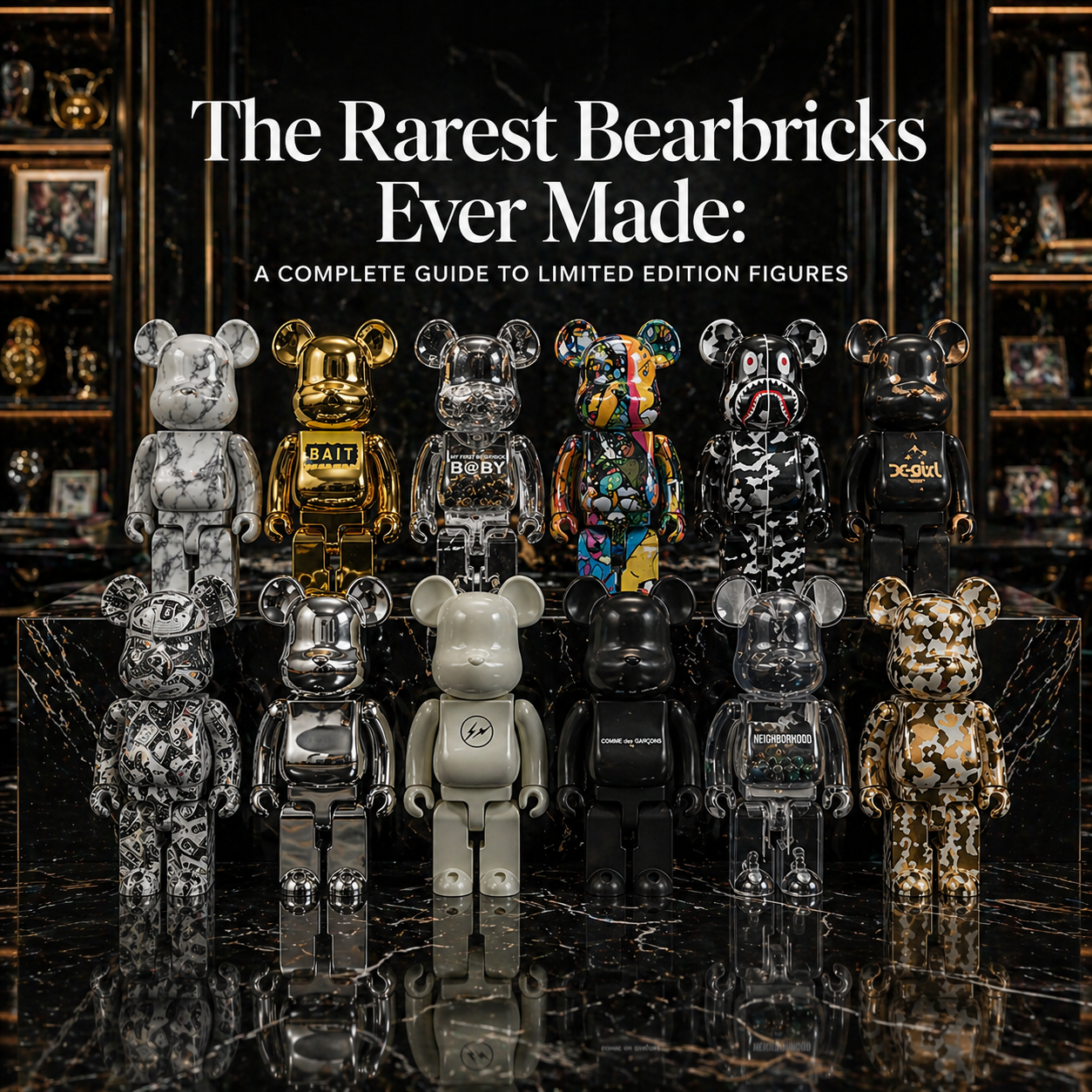
How a Bear-Shaped Toy Became One of the Most Competitive Collector Markets in the World
In May 2001, Tatsuhiko Akashi — founder of Medicom Toy — had a problem. He’d been asked to produce a handout gift for attendees of the World Character Convention in Tokyo, a celebration of the teddy bear’s 100th anniversary. The numbers were too big, the timeline too tight. So he modified an existing design, kept the body simple, rounded the head into something bear-like, and produced thousands of them.
Nobody expected what happened next.
That first Bearbrick — 70 millimetres of moulded plastic, given away free at the door — would eventually spawn a collector market where individual figures sell for six figures at Sotheby’s and Christie’s. Where a single collaboration with the right artist can turn a $300 retail price into a $50,000 auction result inside a decade. Where people queue for hours, crash websites, and fly to specific cities just to be in the room when a new limited edition drops.
This is a guide to the figures that defined that market. The rarest Bearbricks ever produced, what they sold for, and what makes them worth understanding whether you collect or just want to know what the fuss is actually about.
Why Limited Edition Bearbricks Are Different
Before getting into specific figures, it’s worth understanding what separates a standard Bearbrick from a genuinely rare one. Because Medicom Toy produces hundreds of releases every year, and most of them are not particularly hard to find.
The figures that command serious money share a few consistent characteristics. First, the collaboration partner matters enormously — an artist or brand with their own established collector base brings two audiences to one object. Second, production numbers need to be genuinely low, not “limited” in the marketing sense but actually constrained. Third, there’s usually a story: a specific event, a charitable purpose, a one-time context that makes reissue unlikely or impossible. Fourth, condition and provenance. Original box, certificate, documented purchase history — these aren’t optional extras at this level of the market, they’re table stakes.
The figures below tick most or all of those boxes. Some are almost impossible to source. Others appear occasionally on the secondary market. All of them have sold at prices that would have seemed absurd when Medicom first gave them away at a convention.
The 13 Rarest Limited Edition Bearbricks
1. Yue Minjun “Qiu Tu” — 1000%
Auction record: $157,000
This is the most expensive Bearbrick ever sold. Chinese contemporary artist Yue Minjun is known for his self-portraits — wide-open mouth, frozen laugh, a recurring image that reads differently depending on who’s looking. Medicom produced a single 1000% Bearbrick in his “Qiu Tu” style. One piece, no edition, no reissue. It sold at auction for $157,000 and holds the record.
This figure sits at the absolute edge of what Bearbrick has produced. It’s not a collectible in the usual sense — it’s a one-of-one artwork that happens to take the form of a bear.
2. Coco Chanel — 1000%
Secondary market: $8,000–$62,000+ depending on condition
Designed by Karl Lagerfeld in 2006 as the first luxury fashion house collaboration in Bearbrick history. Around 1,000 numbered pieces were produced, originally displayed in Chanel boutique windows before being released through a Hong Kong charity event supporting the Blood Cancer Foundation. The figure wears Coco Chanel’s signature look — black tweed, white pearls, camellia at the ear, dark glasses.
Prices climbed significantly after Lagerfeld’s death in 2019. One example sold on StockX for $62,003 in 2023. The figure is a grail piece for collectors across both the fashion and designer toy worlds simultaneously, which is exactly why demand hasn’t softened.
3. BAPE x Readymade — 1000%
Secondary market: $18,500–$121,000
Released in 2018, this collaboration between A Bathing Ape, Readymade, and Medicom Toy produced what many consider the most technically interesting Bearbrick ever made. The figure comes dressed in a real, functional BAPE hoodie — sewn from Readymade designer Yuta Hosokawa’s signature vintage military fabric, with a working zipper, ribbed hems, chenille patches, and a tiny pocket. It retailed for around $2,700. Current market pricing on StockX has reached $121,000 for the right example.
The gap between retail and resale here — roughly 4,000% — is one of the most dramatic in the history of the format.
4. KAWS Dissected Companion — 1000%
Secondary market: $8,000–$50,000+
KAWS — Brian Donnelly — has collaborated with Medicom Toy more times than any other artist. His first Bearbrick came out in 2003 and helped establish the template for what a high-value artist collaboration could look like. But the Dissected Companion series, launched in 2010, is the one collectors keep coming back to.
The design exposes what’s notionally inside the bear — internal organs rendered in KAWS’s particular graphic vocabulary, the figure split between its exterior surface and a cross-section of its interior. It’s genuinely strange and genuinely arresting, and that tension between cute and unsettling is exactly what KAWS has built his career on. The 1000% versions trade between $8,000 and $50,000 depending on colourway and condition.
5. Karimoku Horizon Wood — 1000%
Secondary market: ~$22,000
Karimoku is an 80-year-old Japanese furniture company. Their Bearbrick collaborations with Medicom Toy produce figures made from real walnut wood — handcrafted, made to order, not injection-moulded plastic. The Horizon Wood 1000% retailed for around $5,380 and currently trades at roughly $22,000. The Brick Style Tiles collaboration, also with Karimoku, sits around $10,000.
These figures occupy a different part of the collector market. The people who buy them are often not primarily Bearbrick collectors — they’re furniture and craft enthusiasts who want an object made with genuine material skill. The wood grain runs across the bear’s surface. It doesn’t look like a toy. It looks like sculpture, because that’s basically what it is.
6. Swarovski x Colette — 1000%
Auction result: $22,180
Released in 2009 as part of Colette’s “White Crystal Christmas” concept — Colette being the Paris concept store that functioned, until it closed in 2017, as the cultural barometer of what was actually interesting in design and fashion. The figure is covered in hundreds of hand-applied Swarovski crystals. The collaboration between Swarovski’s craft and Colette’s curation produced something that genuinely reads as jewellery rather than toy.
It sold at auction for $22,180. The Colette connection matters here — that store’s closure has added a retrospective weight to everything it touched.
7. Andy Warhol Foundation Series — 1000%
Secondary market: $2,000–$8,000 per figure
Medicom Toy has released multiple series with the Andy Warhol Foundation, covering his most recognisable work: Marilyn Monroe, Elvis Presley, Muhammad Ali, the Campbell’s Soup imagery. The foundation has been an active licensor, which means there are several iterations in circulation — different colourways, different image choices, different series numbers.
The 1000% versions of the rarest colourways trade in the $5,000–$8,000 range. The Warhol collaborations matter because they bridge the gap between the art world and the toy collector world as explicitly as anything Medicom has produced — there’s no ambiguity about what these are referencing, and the Warhol estate’s involvement gives them a legitimacy that unlicensed homages don’t have.
8. Keith Haring Series — 1000%
Secondary market: $1,500–$6,000
Eight series of Keith Haring Bearbricks have now been produced, each drawing from different periods and motifs in Haring’s work. The collaboration makes obvious sense: Haring’s figures are simple, bold, immediately readable, and designed to work on any surface — which is exactly what the Bearbrick format provides.
Earlier series command higher prices than recent ones. The first and second series in 1000% format are the most sought after, with prices in the $4,000–$6,000 range for clean examples. The Haring Foundation’s ongoing involvement means new series continue to appear, which keeps the earlier ones as the historically significant pieces.
9. KAWS x OriginalFake 6th Anniversary — 1000%
Secondary market: ~$8,000
OriginalFake was KAWS’s own retail brand, operating from 2006 to 2013. The 6th Anniversary Bearbrick, released in 2012, was exclusive to Ambush Singapore — a single retailer in a single city. The figure features KAWS’s signature monogram pattern on fabric that unzips to reveal the bare vinyl beneath.
The geographic restriction is what makes this one particularly hard to find. Most of the collector market for KAWS is in the US, Europe, and Japan. An exclusive Singapore release reached very few of the people who would most want it.
10. Mastermind Japan x BAPE — 400%
Secondary market: $2,000–$5,000
Released in 2021, this figure splits the bear down the middle — literally. One half carries Mastermind Japan’s skull and crossbones branding, the other half shows BAPE’s shark face. The figure is dressed head to toe in yellow camo with BAPE’s full-zip hoodie bisecting it. It’s a collector piece for people who follow both streetwear brands, and both communities are large and active.
11. Medicom x Hermès — 1000%
Secondary market: $15,000–$30,000
One of the rarest fashion house collaborations in Bearbrick history. Hermès produced a figure as part of a charity auction alongside other luxury brands — Salvatore Ferragamo, Moschino, and Chanel were also represented at the same event. The Hermès example is among the hardest to find, with fewer documented sales than the Chanel figure. When examples surface, prices are in the five-figure range.
12. Daniel Arsham x Sorayama — 1000%
Secondary market: $3,000–$8,000
This three-way collaboration between Medicom Toy, sculptor Daniel Arsham, and illustrator Hajime Sorayama produced something genuinely unusual in the Bearbrick catalogue. Arsham is known for his “fictional archaeology” — objects depicted as if they’ve been excavated from the future — and Sorayama for hyper-realistic chrome figures. The combination creates a figure that looks simultaneously eroded and polished. It trades well because both artists have independent collector bases that don’t completely overlap.
13. Nike SB — 1000%
Secondary market: $2,000–$4,000
The 2020 Nike SB collaboration produced a figure that looks like someone figured out how to make a sneaker into a bear. Laces run up the body, a Swoosh sits along the side, stitched detailing covers the surface. The packaging mimics Nike SB’s Rainbow Box. It sits at the intersection of sneaker collecting and designer toy collecting — two communities with enormous combined spending power — which explains why it’s held its value as well as it has.
How Auction Houses Changed the Market
Something shifted in the Bearbrick market around 2018–2019. Before that point, the secondary market was primarily peer-to-peer: online forums, StockX, direct sales between collectors. The figures existed in a collector world that had its own pricing logic, mostly invisible to the broader art market.
Then Sotheby’s started taking Bearbricks seriously. Christie’s followed. Phillips included them in major sales. When an object enters the serious auction circuit, it doesn’t just sell — it gets priced against other auction results, gets documented in sale records, gets treated as an asset class rather than a hobby purchase.
That shift has been good for sellers of rare figures and complicated for buyers who entered the market expecting collector prices rather than auction house prices. A KAWS Bearbrick that would have traded for $3,000 between collectors in 2017 might clear $15,000 at Sotheby’s in 2023 — and that auction result then becomes the reference point for the next sale.
The practical effect: anyone buying rare limited edition Bearbricks now is operating in a market with documented institutional pricing. The days of finding something significant at a bargain because the seller didn’t know what they had are largely over. The information is public. The prices are traceable.
How to Start Collecting Seriously
There’s a version of Bearbrick collecting that costs $50 — a blind box 100%, pulled from a series at retail, displayed on a shelf. And there’s a version that costs $50,000. Both are legitimate, but they require different approaches.
Start with what you actually respond to. The collectors who do best over time are the ones who buy figures because they find them genuinely interesting, not because a spreadsheet says they should appreciate. The market for designer toys rewards knowledge and taste, and knowledge comes from paying attention to what you like before you start spending seriously.
Understand the collaboration landscape. KAWS, Andy Warhol, Keith Haring, Chanel, BAPE — these are not interchangeable. Each collaboration has its own history, its own edition structure, its own collector community. The Warhol figures attract art collectors. The BAPE figures attract streetwear collectors. The Chanel figures attract fashion collectors. Knowing which communities overlap with your own interests tells you where to focus.
Condition is not negotiable at the top end. A rare Bearbrick without its original box and certificate is worth meaningfully less than the same figure with both. At the $5,000+ level, condition differences can translate to thousands of dollars in price. Buy the best example you can afford, not the cheapest example of what you want.
Buy from documented sources. The Bearbrick market has fakes. Not at the $100 level — there’s no money in faking cheap figures — but at the level where it matters. Chanel Bearbricks, KAWS figures, early BAPE collaborations: all have been replicated. Sotheby’s, Christie’s, established dealers with authentication processes, and platforms with guarantee policies are safer than anonymous sellers with no track record.
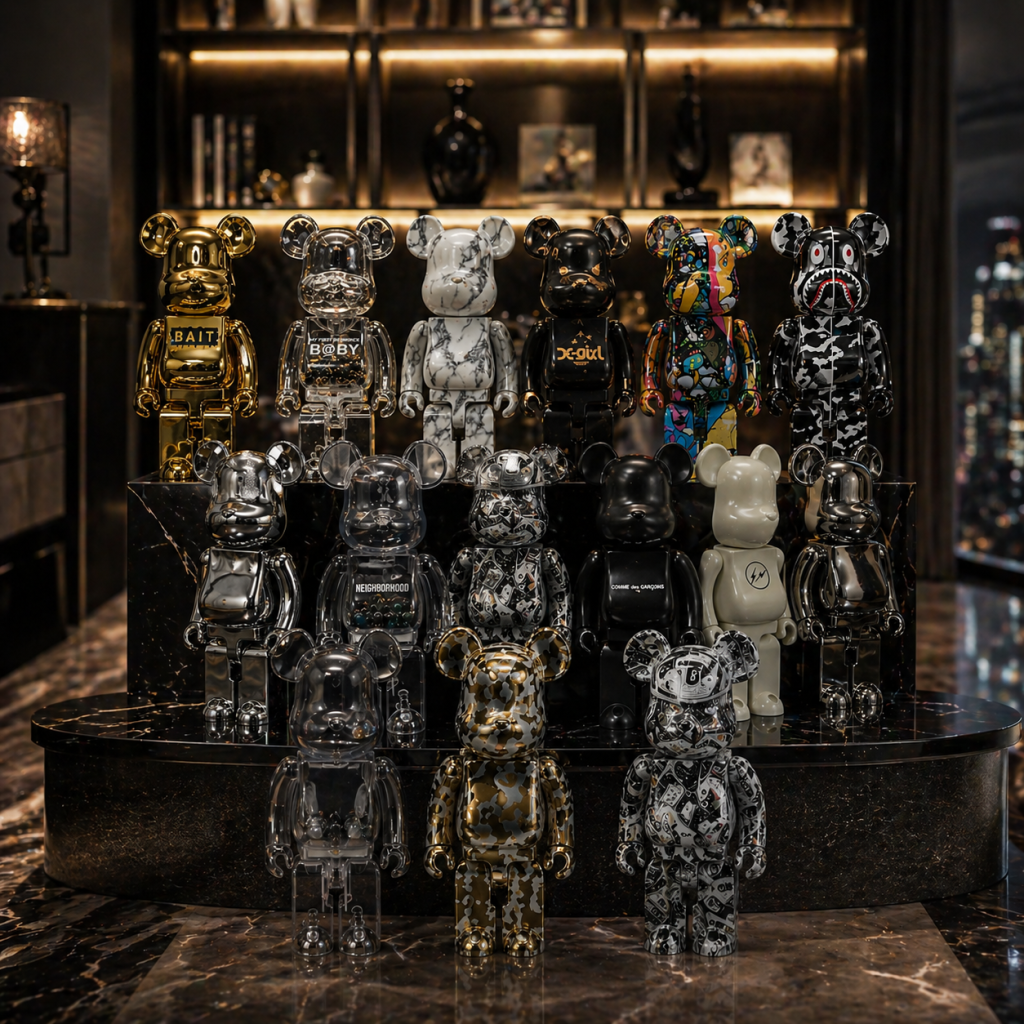
Think about display seriously. A 1000% figure is 70 centimetres tall. It doesn’t go on a shelf. It needs a dedicated space, the right lighting, and a stable temperature environment. Vinyl can yellow. Paint can chip. Figures stored in original boxes hold their value better than ones that have been handled regularly. None of this is complicated, but it’s worth thinking about before you have a $10,000 figure and nowhere sensible to put it.
Follow the drops, not just the secondary market. New limited edition Bearbricks appear regularly. Some retail at prices that will look very low five years from now. The collectors who bought a BAPE x Readymade at $2,700 in 2018 are not upset about it today. Getting access to retail drops requires attention — mailing lists, follow-up on Medicom Toy releases, relationships with specialist retailers — but it’s how the best value in this market gets captured.
What the Prices Actually Mean
Some people look at a $50,000 Bearbrick and see absurdity. A piece of plastic that cost a few hundred dollars to produce, selling for the price of a car.
But that framing misses something. The price is not for the plastic. It’s for the collaboration, the edition, the documentation, the specific moment in cultural history that the object captures. A KAWS Dissected Companion from 2010 isn’t worth $30,000 because of its materials — it’s worth $30,000 because KAWS is one of the most significant figures in contemporary art, because that specific design was produced in genuinely limited numbers, because it has documented auction records and authenticated provenance, and because the collector community that wants it is global and well-funded.
That’s not so different from why a Basquiat painting is worth what it’s worth, or why a first-press vinyl record with a specific matrix number commands a premium. The object is a carrier for meaning, and the meaning is what’s priced.
Whether that meaning holds, grows, or eventually dissipates — that’s the actual risk in collecting anything. The Bearbrick market has appreciated consistently over two decades. That’s not a guarantee of the next two decades. But it’s not nothing either.
Browse Our Collectible Figures
At Colectika, we source and verify rare and limited edition Bearbricks and designer collectibles for collectors across Europe. If you’re looking for specific figures — or want to browse what’s currently available in our collection — you’ll find our authenticated pieces in the shop. Every figure we list comes with full documentation and sourcing history.