A Toy That Wasn’t Really a Toy
There’s a Bearbrick sitting in a private collection in Paris that its owner was never supposed to sell. He received it in 2006, a gift from Karl Lagerfeld. He held onto it for fifteen years. When he finally let it go, it went for just under $18,000.
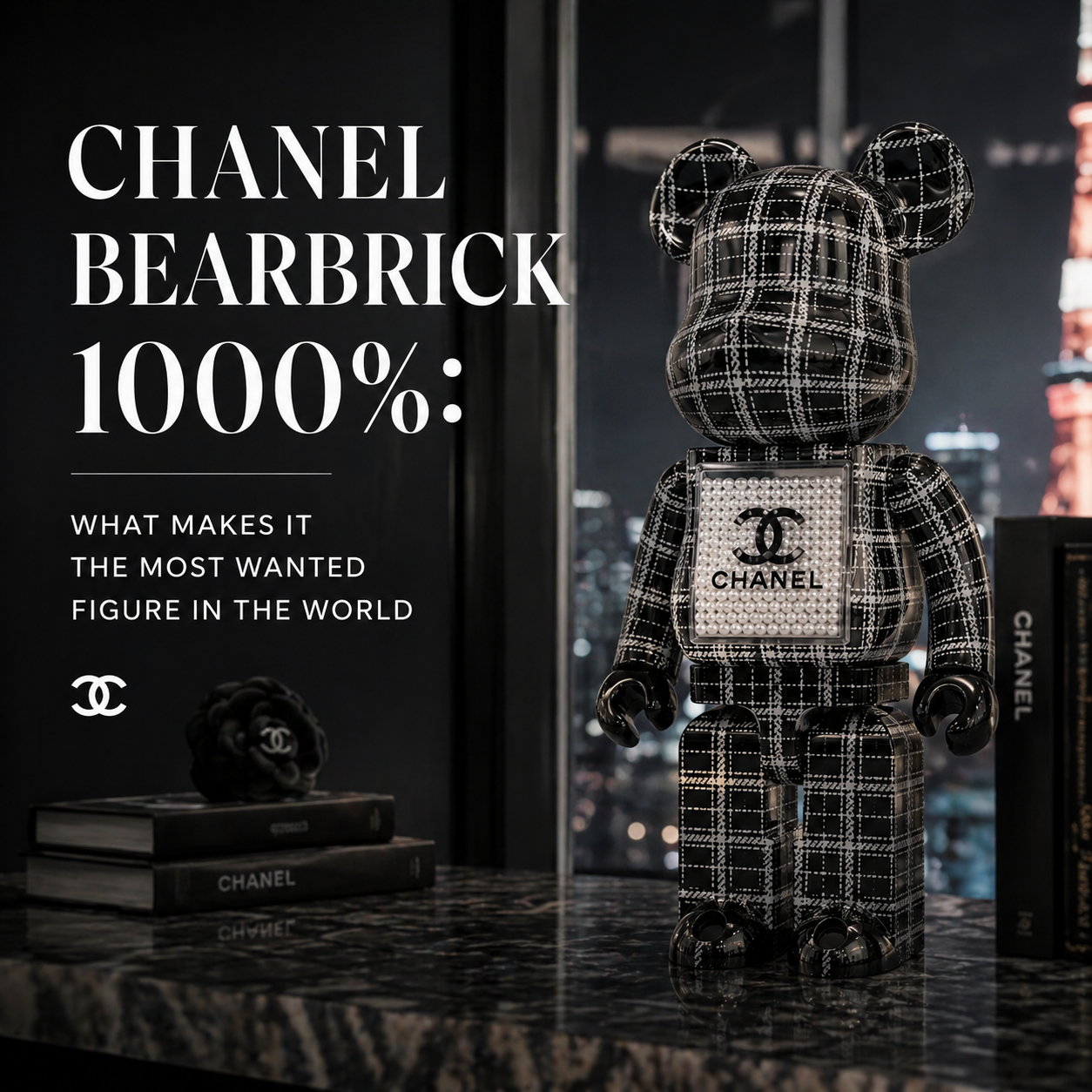
That figure — 70 centimetres of painted vinyl, black tweed, white pearls, camellia at the ear — is the Coco Chanel Bearbrick. And the story of how it exists at all is stranger and more interesting than most people realise.
Lagerfeld did not sit down one afternoon and decide to make a toy. The collaboration came through Blackrainbow, a French creative agency working at the edge of luxury and streetwear, who had already been watching what Medicom Toy was doing in Japan with their BE@RBRICK format. The pitch was simple enough: take the most iconic figure in fashion history, put her in the most collectible toy format in the world, and make very few of them.
Chanel agreed. Lagerfeld designed it. Medicom Toy produced it. And in 2006, before a single piece reached the open market, the figures started appearing in Chanel boutique windows around the world.
That detail matters. This was not a product launch. It was a window display. The Chanel Bearbrick was never meant to be sold in the ordinary sense — it was an object made to be seen, to signal something about what Chanel was and who Lagerfeld thought Coco was. The retail version came later, through the “Love Is Big, Love Is Bearbrick” charity event in Hong Kong, where proceeds went to the Hong Kong Blood Cancer Foundation. Only around 1,000 numbered figures were released.
If you didn’t know someone, or weren’t in Hong Kong at the right moment, or weren’t already deep enough in the collector world to hear about it — you missed it.
What You’re Actually Looking At
Before talking about the market, it helps to spend a moment with the object itself.
The figure stands at 1000% scale. In Bearbrick terms, that means roughly 70 centimetres — about the height of a large dog standing up. It’s not a shelf piece in the usual sense. It demands floor space, a dedicated corner, a plinth. People who own one tend to build around it.
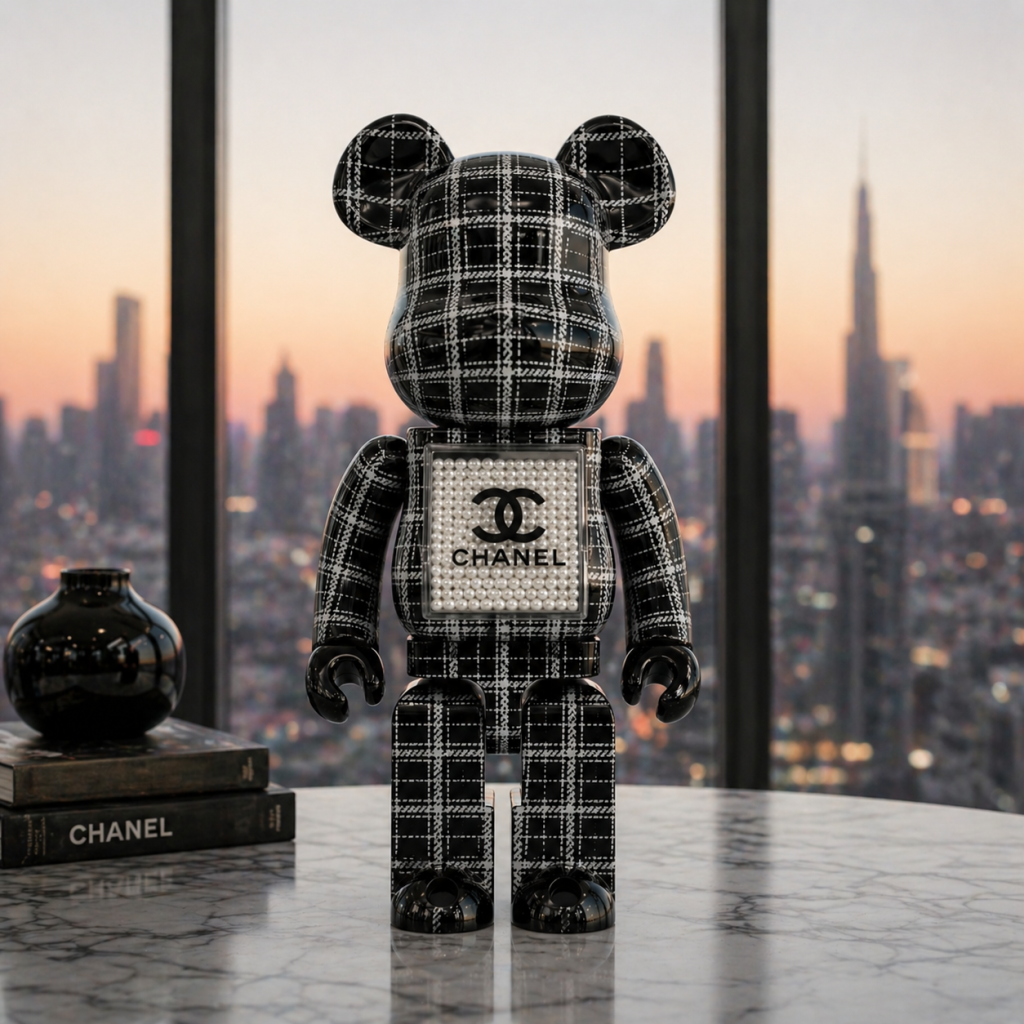
Lagerfeld dressed the figure in Coco Chanel’s signature look with real attention. The black tweed suit. The pearl necklace, white and layered. Dark sunglasses. A camellia flower pinned at the ear — the flower that Coco wore throughout her life and that became the unofficial symbol of the house. Each piece is numbered on the back, in the format CHANEL N° followed by the edition number, and the originals came boxed with a certificate of authenticity.
The material is painted cast vinyl. It has some weight to it. The articulation is standard Bearbrick — head turns, arms move at the shoulders — but most owners don’t move the joints. You put it somewhere and leave it.
What Lagerfeld understood, which not everyone who designs collectibles understands, is that the Bearbrick format works because of what it strips away. The figure is not realistic. It doesn’t try to be a portrait. It’s a silhouette, a shape, a suggestion — and within that constraint, the Chanel details hit harder than they would on something more literal. The pearls against the blocky vinyl neck. The camellia on the rounded ear. The tweed pattern on a form that looks like a toy. The contrast is the whole point.
The Price of Being First
The Chanel Bearbrick was not the first fashion Bearbrick. But it was the first one made by a luxury house of this scale, for an event of this kind, in this kind of quantity. That precedent is part of what the market is paying for now.
At auction and on the secondary market, prices for authenticated examples have settled in a range between $8,000 and $20,000, though exceptional examples with pristine boxes and unambiguous provenance have gone higher. The $20,000 figure cited by Sébastien Jondeau — Lagerfeld’s personal assistant, who received one himself — reflects what the market looked like after Lagerfeld’s death in February 2019. Before that, prices were lower. After, they climbed.
This is a common pattern with objects tied to an artist or designer who has died. The supply is already fixed. The demand often increases as the cultural weight of the person’s work settles in. Lagerfeld’s case is interesting because he was so prolific, and because so much of what he created was explicitly ephemeral — runway collections, window displays, event pieces. The Chanel Bearbrick is unusual in being something permanent that he made, something you can hold.
There are multiple versions in circulation, which matters when you’re trying to understand what you’re buying. The primary version most collectors seek is the black and white figure in Coco’s signature ensemble. There’s also a multicolour variant — sometimes listed as the “Multi” version — which commands different prices depending on condition and provenance. Some examples appear without original boxes, which affects value. Some are numbered low (under 100) and carry a premium for it.
If you’re buying, you need to understand which version you’re getting, and whether the box and certificate are present. Without those, authentication becomes significantly harder.
How to Tell Real from Fake
The Chanel Bearbrick is expensive enough to be faked, and fakes exist. Knowing what to look for is not optional if you’re spending serious money.
The numbering on the back is the first thing to check. Authentic figures have a clean, precise edition number in the format CHANEL N° followed by the number. The font should be consistent with other Medicom Toy products of the period. If the numbering looks uneven, poorly printed, or inconsistent with the format, that’s a problem.
The certificate of authenticity is not a document that can be easily reproduced convincingly. Original certificates have specific characteristics — paper weight, printing quality, official Chanel branding — that knock-off versions typically get wrong. If a seller doesn’t have the certificate, that doesn’t automatically mean the piece is fake, but it does mean you need to be more careful about everything else.
The camellia flower is a detail that fakers often get slightly wrong. The placement, the colour, the texture — these are specific. Compare reference images from documented authentic sales (RealReal, 1stDibs, Sotheby’s) to what you’re looking at.
The box matters too. Original Chanel Bearbrick boxes have a specific design, specific materials, and specific printing. A damaged original box is worth less than a pristine one, but it’s still an original. A reproduction box is a different problem entirely.
When in doubt: buy from sellers with documented provenance and clear return policies. The secondary market for objects in this price range runs on reputation. Sellers who move high-value collectibles without provenance documentation are sellers to avoid.
At Colectika, every piece we list is sourced and verified before it reaches the site. If we don’t have documentation, we don’t list it.
Who Actually Buys This
The collector base for the Chanel Bearbrick is genuinely unusual, and understanding it helps explain why prices have held where they have.
Fashion collectors — people who buy Chanel as an investment or as a passion — know this piece. It sits alongside vintage bags and archival garments as one of the documented Lagerfeld-era objects. But fashion collectors don’t typically buy designer toys. This is often their first crossover purchase, which means they’re sometimes not familiar with Bearbrick pricing dynamics or where to source authentically.
Designer toy collectors — people who have followed Medicom Toy since the early 2000s, who track every collaboration, who know the difference between a 100%, 400%, and 1000% — know this piece from a completely different angle. For them, it’s not primarily a Chanel object. It’s a significant moment in the history of BE@RBRICK, the first time the format connected with high fashion at this level. Many of them didn’t have the access or funds to acquire one in 2007 and have been watching the market ever since.
Then there’s a third group: people who understand neither world particularly well but who have the means and are looking for objects with clear scarcity, clear narrative, and clear appreciation history. The Chanel Bearbrick ticks all three. You can explain it to anyone in two sentences. You can point to auction records. You can show that fewer examples reach the market each year.
All three groups create demand. None of them are going away.
Lagerfeld, Coco, and Why This Figure Makes Sense
It’s worth pausing on the creative logic here, because it’s not obvious.
Karl Lagerfeld joined Chanel in 1983, when the house was struggling. Coco Chanel had died in 1971, and the decade that followed had not been kind to the brand. Lagerfeld’s task — unofficial, never stated that bluntly — was to keep Coco’s spirit alive while making Chanel feel current. He spent forty years doing exactly that.
The Bearbrick is a small, specific instance of that larger project. Coco in vinyl, Coco in a toy format, Coco as an art object that sits in a boutique window and gets photographed — this is Lagerfeld translating the house’s founding figure into a language that 2006 was paying attention to. Designer toys were having a significant cultural moment. Medicom Toy was collaborating with KAWS, with Takashi Murakami, with brands that understood that the collector market and the art market were starting to overlap.
Lagerfeld saw that overlap and put Coco Chanel inside it. The result is a figure that doesn’t feel like a licensing deal or a marketing exercise. It feels like something he actually thought about.
That intention comes through in the details. The sunglasses are right. The pearls are right. The camellia is exactly where it should be. Whoever got these details wrong would have had to answer to Lagerfeld, and nobody was going to get them wrong.
The Market Now
The Chanel Bearbrick doesn’t trade often. That’s worth saying plainly. This is not a figure you can find listed on ten different platforms on any given Tuesday. When examples appear, they tend to sell. When they don’t appear, the market price is essentially theoretical — you know the range, but you can’t act on it.
This illiquidity is a feature, not a bug, for most of the people who own these figures. They’re not looking to flip. They bought to hold. The people who are selling are usually doing so because circumstances changed, or because they need capital, or because a collection is being dispersed.
The practical implication: if you want one, you need to be patient and connected. You need to know where to look and who to talk to. You need to have done the authentication research before an example appears, not after.
The multicolour version and the black-and-white version occupy slightly different market positions, and condition matters enormously at these prices. A figure with original box, certificate, and clean vinyl in the high hundreds commands more than one missing any of those components. The gap between best and average condition examples can be $4,000 to $8,000.
Frequently Asked Questions
What exactly is the Chanel Bearbrick?
A 1000% BE@RBRICK figure produced by Medicom Toy in 2006, designed by Karl Lagerfeld. It depicts Coco Chanel in her signature look — black tweed, pearls, sunglasses, camellia. Around 1,000 numbered examples were released through a charity event in Hong Kong. It’s widely considered the first luxury fashion house collaboration in the Bearbrick format.
How much does a Chanel Bearbrick cost today?
Authenticated examples on the secondary market trade between $8,000 and $20,000+. Price depends on condition, whether the original box and certificate are present, and the edition number. Prices moved up notably after Lagerfeld’s death in 2019 and have held since.
Is the Chanel Bearbrick still being made?
No. Production was a single run in 2006–2007. Chanel and Medicom Toy have not reissued it, and there’s no indication they plan to. All examples in the market today are from that original edition.
Are there different versions?
Yes. The primary version is the black and white figure in Coco’s classic ensemble. There’s also a multicolour variant. Both are from the same 2006 production period. Prices and availability differ between them.
How do I verify one is authentic?
Check the numbering on the back — format CHANEL N° followed by the edition number. Review the certificate of authenticity if present. Compare camellia placement, box design, and print quality against documented authentic examples from reputable auction houses. When spending this kind of money, buy from sellers with clear provenance and return policies.
How big is it?
At 1000% scale, the figure stands approximately 70 centimetres tall (around 28 inches). It’s a floor or pedestal piece. Not a shelf item.
Why has it gone up in value?
Fixed supply, growing demand from two separate collector communities, and Lagerfeld’s death removing any possibility of a reissue or follow-up. The object is also genuinely interesting — the history behind it, the charity context, the fact that Lagerfeld designed it — and interesting objects tend to hold value in collector markets.