A Character Built for the Dark — And for Display Cases
Batman has been reimagined more times than almost any other fictional character. He’s been a campy TV star in the 1960s, a gothic anti-hero in Tim Burton’s hands, a tactical realist in Nolan’s trilogy, and a rage-fuelled loner in everything that came after. Every decade, someone takes the bat symbol and does something different with it.
What Medicom Toy did in 2003 was different in a specific way. They didn’t just slap a Batman logo on a bear-shaped vinyl figure. They looked at what the character actually is — the silhouette, the suit, the unsmiling presence — and figured out how to make that work within the Bearbrick format. The result was the first Batman Bearbrick, and it sold well enough to start something that’s now been running for over twenty years.
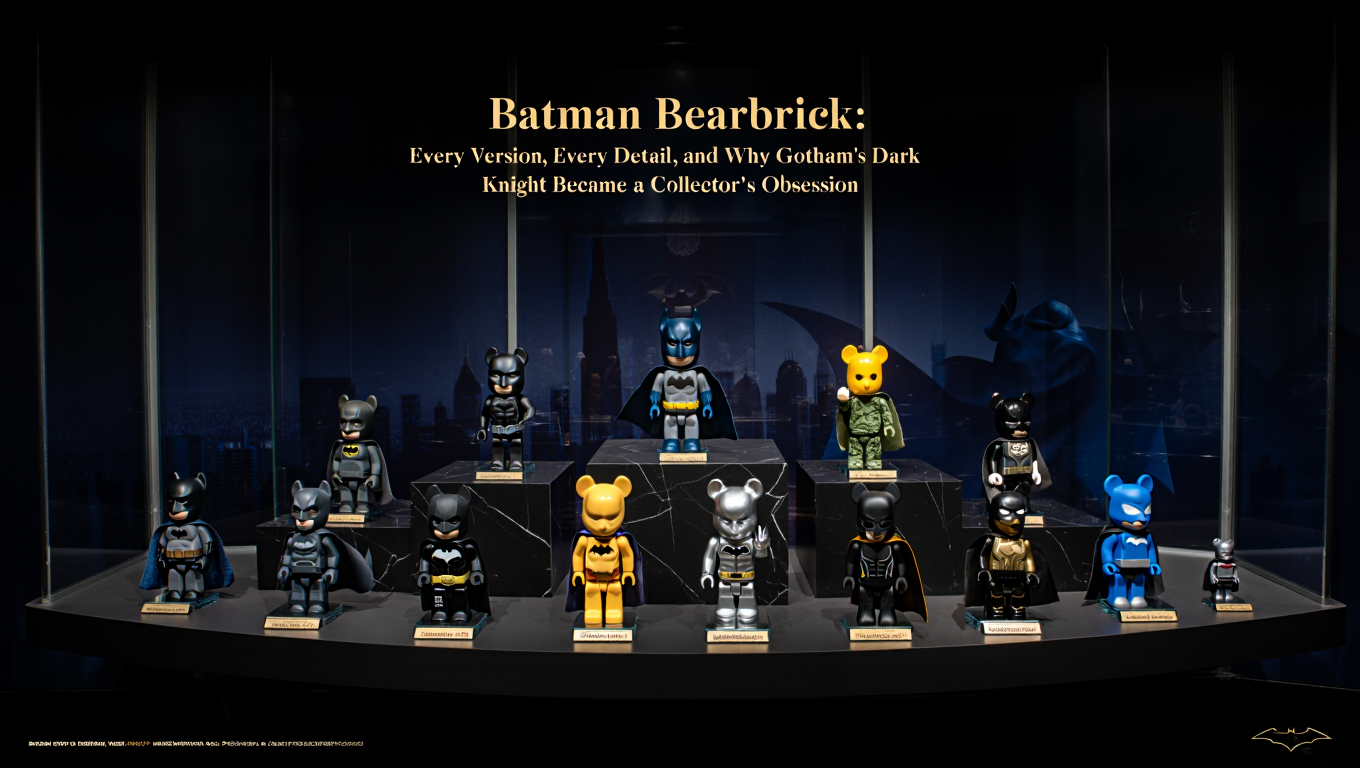
This is the complete guide to Batman Bearbricks: every major version, what makes each one distinct, how the collector market has developed, and what you need to know before buying one.
Why Batman Works as a Bearbrick
Most character Bearbricks face the same challenge: the format is round, friendly, and cartoon-like, and the character being applied to it has its own visual language. Sometimes the two things fight each other. Sometimes they work.
Batman works for a few reasons. The costume is iconic at the silhouette level — pointed ears, cape, chest symbol, utility belt — and those elements translate well onto the Bearbrick’s rounded form. The dark colourway, usually grey, black, or dark blue, makes the figure feel less like a toy than many other Bearbricks do. And Batman as a character has no face visible under the mask, which means the blank Bearbrick face doesn’t create the uncanny valley problem it creates with human characters. The mask is the face. The figure reads as Batman immediately.
The Joker figures in the same lineup benefit from the opposite logic: maximum colour and detail against the Bearbrick’s neutral geometry. Purple suit, green hair, the specific wide-mouth grin from the animated series. The contrast between the figure’s rounded shape and the Joker’s inherently angular character design creates something genuinely interesting.
Both characters — Batman and the Joker together — represent the fullest version of what the Bearbrick format can do with a superhero property. You’re not just buying a toy. You’re buying a design exercise in how far two completely different aesthetic systems can be pushed toward each other.
The Versions: What Medicom Toy Has Released
Medicom Toy has produced Batman Bearbricks across multiple series, versions, and source materials since 2003. Not every release is equally significant, and the collector market treats them very differently.
The Original Batman (2003)
The first Batman Bearbrick came out in 2003, just two years after Medicom launched the format. It was one of the earliest brand character collaborations the company had done, and its success helped establish that DC Comics properties could work in this space. The figure drew from the classic Batman costume — grey and blue suit, pointed ears, yellow belt — and sold through specialty retailers in Japan and the US.
Condition and original packaging matter a lot for this one. It predates the period when Medicom’s distribution in Europe was well-established, which means fewer examples reached European collector markets at the time. Authenticated examples with original boxes are not common.
Batman: The Dark Knight Returns Version
Based on Frank Miller and Klaus Janson’s 1986 graphic novel, which remains the defining version of Batman for an entire generation of readers. The Dark Knight Returns reinvented the character as a fifty-something vigilante coming out of retirement, darker and more brutal than anything the mainstream Batman comics had shown before. The Joker in that story is equally disturbing — and Medicom’s Joker Bearbrick based on the Dark Knight Returns artwork is one of the stranger figures in the DC lineup. It was limited to 2,000 pieces outside Asia when it released, making it relatively scarce in European markets from the start.
The artwork evokes Miller and Janson’s specific line work — angular, heavy, nothing like the cleaner animation style versions — which makes it visually unlike anything else in the Batman Bearbrick range.
Batman: The Animated Series Version
Released in multiple formats including 100%, 400%, and 1000% scales. The Animated Series — which ran from 1992 to 1995 — is widely considered the best Batman adaptation ever made, animation or otherwise. It was darker and more complex than a cartoon for kids had any right to be, and its design language, heavily influenced by 1940s film noir, has never quite been replicated.
Medicom’s Animated Series Batman captures that aesthetic. The colour palette is specific to the show: darker blues, muted greys, the kind of palette that looks like a shadow is always falling across it. The 1000% version stands 70 centimetres tall and works as a statement piece for anyone who grew up watching the show and now has the wall space for something that size.
The Joker from the same series is the version most people think of when they picture the Joker at all. Green hair, orange vest, bright purple suit, blue hands, thin black shoes. The figure is almost cheerful-looking, which makes it unsettling in the way the character always was. Both Batman and Joker from this series were released around the same period, and they work together as a paired display — which is how many collectors approach them.
Batman: Hush Version (2022)
The most accessible and most currently available major Batman Bearbrick release. Batman: Hush is a 2002-2003 comic storyline written by Jeph Loeb with artwork by Jim Lee — the artwork that defined what a lot of collectors think a Batman comic should look like. Lee’s style is detailed, muscular, and cinematic. His Batman has weight and physicality that many other artists don’t convey.
The Hush Bearbrick version captures that. The figure has sharp white eyes, a grey and blue suit, the yellow utility belt, and a general feeling of presence that other Batman figures don’t quite match. It released in January 2022 at a retail price of $560 for the 1000% version, and in May 2022 as a 100% and 400% set for $125.
A black version also exists — the Hush Black Version, which drops all the colour and renders the figure in a near-monochrome palette. It’s more severe than the standard version and appeals to collectors who want something that works with a minimal, dark aesthetic.
Medicom also released a Superman from the same Hush storyline — because the Hush arc involves Batman’s entire rogues gallery and several allies — at a retail price of $555 for the 1000% version.
The Batman (2022 Film Version)
Tied to Matt Reeves’ 2022 film, which gave Robert Pattinson the role and stripped the character back to something almost procedural. The film’s Batman is less invulnerable and more obsessive — a detective first, a fighter second, someone who looks like he hasn’t slept in months. The costume is specifically different from any previous version: darker, more improvised-looking, less superhero and more something someone actually built in a basement.
Medicom’s The Batman figure captures that specific design. It was distributed through Sideshow Collectibles in the US market, which meant Western collectors could access it relatively easily. The 100% and 400% set came in at $160 retail; the 1000% solo figure was $446.
Batman: Knightmare Version (2017)
Based on the brief Knightmare sequence in Batman v Superman: Dawn of Justice, which shows a possible dystopian future where Superman has turned. Batman in this version wears a trenchcoat and goggles over his standard suit — it’s a brief scene but a visually distinctive one. The 400% version released in 2017. It’s a figure that appeals specifically to collectors who track Bearbricks by DC property rather than just the classic Batman character, because the Knightmare design is genuinely unusual.
Batman and Joker: The Case for Collecting Both
Several Medicom releases have treated Batman and Joker as a paired set rather than separate figures, which makes sense given the characters. The most notable is the Batman & Joker Set that released as a 100% pair in 2009 — a rare and early example of Medicom packaging the hero and villain together as a deliberate pairing.
More recently, Tom and Jerry entered this dynamic in an unlikely way. Medicom released a figure where Tom is dressed as Batman and Jerry is dressed as the Joker, a 100% and 400% set at $165 retail. It’s a collision of three different cultural properties — Warner Bros animation, DC Comics, and the Bearbrick format — that either appeals to you immediately or doesn’t at all. For collectors who follow Medicom Toy’s stranger output, it’s exactly the kind of unexpected release that makes this market interesting.
The Joker from Batman: The Animated Series deserves attention on its own. The figure is genuinely well-designed. Medicom got the specific colour palette right — the purple suit with orange vest and green hair is a specific combination that’s easy to get wrong — and the figure has the right proportions to look like the character rather than a generic approximation. It’s sold separately from the Batman figure in most releases, which means building the pair requires deliberate effort. That effort is part of the appeal for collectors building a full Gotham display.
What These Figures Cost on the Secondary Market
Batman Bearbricks occupy a specific price band in the Medicom Toy secondary market. They’re not at the extreme end — you’re not looking at KAWS Dissected Companion prices or Chanel Bearbrick territory — but they’re not cheap either, and the rarer versions are genuinely hard to find.
For the Hush Version, which is the most recent major release: the 1000% version retails at around $560 and has held its value on the secondary market without large premiums. It’s available enough that you don’t pay a significant mark-up for it. The 100% and 400% set is similarly accessible.
For the Animated Series versions — Batman and Joker — secondary market prices run from around $300 to $900 depending on size and condition. These aren’t the most expensive figures Medicom has ever made, but they’re also not reissued regularly, so clean examples with original packaging are worth holding.
For early releases — the 2003 original, the Dark Knight Returns Joker — prices reflect genuine scarcity. These figures predate Medicom’s current global distribution infrastructure, fewer examples were produced for Western markets, and the secondary market has absorbed a lot of them into collections where they stay. When they surface, expect to pay a meaningful premium.
The Knightmare Version and other film-tied releases sit somewhere in the middle — produced in enough quantity to be findable, but not so abundant that secondary market prices are low.
One consistent pattern: Batman Bearbricks with original boxes and in pristine condition hold their value better than figures that have been displayed out of box for years. The vinyl doesn’t yellow quickly, but the painted details on the costume can show wear over time, and the box is part of what a collector is buying.
Collecting Batman Bearbricks: How to Build a Meaningful Display
There are a few different ways to approach Batman Bearbricks as a collection, and they lead to very different results.
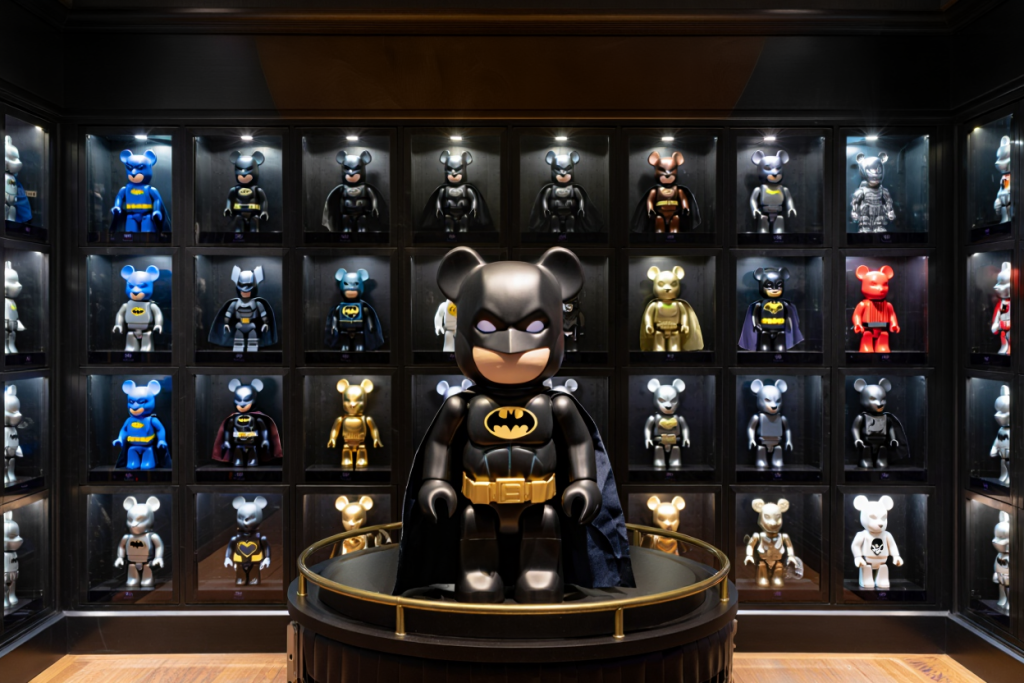
The character collection approach means buying every version of Batman across different Medicom releases — Animated Series, Hush, Dark Knight Returns, The Batman film — and displaying them together. This reads as a visual history of how the character has been interpreted across different eras of DC media, which is more interesting than it sounds. The design differences between the 2022 Hush version and the 2003 original, for example, reflect twenty years of how Batman has been drawn and filmed.
The Gotham display approach means building a collection that includes both heroes and villains. Batman and Joker as a primary pair, perhaps with other DC characters Medicom has released over the years. This requires more research and more patience, because not every character from the DC lineup has received equal treatment from Medicom. The Batman and Joker figures are the most developed; other characters exist but in fewer versions.
The size-focused approach means picking a version you love and collecting it across all available sizes. The Animated Series Batman in 100%, 400%, and 1000% displayed together creates a visual scale progression that works well in larger spaces. The 1000% figure at 70 centimetres dominates a room in a way the smaller versions don’t.
Whichever approach you take: buy authenticated figures from sources with documented provenance. Batman is one of the most collected character properties in the world, and the market for Medicom figures with his image has attracted counterfeit production at the lower price points. The tells are usually in the paintwork — slightly off-colour utility belt, imprecise bat symbol proportions, vinyl quality that doesn’t feel right — but they’re not always obvious without comparison to a documented authentic piece.
Who Actually Buys These
The Batman Bearbrick collector is often a different person from the collector buying KAWS or Chanel figures. There’s less overlap with the fine art world and more with the comics and superhero culture community — people who grew up reading Batman: Hush when it first came out in 2002, who watched the Animated Series as children and still know the Joker’s voice in their heads, who followed the Nolan films closely enough to recognise the specific Knightmare costume design.
That’s not to say serious Bearbrick collectors ignore Batman figures. Many collection-builders include them precisely because the character versions sit alongside artist collaborations in a way that provides contrast. A shelf with KAWS Dissected Companion, Chanel Bearbrick, and Batman Animated Series 1000% tells a more complete story about what the format has done over twenty years than any single category alone.
The price point also matters. Batman Bearbricks — the Hush version in particular — are accessible enough that they work as a starting point for someone new to Medicom Toy collecting who wants to buy something significant without the four-figure commitment that KAWS or Chanel require. The character is familiar. The figure is well-made. The format is approachable.
Frequently Asked Questions
When did the first Batman Bearbrick come out?
Medicom Toy released the first Batman Bearbrick in 2003, two years after the format launched, making it one of the earliest major character collaborations in Bearbrick history.
What’s the most sought-after Batman Bearbrick?
Among current collectors, the Batman and Joker figures from the Animated Series are the most consistently referenced, followed by the Hush version for its Jim Lee artwork. Early releases from 2003 and the Dark Knight Returns Joker are harder to find and command higher premiums on the secondary market.
How much does a Batman Bearbrick 1000% cost?
The Hush Version 1000% retailed at $560. Secondary market prices for most 1000% Batman figures run between $400 and $900 depending on version and condition. Rarer early releases can go higher.
Are there Joker Bearbricks too?
Yes. Medicom has released Joker figures as part of the Batman: The Animated Series lineup, as a Dark Knight Returns version, and in paired sets with Batman. The Animated Series Joker is the most visually distinctive and most sought-after.
What’s the difference between the Hush Black Version and the standard Hush Version?
The standard Hush Version uses the classic Batman colour palette — grey and blue suit with yellow utility belt and white eyes. The Black Version removes most of the colour, rendering the figure in near-monochrome. Both are based on Jim Lee’s artwork from the 2002-2003 comic arc.
Is the Batman Bearbrick a good first figure for new collectors?
The Hush Version 1000% is a reasonable entry point — it’s well-made, clearly documented, available at retail price without significant secondary market premium, and unmistakably Batman. For collectors new to Medicom Toy, it’s a lower-risk starting point than rarer artist collaborations.