A Store That Started With Skaters and Brown Paper on the Windows
Peter Bici skated all the way from Queens to downtown Manhattan in 1994 looking for the new Supreme store. He kept going the wrong direction on Lafayette Street, which at the time was mostly empty antique shops, until finally he spotted a sign and walked in. “This is a state-of-the-art, modern skateboard shop,” he said. “This is sick.”
Nobody had any idea.
James Jebbia opened that first Supreme store in a former office space on Lafayette Street in April 1994. The layout was designed specifically to accommodate skateboarders — clothing racks around the perimeter of the room, central space left open so people could ride in. The first employees were skaters and actors from the downtown New York scene. The music played loud. The vibe was deliberately exclusive in the way that only truly underground things are exclusive — not performatively, just genuinely not built for everyone.
Jebbia was inspired by Barbara Kruger’s artwork when designing the red box logo — the white Futura Heavy Oblique font in a red rectangle that would become one of the most recognised marks in fashion history. Kruger herself later commented critically on Supreme’s approach to intellectual property, which is its own story. But the logo stuck, and it spread — on stickers first, then on everything else.
Supreme’s first artist collaboration was with Rammellzee in 1994, the year the brand opened. It produced hand-painted trucker hats and backpacks. That set the template thirty years ahead of time: find someone interesting, make something in small quantities, let it go. The list of artists who’ve worked with Supreme since — Damien Hirst, KAWS, Takashi Murakami, Richard Prince, Daniel Johnston — reads like a very specific curation of the people who moved between art, street, and music without belonging entirely to any of them.
The Bearbrick collaboration fits that template exactly.
Why Supreme and Medicom Toy Make Sense Together
Medicom Toy and Supreme have collaborated going back to the early 2000s. One of the earliest joint releases was a Supreme x Kermit Kubrick — the Kubrick being Medicom’s predecessor format to Bearbrick — that had New Yorkers lining up outside Supreme’s SoHo store. Both formats sold out. The queue for a toy outside a skate shop on Lafayette Street was unusual enough that people noticed. That release showed Medicom and Supreme’s communities were more overlapping than anyone had formally acknowledged.
When you think about it, the alignment is obvious. Supreme runs on scarcity, unannounced drops, and a collector mentality that transfers directly from clothing to objects. Medicom Toy operates the same way. Supreme Bearbrick releases are never announced in advance. They drop without warning, sell out immediately, and then disappear into the secondary market. This is exactly how Supreme drops clothing. The same person who refreshes supremecommunity.com at 11am on a Thursday looking for a new box logo tee is the same person checking for Bearbrick stock updates.
There’s also the question of what the red box logo does to the Bearbrick format. The Bearbrick is — by design — a blank canvas. Its surface is smooth, rounded, and neutral. When you put Supreme’s red box logo on that surface, the result is immediately recognisable to two separate collector communities simultaneously. Bearbrick collectors see a sought-after Medicom collaboration. Supreme collectors see the logo they’ve been chasing since they first saw it on a sticker in downtown New York. The object works for both without needing to compromise for either.
The Releases: What Supreme and Medicom Have Made Together
The first Supreme Bearbrick was released in 2006. That’s five years into the Bearbrick format’s existence, which makes Supreme an early collaborator by any measure. The original figure carried the box logo prominently and sold through Supreme’s own channels in limited quantities.
What followed was a pattern of sporadic releases across multiple years, each with slightly different design treatments but always anchored to the box logo as the primary visual element.
The Box Logo Figures
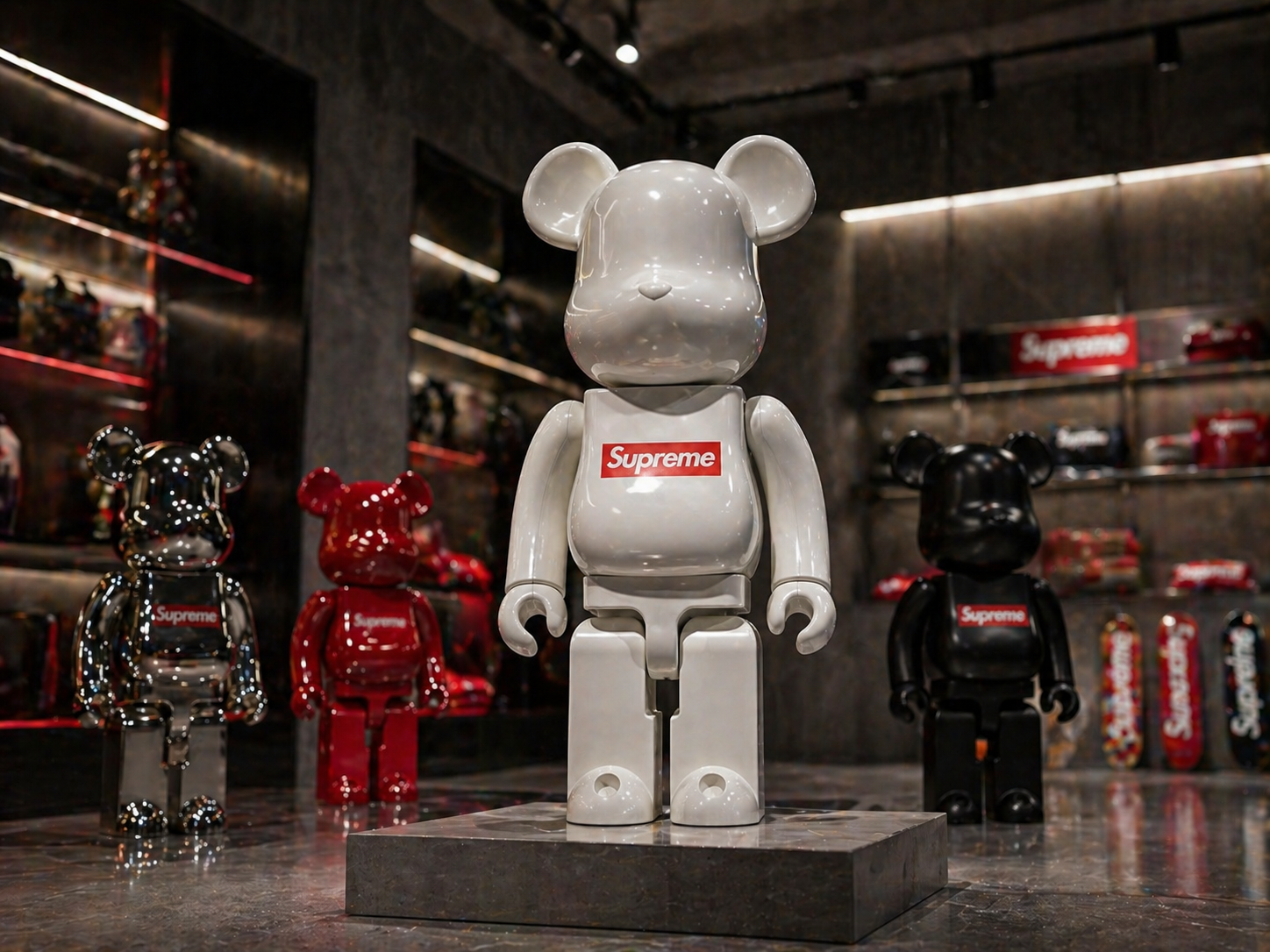
The standard Supreme Bearbrick is built around one thing: the red box with white text. It sounds simple. On the rounded surface of a 1000% Bearbrick at 70 centimetres tall, it reads differently than it does on a T-shirt. The scale changes the object. What’s a graphic on clothing becomes almost architectural on a large vinyl figure.
The most in-demand Supreme Bearbrick designs include the Box Logo figures, the Motion Logo versions where Supreme text appears on the arms or head, and early KAWS-influenced designs featuring skull motifs. The Box Logo releases have appeared in multiple colourways across different years. Red on white is the classic. Other colourways have appeared as seasonal or event-specific variants.
The Motion Logo Versions
Some Supreme Bearbrick releases have featured the logo applied in motion — a repeating pattern across the surface of the figure, or text running around the body rather than confined to a single chest placement. These are visually more complex than the standard box logo figures and have generally held higher secondary market premiums, partly because the design is more labour-intensive and partly because they were produced in smaller numbers.
The KAWS Connection
KAWS has collaborated with Supreme on multiple projects. The crossover between KAWS, Supreme, and Medicom Toy creates a Venn diagram that serious collectors navigate carefully. Figures that carry KAWS design elements within the Supreme Bearbrick context are among the most sought-after in the catalogue. They appeal to three communities at once — KAWS collectors, Supreme collectors, and Bearbrick collectors — and that triple demand is reflected in secondary market prices.
The Undercover Triple Collaboration
Medicom Toy produced a Supreme x Undercover x Medicom Toy collaboration — the GILAPPLE — which sits as one of the more interesting three-way releases in either brand’s history. Jun Takahashi’s Undercover has its own long relationship with Medicom, and Supreme and Undercover have crossed paths repeatedly in the Japanese streetwear world. When all three come together, the result appeals to collectors who follow any combination of the three brands.
The Crow Kubrick (2021)
In Fall 2021, Supreme released a Crow-themed Kubrick — Medicom’s older format, distinct from Bearbrick — as part of their FW21 collection. This matters because it shows Supreme’s relationship with Medicom Toy is not limited to the Bearbrick format. They’ve worked across Medicom’s entire output, which gives the collaboration a depth that single-format partnerships don’t have. For collectors who track Supreme objects rather than specifically Bearbricks, the Kubrick releases are part of the same story.
How Supreme Drops Work — and Why It Matters for Bearbricks
To understand why Supreme Bearbricks are hard to get, you need to understand how Supreme actually releases products.
Supreme’s limited-edition releases often sell out within minutes of going live online. This is not an accident or a production failure. It’s the entire point. Supreme manages its supply deliberately below demand, which is the same logic Nigo used at BAPE in 1998 when he pulled the brand from 40 stores and concentrated it in one. The shortage creates the desire.
There is never an advance schedule for Supreme Bearbrick releases. New figures appear without announcement, drop without warning, and disappear quickly. Past release patterns suggest figures tend to appear in spring and December, but nothing is guaranteed.
For collectors outside Japan and the US, this creates a specific problem. Supreme’s store network — with locations in Manhattan, Los Angeles, London, Paris, Tokyo (three stores), Nagoya, Osaka, Fukuoka, Berlin, Milan, Chicago, Seoul, and Shanghai — is significant, but it doesn’t include most of Europe. A Supreme Bearbrick drop at the London store or via the EU online channel is often the only legitimate retail access point for European collectors. Miss it, and the secondary market is the only option.
The secondary market pricing reflects this access friction. Someone in Berlin or Amsterdam who wants a Supreme Bearbrick they missed at retail is competing with resellers who bought specifically to sell, with collectors in Japan who had easier access, and with other European collectors in the same position. The premium over retail is partly supply scarcity and partly geographic scarcity stacked on top of each other.
The Prices: What Supreme Bearbricks Actually Trade For
Supreme Bearbrick retail prices have ranged from around $59 for a 100% figure up to roughly $250 for a 1000% size. On the secondary market, prices can easily surpass $1,000 and reach five figures for extremely rare pieces. Resellers typically apply a 2x to 10x markup over retail depending on the specific figure and its scarcity.
This range is wide, and intentionally so, because the Supreme Bearbrick market is not monolithic. Here’s how the tiers actually break down:
Standard 100% and 400% box logo figures from recent years trade at modest secondary market premiums — typically $100 to $400 above retail depending on colourway. These are findable. They’re not cheap, but they’re accessible to collectors who are paying attention.
1000% box logo figures are where the market gets serious. These don’t appear as frequently as the smaller sizes, and when they do, secondary market pricing often sits between $600 and $2,000 for standard releases. The large format amplifies the design in a way the smaller figures don’t, which creates a collector premium beyond the simple scarcity argument.
Early releases — pre-2010 — command a retrospective premium that reflects both scarcity and historical significance. The first Supreme Bearbrick from 2006 is not particularly abundant on the secondary market, and when clean examples appear, prices reflect two decades of collector attrition.
Triple collaboration releases and limited event exclusives sit at the top of the market. These were produced in genuinely small numbers, often through specific channels rather than general Supreme drops, and the combined brand premium of Supreme plus a third party pushes prices significantly above standard releases.
The price ceiling is harder to define than it is for some other Bearbrick collaborations, partly because Supreme Bearbrick authentication is slightly more complex than it sounds. Supreme has been heavily counterfeited globally, and the combination of Supreme branding and Medicom Toy construction gives fakers two distinct logos to get right. More on this below.
Supreme vs. Other Streetwear Bearbricks: How It Fits
The collector market for streetwear Bearbricks essentially has three major players: BAPE, Supreme, and to a lesser degree, Stüssy and Fragment Design.
BAPE has the longer and more formalised relationship with Medicom. BAPE Bearbricks come in multiple sizes annually, they have a documented anniversary series structure, and the BAPE community’s familiarity with Japanese streetwear culture means access and authentication are slightly better understood. The BAPE x Readymade 1000%, which reached $121,000 on the secondary market, is the outlier that proves what happens when extreme craft meets extreme scarcity.
Supreme’s releases are less frequent and less structured. There’s no annual anniversary format, no scheduled drop calendar, no size progression that collectors can plan around. This irregularity keeps demand permanently elevated because collectors never know when the next figure will appear. It’s the same dynamic Supreme uses with their weekly drops — the uncertainty is the product.
Fragment Design’s Bearbricks are quieter but significant for collectors who follow Hiroshi Fujiwara’s work. Comme des Garçons has appeared in the Medicom catalogue. Undercover’s releases carry their own collector community.
Among all of them, Supreme occupies the most charged position in terms of cultural recognition. Put a Supreme box logo on anything and it communicates something immediately to a global audience. That’s not true of most other streetwear brands. It creates a Bearbrick that works as a communication object — you can put it on a shelf and it tells visitors something about who you are and what you know.
The Barbara Kruger Angle — and Why It’s More Interesting Than It Sounds
Here’s something worth knowing if you’re going to talk seriously about Supreme’s visual identity.
James Jebbia was inspired by a book on Barbara Kruger’s artwork when designing Supreme’s red box logo. Kruger is an American conceptual artist known for her text-based works — bold white text on red backgrounds, often making statements about power, desire, and consumer culture.
The irony is not subtle. Kruger’s work explicitly critiques the machinery of consumer desire. Supreme took her visual language and built a consumer brand around it that generates more desire than almost any other clothing company in history. Kruger noticed. She commented on it publicly, describing the Supreme community in terms that weren’t flattering.
But here’s what makes it interesting for Bearbrick collectors specifically: when a Supreme Bearbrick sits on your shelf, you’re looking at an object that carries this entire argument inside it. It’s a Japanese vinyl toy wearing the logo of a New York skate brand that stole its visual language from a conceptual artist who was critiquing consumer culture. The layers are genuinely there if you want them.
Most people don’t want them. They just like the way the red box looks against the bear’s rounded white chest. That’s fine too.
Authenticity: The Specific Risks with Supreme Bearbricks
Supreme is one of the most counterfeited brands in the world. Medicom Toy is also heavily counterfeited. A figure that combines both brand identities requires authentication at two levels simultaneously.
The Medicom Toy base figure should show consistent vinyl quality — matte finish, smooth joints, clean moulding without seam issues or rough edges. The Medicom Toy stamp on the underside should be clear and properly formatted. Counterfeit Bearbricks often get the general form right while getting the surface quality wrong — the plastic feels slightly cheaper, the finish is slightly off.
The Supreme branding needs to be correct in typeface, colour, and proportions. The Futura Heavy Oblique font in the box logo has very specific weight and spacing. On authentic figures, the print is sharp-edged and consistent. On fakes, the red is often slightly wrong — too orange, too dark, or with uneven printing that shows at the edges of the lettering.
The packaging is documentation. Original Supreme Bearbrick boxes have specific construction and printing quality. Supreme packaging is generally well-made — they care about the presentation of objects — and reproductions tend to have slightly softer printing, lighter card stock, or misaligned elements.
Buy from established sources. Supreme’s own channels (where you can access them) are the only guaranteed-authentic retail point. On the secondary market, StockX’s authentication process, established dealers with track records, and private collector sales with documented provenance are your options. Be cautious about figures offered significantly below the known secondary market range — the discount is usually there for a reason.
Who Collects Supreme Bearbricks
The Supreme Bearbrick collector sits at an intersection that’s worth understanding. This person is probably not primarily a Bearbrick collector in the way that someone who owns a KAWS Dissected Companion and a Chanel 1000% is a Bearbrick collector. They’re more likely primarily a Supreme collector — someone who buys weekly drops, who knows their Supreme history, who has box logo tees they’ve never worn.
For that person, a Supreme Bearbrick is an extension of their existing collection into a different format. It’s the same brand, the same visual language, the same drop culture — just as a 70-centimetre vinyl figure instead of a T-shirt. It sits on a shelf next to Supreme accessories and other Supreme objects and reads as part of a coherent collection.
The overlap with serious Bearbrick collectors is real but smaller. Someone who tracks Medicom’s entire output will include Supreme figures in their collection the way they include BAPE and Undercover — as part of the streetwear collaboration category within a broader collection. For them, the Supreme Bearbrick is interesting but not necessarily the priority.
The sweet spot is the collector who follows both. Who knows Supreme’s drop calendar and also knows Medicom Toy’s release history. Who understands why the 2006 first release matters and also why the triple collaborations command different prices. These collectors are not common, but they exist, and they drive the upper end of the Supreme Bearbrick secondary market.
Display and Practical Considerations
A Supreme Bearbrick 1000% is 70 centimetres tall. It needs real floor or shelf space, and the red box logo reads well from a distance — this is one of the figures where display placement actually matters. Put it somewhere it can be seen clearly, because the design is too specific to work as a vague shape in the background.
Keep it out of direct sunlight. The red pigment in Supreme’s box logo can fade over time under UV exposure, and the white vinyl base can yellow. Neither process is fast, but both are irreversible. Collectors who want to maintain the figure’s value long-term keep it in a stable environment away from windows.
Store in original packaging when not displaying, for maximum protection. The box is not just packaging — it’s part of the object’s documented provenance. A Supreme Bearbrick without its original box is worth less than the same figure complete. This is true across essentially all Bearbrick releases, but it matters more with Supreme figures because authentication on the secondary market relies partly on the packaging’s consistency.
Frequently Asked Questions
When was the first Supreme Bearbrick released?
The first Supreme Bearbrick was released in 2006, making Supreme one of the earlier streetwear collaborators in Medicom Toy’s catalogue.
Are Supreme Bearbricks still being made?
Yes. Supreme and Medicom Toy continue to produce figures sporadically. There’s no regular schedule. Releases appear without advance notice through Supreme’s own channels.
Where can I buy a Supreme Bearbrick?
At retail: directly from Supreme stores or supremenewyork.com during a drop. On the secondary market: StockX, established dealers, and private collector sales with documented provenance.
How much does a Supreme Bearbrick cost?
Retail prices range from roughly $59 for a 100% figure to $250 for a 1000%. Secondary market prices typically run 2x to 10x retail, with rare pieces reaching five figures.
How do I know if a Supreme Bearbrick is real?
Check the vinyl quality and surface finish on the Medicom base figure, the font weight and colour accuracy on the Supreme logo, and the construction and printing quality of the original packaging. Buy from sources with documented authentication processes.
Are Supreme Bearbricks a good investment?
Early releases and triple collaborations have shown meaningful appreciation. Standard recent releases hold value reasonably well but don’t show dramatic gains. As with any collector market, buying figures you genuinely want to own is safer than buying purely for appreciation.