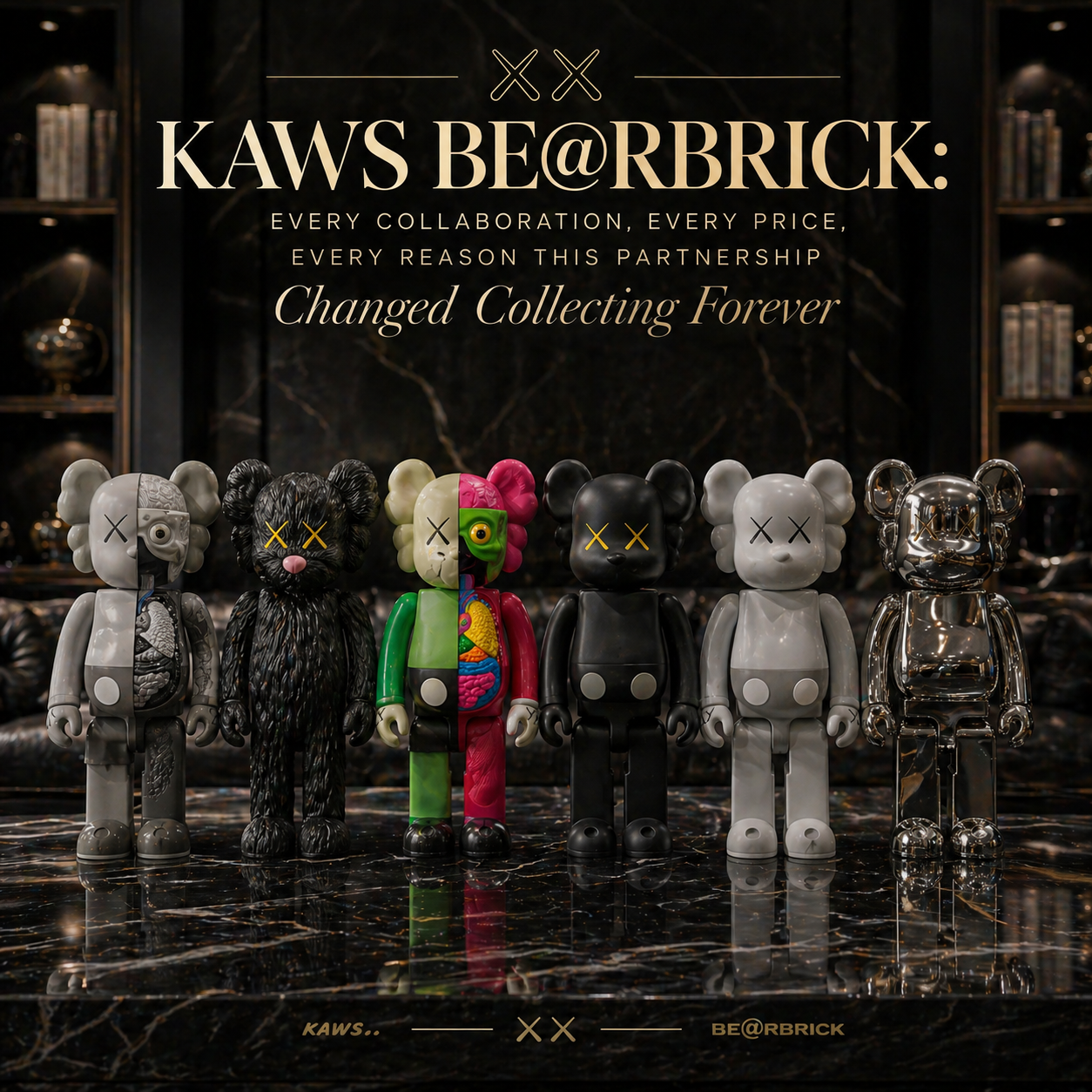
Before the Bear, There Was a Kid with a Skeleton Key
Brian Donnelly grew up in Jersey City, New Jersey, in a house where his parents were, by his own description, completely indifferent to his graffiti. His father was a stockbroker. His mother was a homemaker. Neither of them particularly cared that their son had started painting his tag — four letters, K-A-W-S, chosen because he liked the shapes — on a rooftop he could see from his high school classroom.
That indifference probably helped. KAWS kept going.
By the early 1990s, he’d moved to New York, graduated from the School of Visual Arts with a BFA in illustration, and picked up a day job at Disney doing background animation for 101 Dalmatians, Daria, and Doug. The day job paid. The nights were for something else. A fellow graffiti artist gave him a skeleton key that opened bus shelter panels and phone booths. He’d break in, paint over the advertisement inside, put everything back, and disappear. Fashion ads — DKNY, Calvin Klein — became something weirder and more interesting. His Companion figure started appearing in places where it wasn’t supposed to be.
People noticed. Then people started removing the panels just to keep them.
In 1999, he produced his first vinyl toy through Japanese clothing brand Bounty Hunter. It sold. He followed it with more. By the time Medicom Toy came looking for a collaboration in 2001 — the year they launched Bearbrick at the World Character Convention in Tokyo — KAWS was already building something with a collector market behind it. The first KAWS Bearbrick came out in 2002.
What happened over the next two decades is one of the stranger and more interesting stories in the history of collectible culture.
What Makes a KAWS Bearbrick Different
There’s a specific look to every KAWS figure, and it doesn’t change much regardless of what it’s applied to.
The Companion is his main character — a figure that started as a riff on Mickey Mouse but became something entirely its own. Rounded ears. A clown-like silhouette. And the eyes: crossed-out Xs where pupils should be, which KAWS has used since his earliest street work. On the Bearbrick format, those Xs sit above the standard bear face, and the result is something that simultaneously reads as playful and slightly off. The figure is happy in the way that a person smiling while clearly exhausted is happy. You’re not entirely sure what you’re looking at.
That ambiguity is intentional. KAWS has talked about wanting his work to function for people who know the references and people who don’t. A kid can look at a KAWS Companion and see a funny cartoon character. A collector sees twenty years of street art, vinyl toys, museum shows, and auction records. Both readings are valid, and the figure doesn’t foreclose either.
The Dissected Companion takes this further. Split down the middle, it shows what would notionally be inside the bear — organs, structure, the interior of something that was always presented as solid and complete. It’s a genuinely strange design, and it stuck. The Dissected series is probably the most sought-after across the KAWS Bearbrick catalogue.
The Collaborations: Year by Year
2002 — The First KAWS Bearbrick
Medicom reached out to KAWS just one year after launching the format. The result was the first KAWS Companion Bearbrick — the Xs over the eyes, the rounded ears, the silhouette that would become one of the most recognisable in the designer toy world. It released in 100% and 400% sizes. At the time, it sold to a small community that understood what they were getting. Most of the people who most want one today had no idea it existed.
2003 — The Chomper
The second collaboration, and the one Sotheby’s has described as the figure that set the stage for the high-end Bearbrick market. Released in an edition of only 500, the Chomper came as a set — a 100% and 400% in the same box, in a vivid blue colourway. It’s a specific, unusual piece in the KAWS catalogue because the design leans into something almost aggressive, the mouth wide open in a way the Companion rarely shows. Clean examples with original boxes are hard to find. When they appear, prices are in the several-thousand-dollar range.
2005 — Karimoku Wood BBWT
A version of the KAWS Bearbrick produced in collaboration with Karimoku — the same Japanese furniture company that would later produce their own standalone wood Bearbricks at $22,000 a piece. The BBWT is made from natural wood rather than vinyl, which changes the object entirely. It’s heavier, warmer to the touch, and visually quieter than the painted vinyl versions. Artsy lists it among KAWS’s most sought-after figures. It’s the kind of piece that appeals to collectors who don’t usually buy designer toys, which extends the demand base significantly.
2008–2010 — The Dissected Companion Series
This is probably where serious KAWS Bearbrick collecting starts for most people. The Dissected Companion series across these years produced figures in multiple colourways — grey, black, brown — in 100%, 400%, and 1000% sizes. The 1000% Dissected is 70 centimetres of painted vinyl that somehow manages to look both like a toy and a medical specimen simultaneously. Grey versions trade consistently above $8,000. Rare colourways push significantly higher. The design is distinctive enough that it appears in mainstream contemporary art references, which is not something most designer toys can claim.
2012 — OriginalFake 6th Anniversary
OriginalFake was KAWS’s own retail brand, operating from a store in Aoyama, Tokyo, from 2006 until it closed in 2013. The 6th Anniversary Bearbrick was released exclusively through Ambush, a single retailer in Singapore. The figure carries KAWS’s signature monogram pattern on fabric that unzips to reveal the bare vinyl beneath. Edition size was small. Geographic distribution was essentially nonexistent for most of the global collector market. It now trades around $8,000, and the fact that it was exclusively available in Singapore — in a single store — on a specific date means most people who wanted it simply couldn’t get it.
The BBWW Tour figure from the same year also commands consistent secondary market interest, released to coincide with KAWS’s “Seeing/Watching” exhibition tour.
2013–2020 — Ongoing Companion Releases
Throughout this period, KAWS and Medicom continued releasing Companion Bearbricks in different colourways and configurations. Not every release became a grail — some are relatively straightforward to source on the secondary market at modest premiums. The ones that appreciate most consistently are those with very small edition sizes, specific geographic exclusives, or unusual materials. Standard 1000% Companions from this era typically trade in the $3,000–$8,000 range depending on colourway and condition.
2019 — The KAWS Album Connection
April 2019 was a specific moment in KAWS’s market history. His painting The KAWS Album — a riff on the Sgt. Pepper’s Lonely Hearts Club Band cover, with Simpsons characters in place of the original figures, all with Xs for eyes — sold at Sotheby’s Hong Kong for $14.8 million. The room was full of people in hoodies. The auction house sold roughly $28 million of KAWS work in a single session.
That sale pushed awareness of KAWS into a completely different register. People who hadn’t been paying attention to the designer toy market started paying attention. Secondary market prices on older Bearbrick releases moved upward over the following months. The Dissected Companion series, already valuable, became noticeably harder to source.
2020s — Continued Releases
New KAWS Bearbrick releases continue to appear. The format hasn’t changed, but the context has. Each new release now enters a market where the historical record is documented, where auction results are public, and where the collector community is international and well-funded. Retail prices for new releases are higher than they were in 2002. Secondary market premiums are still significant.
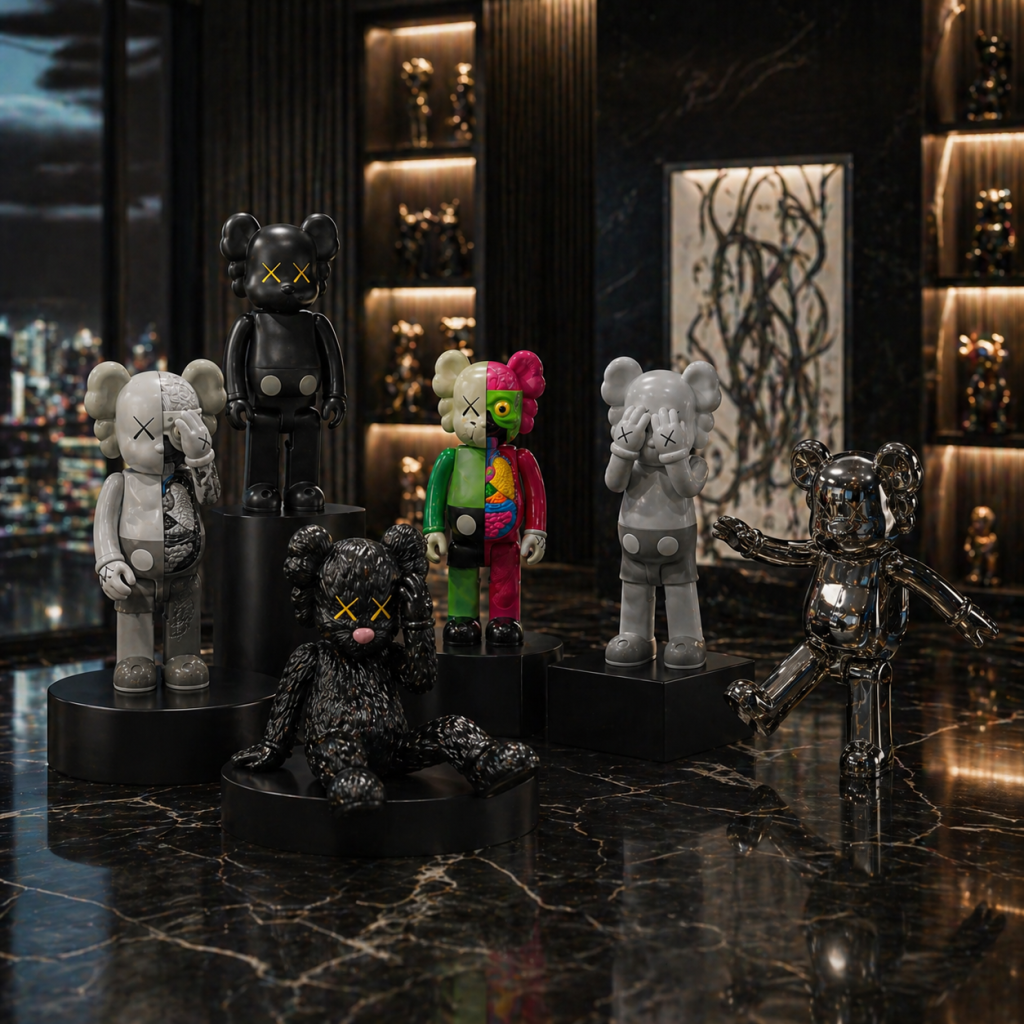
The Prices: What They’ve Actually Sold For
Here’s the part most people come for first, so let’s be direct about it.
Standard 100% and 400% KAWS Bearbricks — figures from recent releases in colourways that aren’t particularly rare — trade from around $600 to $2,000 on the secondary market, depending on colourway and edition. These are not especially hard to source.
1000% Companion figures from the 2008–2020 period — the larger, more display-focused releases — generally trade between $3,000 and $12,000, with premium colourways and mint condition examples pushing toward the higher end.
Dissected Companion 1000% in grey or black — consistently above $8,000, with some examples significantly higher. These are the figures most frequently referenced in editorial coverage and most likely to appear at established auction houses.
The Chomper (2003, 500-edition set) — trades in the $5,000–$15,000 range for authenticated examples with original packaging. Genuinely hard to find.
OriginalFake 6th Anniversary — around $8,000 for clean examples.
Rare colourways and extremely small editions — these don’t have fixed market prices because they don’t trade frequently enough. When they appear, they’re typically offered through specialist dealers or in private collector sales, and pricing reflects whatever the specific parties involved agree to.
For context: the $14.8 million KAWS Album sale in 2019 is the top of the KAWS market, not the Bearbrick market. But the auction record affected Bearbrick prices because it shifted the general perception of KAWS as a collectible artist. Figures that had been trading at one level moved to another, and they didn’t move back.
Why This Collaboration Keeps Working
Twenty-plus years is a long time for any creative partnership. Most brand collaborations have a shelf life measured in releases. The KAWS x Medicom Toy relationship has produced figures every few years across two decades, and the new releases still generate genuine collector interest rather than the fatigued shrug that greets many long-running collaborations.
Part of the reason is that KAWS’s own market has continued to develop rather than plateau. His work is in the permanent collections of the High Museum of Art in Atlanta and the Modern Art Museum of Fort Worth. His public installations have appeared in Hong Kong Harbour, in parks across Europe, and in the Brooklyn Museum’s main exhibition space. The KAWS Album sale at Sotheby’s put him in a different category than most artists who started in designer toys.
Every time KAWS’s fine art profile rises, it reflects back onto the Bearbricks. The figures aren’t just collectibles — they’re the most accessible physical objects produced by an artist with a documented auction track record in the tens of millions. That’s a specific and unusual position for a toy to occupy.
The other reason is that the KAWS Companion design genuinely works in the Bearbrick format. Some artist collaborations feel like a licensing deal — the artist’s imagery applied to the surface of a bear, nothing more considered than that. The KAWS Companion, with its own ears, its own eyes, its own silhouette, creates something more complicated. The Bearbrick and the Companion are two distinct design languages that happen to share a space, and the tension between them is more interesting than either would be alone.
KAWS Bearbrick vs. Other KAWS Figures
KAWS produces vinyl figures that aren’t Bearbricks — the standalone Companions, the BFF, the SHARE figure that appeared in his Skarstedt London show. These are in some ways more purely KAWS than the Bearbricks, because they don’t carry the Medicom format as a constraint.
But the Bearbricks have their own logic. They’re part of a wider collector ecosystem. Owning a KAWS Bearbrick connects you to the Medicom Toy universe — to the Chanel Bearbricks, the BAPE releases, the Andy Warhol series — in a way that standalone KAWS figures don’t. For collectors who are building across multiple categories rather than focusing exclusively on KAWS, the Bearbrick format is often the more sensible entry point.
For collectors who are exclusively KAWS-focused, the Bearbricks represent some of the most affordable and most historically significant pieces in his output. The 2002 and 2003 releases predate almost everything in his current market. They were produced when the collector community was small and prices were modest. The people who bought them then were buying because they found the work interesting, not because of auction records.
That’s generally a decent sign in any collector market.
How to Collect KAWS Bearbricks Without Getting It Wrong
The KAWS Bearbrick market has fakes. Not crude fakes — convincing ones, because the prices justify the effort. Here’s what to actually check.
The packaging. Authentic KAWS Bearbricks come in a clear plastic box with specific printing — font, layout, placement. Reproductions often get the general appearance right while getting the details slightly wrong. Compare against documented authentic examples from Sotheby’s, 1stDibs, or similar platforms before buying anything significant.
The X-eyes. The crossed X motif on authentic figures is precise and consistent. On fakes, the proportions are often slightly off — too large, too small, not centred in quite the right way. Print quality matters here. The Xs on cheap knock-offs often look printed rather than applied.
The underside stamp. Authentic figures are stamped on the underside with production information. The stamp should be clean, legible, and consistent with other documented authentic pieces from the same release.
Provenance. Where did the figure come from? Who owned it before? Is there documentation? For older and rarer releases — the 2003 Chomper, the 2005 wood version, anything from the early Dissected series — provenance documentation matters enormously. A seller who can’t explain where the figure came from is a seller to approach very carefully.
Buy from people with track records. The Bearbrick market runs on reputation. Established dealers, auction houses with authentication processes, platforms with money-back guarantees for inauthenticity — these are where the risk is lowest. The cheapest listing for a rare KAWS Bearbrick is almost never the right listing.
Display, Storage, and the Practical Side
A 1000% KAWS Bearbrick is 70 centimetres tall and made of painted vinyl. It needs space, stable temperature, and protection from direct sunlight, which yellows vinyl and fades paint over time. Most serious collectors keep their figures out of direct light and in spaces where temperature doesn’t fluctuate much.
Whether to keep figures in box is a personal choice that affects resale value. Out of box, displayed, the figure is more present in a room and more subject to environmental effects. In box, it retains the original packaging that the secondary market values. Many collectors who own multiple sizes display the 400% and keep the 1000% boxed, which splits the difference.
The 100% and 400% figures are simpler. They go on shelves, in cases, alongside other pieces. They’re less demanding physically, and the collecting logic around them is straightforward — you want specific colourways, specific releases, specific series. Building a comprehensive KAWS Bearbrick collection across all sizes and releases is a project that would take years and significant resources. Most collectors focus on a narrower range and go deep within it.
Browse Our Authenticated Collectibles
KAWS Bearbricks appear in our collection when we can source authenticated examples with documented provenance. If you’re looking for a specific release or want to discuss what’s currently available, you’ll find our verified collectible figures in the shop. Every piece we list has been sourced and checked before it reaches the site — and if we can’t verify it properly, we don’t sell it.
Other limited edition Bearbricks worth exploring: our limited edition Bearbrick guide covers the thirteen rarest figures in the format’s history, including prices and authentication advice.